 |
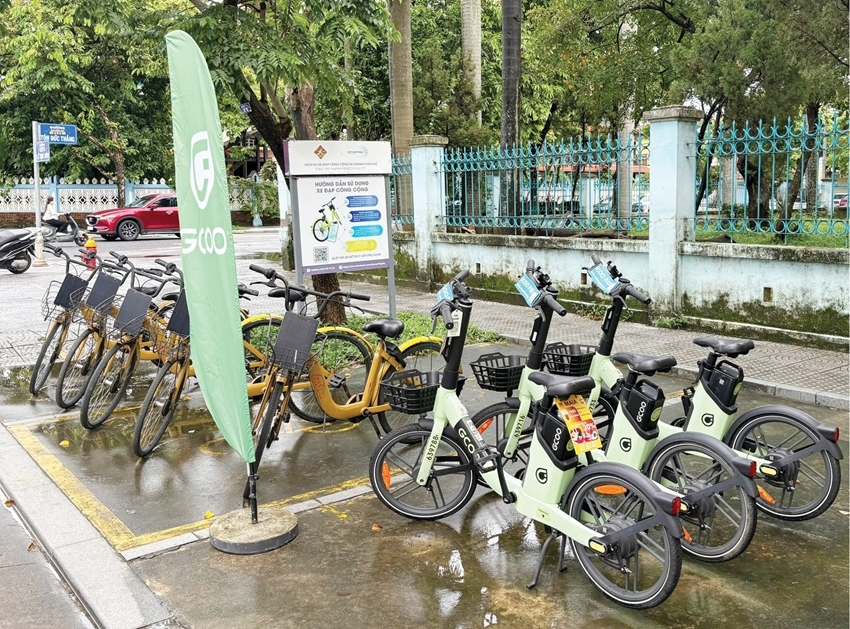
| Public bike stations are located across the city, making them easily accessible and convenient for residents and visitors to use |
A zero-emission journey
During an exchange and study visit in Hue in late September between the Faculty of Architecture, the University of Sciences, Hue University, and the University of Tsukuba (Ibaraki Prefecture, Japan), and Waseda University (Tokyo, Japan), Miji Uchino, a student from the University of Tsukuba, chose a GCOO public pedal-assist e-bike to explore the Ancient Capital. The bicycle took him along tree-lined streets, beside the Huong River, across Truong Tien Bridge, and into the downtown streets.
“I usually get around by bike in Japan, so I was delighted to be able to explore Hue by bike as well. Hue has many beautiful streets and green spaces, so I chose to cycle along the river and experience the city’s rhythm of life,” said Miji. Like Miji, many domestic and international visitors to Hue also choose public bicycles for short trips.
According to statistics from the Department of Construction, the city currently has 17 Hue Smart Bike stations with 147 bicycles, and 31 GCOO public pedal-assist e-bike stations with 283 bicycles, in addition to bicycles serving visitors within the Imperial Citadel. For a medium-sized city like Hue, with numerous riverside routes, green spaces, and concentrated heritage sites, public bicycles offer more than an additional means of transport; they are becoming part of the urban lifestyle while adding another experiential tourism product for visitors.
Alongside bicycles, electric vehicles are becoming increasingly visible on the city’s streets. It is now common to see ‘Xanh SM’ drivers in turquoise uniforms carrying passengers on electric motorbikes, or electric taxis standing out in the traffic. Hue now has more than 600 electric taxis and over 200 charging stations. Under Plan No. 305/KH-UBND, issued by Hue City People’s Committee on July 16, 2025, the city aims for 60% of commercial taxis to be electric, and for electric cars to replace 30% of newly invested contract-based passenger vehicles during the 2025 - 2030 period.
Assoc. Prof. Dr. Tran Anh Tuan, Head of the Department of Natural Resources Management and Climate Change, the Faculty of Environment, University of Sciences, Hue University, said that switching from fossil-fuel vehicles to electric ones is one of the key solutions for reducing transport emissions.
Toward Net Zero
Under the roadmap, the city aims to complete a citywide network of electric vehicle charging stations by 2030, ensuring that every commune and ward has charging stations that meet the needs of residents and businesses. The city also plans to develop charging stations at bus stations, rest stops, car parks, tourist sites, railway stations, airport, and major transport hubs. As electric vehicles proliferate, the siting of charging stations, safety and fire prevention, the load capacity of the power grid, and the harmony with public spaces will all need to be planned in a coordinated way.
The city is also considering a pilot low-emission zone in core heritage area, with the proposed study area covering the Imperial Citadel, Le Loi Street, Truong Tien Bridge, and pedestrian streets. At an international workshop themed ‘Guidelines for building green and low-emission cities, towards Net Zero’, held in Hue in October 2025, the establishment of a low-emission zone in Hue City was among the key topics discussed by experts and officials. Restricting high-emission vehicles, prioritising bicycles, electric vehicles, and electric buses, as well as reorganizing traffic flows could create a more pedestrian- and visitor-friendly urban area. This would also serve as a pilot initiative for Hue to identify a transport model suited to a heritage city, towards a green and low-emission urban city and its goal of achieving Net Zero by 2050.
According to Assoc. Prof. Dr. Tran Anh Tuan, Hue has the advantage of relatively light traffic density, together with distinctive green spaces and landscapes; these provide favourable conditions for green transport development. To capitalize on these advantages, the city needs to sustain investment in infrastructure while gradually changing residents’ travel habits. As walking, cycling, taking the bus, and using electric vehicles become familiar choices, green transport will not only help reduce emissions, but also offer residents a way to preserve Hue’s green spaces and distinctive character.