 |
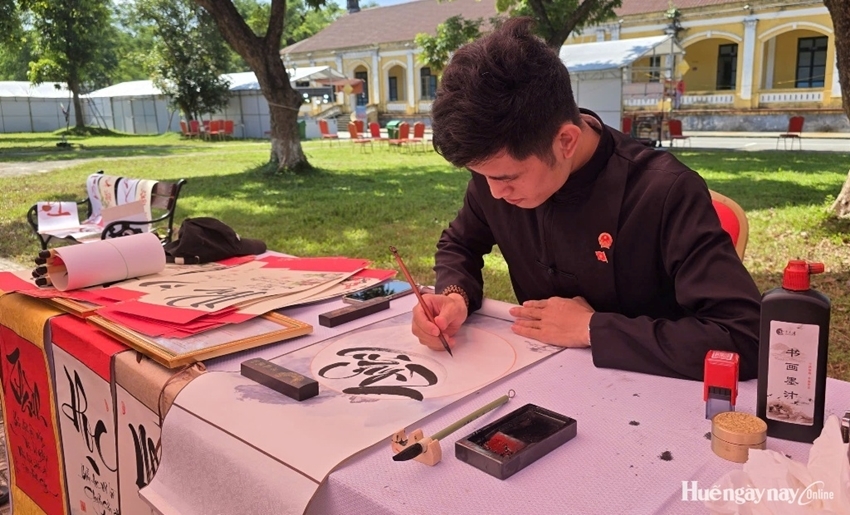
| Calligraphy has become an integral part of the AncientCapital's cultural heritage. Photo: MQ |
Over more than two centuries, calligraphy has become an integral part of Hue Ancient Capital’s culture. Under the Nguyen Dynasty, calligraphy was closely associated with civil service examinations, royal decrees, court documents, and the imperial calligraphy of the emperors, giving rise to a disciplined and dignified writing style. In the 20th century, calligraphy continued to flourish in Buddhist monasteries and refined cultural settings, developing tranquil, introspective, and distinctly Zen-inspired qualities. Since the beginning of the 21st century, as traditional Han-Nom calligraphy has increasingly interacted with Vietnamese Romanized script, calligraphy in Hue has become more prominent in cultural activities, exhibitions, and festivals.
Twenty-seven years ago, while viewing calligraphic works at an exhibition held during Hue Culture Week in Hanoi, Professor Ho Ngoc Dai remarked that Hue calligraphy possessed a style that was ‘refined and elegant’. His observation points to a distinctive feature of Hue's aesthetic sensibility: an elegance distilled from the maturity of each stroke, the restraint of the composition, and the subtlety of material selection and color coordination. Rather than seeking to impress through ostentatious display, this art captivates viewers through its depth and sophistication.
No discussion of Hue calligraphy would be complete without mentioning Venerable Minh Duc of Huyen Khong Son Thuong Pagoda. In this Zen master, refinement seems to extend far beyond the written page. Nestled among pine forests on the outskirts of Hue, the pagoda's tranquil and pristine atmosphere provides a nurturing environment for creative inspiration. When he writes, each movement comes naturally, producing graceful brushstrokes imbued with inner strength. The harmony between form and content, and between the brushwork and the calligrapher's bearing, helps illuminate the refined elegance of Hue calligraphy, as previously discussed by Professor Dai and cultural researchers.
One memorable highlight of Hue Festival 2002 was the appearance of a calligraphic edition of The Tale of Kieu, created by calligrapher Nguyet Dinh and his collaborators. Weighing 75 kilograms and measuring 1,2 x 1,6 meters, the work reproduced the entire masterpiece by the great poet Nguyen Du in the traditional Han-Nom calligraphic painting style, accompanied by illustrations. This extraordinary book was once regarded as one of the largest editions of The Tale of Kieu in Vietnam. Displayed in the Calligraphy Garden, it attracted considerable attention from visitors and collectors. One admirer reportedly offered as much as USD 30,000 for the work, but the creator declined the offer.
Expected to become a cultural highlight of the 2026 Four Seasons Hue Festival, the first Vietnam Calligraphy Festival will create opportunities for Hue calligraphy to engage and connect with calligraphic traditions from across Vietnam and around the world. Beyond the scope of a single event, however, the enduring value of calligraphy in the Ancient Capital lies in its ability to preserve and bring the finest elements of traditional culture to life in modern society.