 |
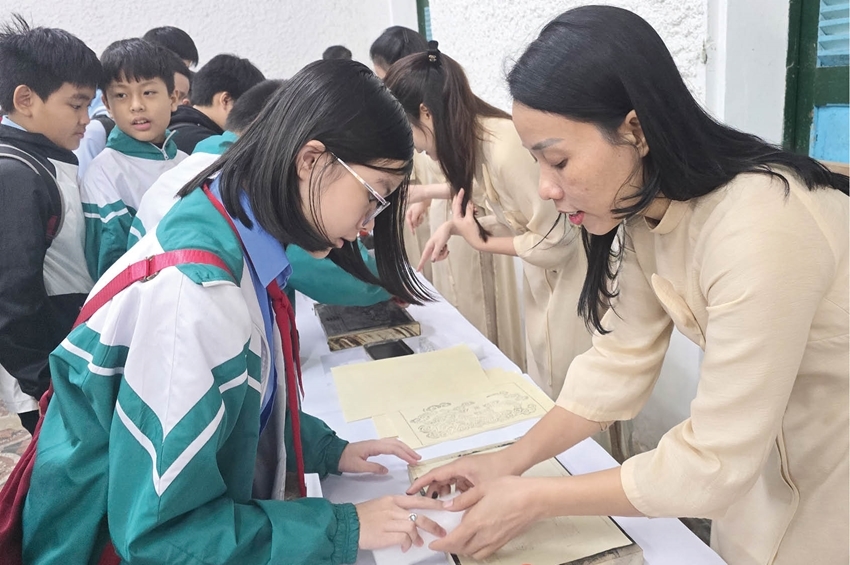
| Hands-on guidance for students in printing Nguyen Dynasty decorative woodblocks |
Supreme authority under the Nguyen Dynasty
Established in 1834 under the reign of Minh Mang, the Co Mat Vien is viewed as a crucial step in the completion of the Nguyen Dynasty’s state apparatus. It served as the forum where the king and senior mandarins of the third rank and above deliberated military matters and other vital affairs of state. This position even placed it above the Noi Cac (Imperial secretariat of the Nguyen Dynasty), an institution with a role akin to that of today’s Government Office.
At its inception, Co Mat Vien was responsible mainly for military affairs and major matters of state, before gradually extending its functions to a wide range of political and diplomatic domains. Its working premises likewise experienced several transitions, moving from the Huu Truc phong ( Right Duty Chamber) inside the Tu Cam Thanh (Forbidden Purple City) to the western corridor of Bo Binh (Ministry of War) after the 1885 fall of the capital, and then to Chanh Mong đuong (Principal hall within the imperial complex used for court deliberations and official affairs) in 1891. In 1899, the Institute was moved beyond Dai Noi (Imperial City), constructed on the former site of Giac Hoang Pagoda and completed in 1903, becoming known as Tam Toa (Three-building complex constructed in the early 20th century as the headquarters of Co Mat Vien).
According to cultural researcher Nguyen Xuan Hoa, under the reign of Minh Mang, two major reforms shaped the governing apparatus. First was the unification of provincial-level administrative units - a foundation that remains in place to this day. Second was the establishment of two institutions: Noi Cac (Imperial Secretariat of the Nguyen Dynasty) and, in particular, Co Mat Vien - an intermediary institution between the king and the Luc bo (Six Ministries). This model bore the imprint of an Eastern monarchical system, similar to Co Mat Vien during China’s Qing Dynasty, allowing the monarch to directly oversee court affairs while being supported and counterbalanced by an elite body.
The present-day headquarters of the Co Mat Vien (at 33 Tong Duy Tan Street, Phu Xuan Ward) is a unique architectural complex that reflects a fusion of French colonial style and Hue imperial motifs. It not only preserves the imprint of a bygone era of court governance but has also borne witness to many major historical upheavals of the former capital.
Nguyen Xuan Hoa expresses the hope that as the site is about to be repurposed into a space for creativity and heritage experiences, transforming from a vital court monument into a cultural institution integrated into social life, the Co Mat Vien will create new creative capacity and enhance the position of the heritage city.
“Open classroom” of the creative city
Toward the goal of positioning Hue as a regional creative city in line with UNESCO’s orientation, the Hue Monuments Conservation Centre is concentrating on a modern approach to heritage values. Director Hoang Viet Trung said the Co Mat Vien space will become the core of the creative ecosystem, converging heritage education, artistic exchange, and cultural experiences open free of charge to the community.
“Heritage is not only to be admired, but must also become a resource for socioeconomic development. We are striving to turn heritage values into creative resources that serve conservation while energizing artistic, cultural, and educational activities,” Trung said.
Among the major priorities is heritage education, a program initiated in 2008 that has grown steadily and now reaches 163 schools across the area. The partnership between the Department of Education and Training and the Hue Monuments Conservation Centre makes history and cultural lessons more engaging through first-hand experiences at heritage sites.
Recently, within the framework of events celebrating Vietnam Cultural Heritage Day on November 23, the Co Mat Vien - Tam Toa for the first time served as a “stage” for numerous display, exhibition, and experiential activities. Among the highlights was the archival photo exhibition “The Co Mat Vien of the Nguyen Dynasty (1834 - 1945): A Journey through Space and Courtly Imprints,” allowing visitors to engage with a wide range of information and materials on architecture, history, and behind-the-scenes stories of court governance.
In parallel, the educational program “Discovering the Co Mat Vien and Experiencing Hue’s Heritage” has attracted more than 800 pupils and students. Participants are introduced to Nha nhac (Royal court music), engage in imperial games, and experience Nguyen Dynasty decorative woodblock printing- activities that help bring textbook knowledge into real life.
Ms. Ho Nguyen Bao Nhi, a teacher at Tran Cao Van Junior High School, shared: “The Co Mat Vien space provides students with vivid history lessons. Through direct contact with tangible traces of the past, students gain deeper insights into Hue’s culture and gradually develop an awareness of heritage preservation.”
Mr. Hoang Viet Trung said that the space will soon host regular artistic activities, exchanges, and performances for visitors, while supporting students from music and art schools to perform, thereby helping to cultivate a sustainable creative environment. The Hue Monuments Conservation Centre will mobilize social resources to secure funding and develop a creative ecosystem connecting multiple organizations and individuals.
Looking ahead, the Co Mat Vien is poised to become a vibrant cultural destination that connects education, experience, and tourism. From a space that once held the secrets of the imperial court, it will evolve into a place for sharing heritage values, inspiring creativity, and nurturing cultural identity among younger generations. This transformation will not only enable the site to “live” but also help shape a renewed image of Hue as a heritage city.