 |
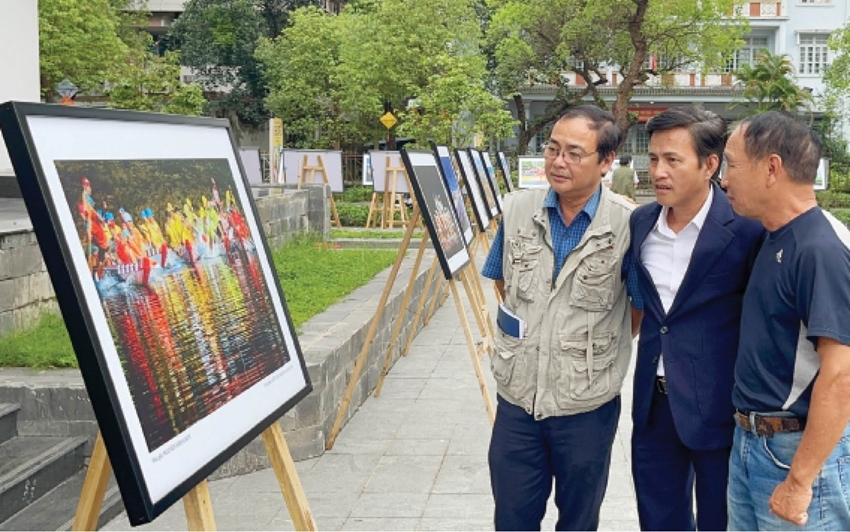
| “Colors and Scents of the Three Regions” photography exhibition |
After the reunification of the country, the three provinces Quang Binh, Quang Tri and Thua Thien united to form Binh Tri Thien Province, and artists from the three provinces gathered. The photography of the province soon thrived with the participation of well-known photographers such as Dinh Lien, Ho Si So, Vo Viet Duc, Nguyen Khoa Loi, etc.
In May 1978, the Fine Arts and Photography Division was officially founded with photographer Vo Van Ky as the Secretary. He was also a member of the executive board of Binh Tri Thien Literature and Art Association, Session 1. After the Meeting in 2000, the division became Thua Thien Hue Photography Association. In 2025, when Thua Thien Hue has become a municipality, it’s been renamed as Hue City Photography Association.
Looking back at the journey since the day of reunification, photography in Hue has gone through 3 stages. On post-war days, Hue Ancient Capital, as an important cultural center of Vietnam, began its rebuilding and developing stage. Though life then was difficult, photographic equipment was outdated and photographic materials such as film and photographic paper were scarce, photographers at the time were still able to take many photos of great documentary and artistic value. Photography was well connected with the media and the cameramen were also journalists or collaborators of newspapers and communication departments.
In 1986, the Doi Moi policy (the Renovation policy) was like a breath of fresh air, creating favorable conditions for artistic activities in Hue, including photography. Themes for photography was expanded with works leaning towards natural landscapes, the cultural heritage, people and festive events. Hue Ancient Capital Complex of Relics and special festivals became the main source of inspiration for photographers in this period.
The photography of the Ancient Capital reached its peak with successive names such as Pham Ba Thinh, Le Quang Hoang, Dang Van Tran, Pham Van Ty, etc., who had won many prizes and medals of various kinds, both national and international, with the appearance of new foundations such as Hue City Photography Club, Vietnam Photography Association in Hue, etc.
The development of digital technology was another breath of fresh air which was welcomed by the circle of photographers in the Ancient Capital. Modern photographic equipment and advanced processing technology were employed. Together with modern equipment was the “blossoming” of photographic environment. Big events became opportunities for photographers to hunt beautiful and original moments. Modern performing stages and festive programs were chances for photographers to promote Hue culture to local people and visitors both in and out of the country.
A generation of young talented photographers such as Truong Vung, Ngo Thanh Minh, Van Dinh Huy, etc., appeared. Photography exhibitions being continuously held created an environment for photographers of the Ancient Capital to exchange their experience and learn from one another. The association helped bring its members to larger playgrounds besides local playgrounds such as competitions and exhibitions. That stage marked the exceptional development of photography in the Ancient Capital.
In recent years, the development of technology has somewhat affected photography. But more than ever before, there has been the gathering of those who truly love the “art of light”. They take care of their photos more carefully, making them meet the high demand of conservation and promotion of cultural and historical values and natural landscape.
Photographers have done a good job in preserving beautiful moments with their cameras. Photos are a source of living documents recording changes in Hue over time while at the same time introducing the image of a dreamy city of Hue with its natural and heritage beauty to international friends.
"Photography has contributed a lot to the conservation and development of the land. Even in this digital transformation stage, it is still a means of conveying messages quickly and effectively with high interoperability,” said Pham Van Ty, former Vice Chairman of Vietnam Photography Association and former Chairman of Thua Thien Hue Photography Association (i.e. Hue City Photography Association now).