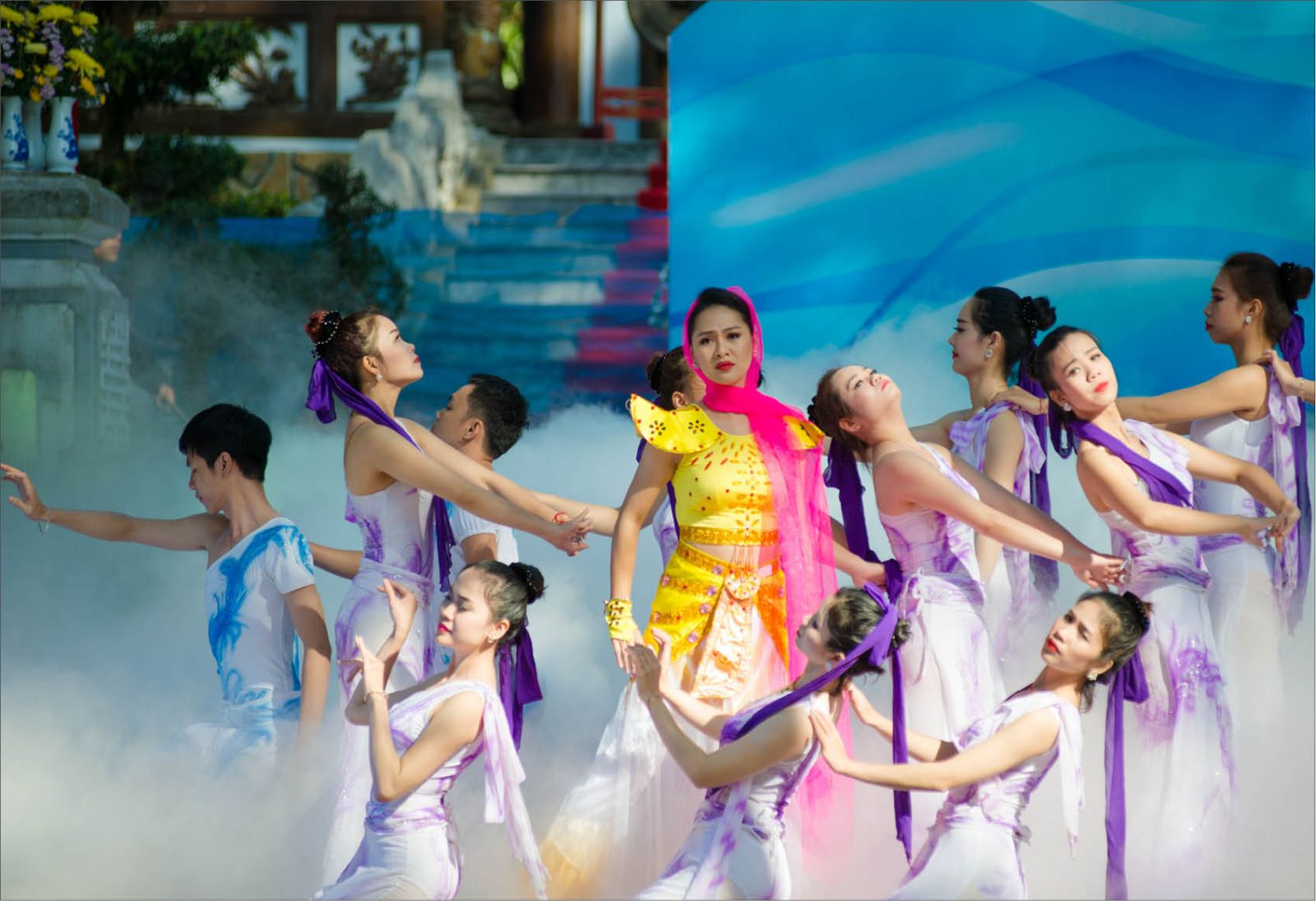
Epopoeia Huyen Tran Cong Chua performed by Hue Singing Drama Theatre
When cai luong appeared in South Vietnam in 1917, chamber Hue singing also changed to a new form: singing plus gestures. It gave rise to Hue singing drama which is based on Hue singing but combined with folk songs in the area of Binh Tri Thien.
Initially, there were no scripts. Actors and actresses could create as they wanted. Gestures were therefore simple. The director’s role was not very important. Those primitive groups were then called phuong ca bo (singing plus gestures troupe).
In 1920, Thu Nuong Troupe performed Hue singing drama Tran Bo in Quang Ngai, based on a tuong (classical drama) of the same name. It was considered the first Hue singing drama marking the beginning of Hue singing drama art.
In the period from 1920-1945, more than ten groups came into existence such as Thu Nương, Kim Sanh, Kim Thịnh, Hong Thu, Van Lam, Tan Tien, Do Thanh, Song Huong, Viet Hung, Mong Thu, Dong Thanh, etc. At the time, the whole song, but not part of it, was performed (except Nam ai, Nam Binh) and therefore the plays had slow tempo.
Hue singling drama was at its best in 1920s-1945 and disappeared during the war against French colonists (1946-1954).
Since then, Hue singing had been performed in chambers in Thua Thien Hue and Saigon. Private Hue singing drama troupes and Hue singing troupes in 1920-1945, as well as Hue singing, and Binh Tri Thien folk song troupes managed by the state in the North after 1954 boasted many talented singers and instrumentalists.
After the Geneva Convention in 1954, many artists in the South went to the North and settled down in Vinh City (Nghe An Province). They together formed Hue-Tri Thien Singing Troupe.
On June 6, 1957 in Vinh City, there happened an important event to Hue singing drama: Tri Thien Singing Drama Troupe was formed. It was a state troupe with 22 members, headed by Nguyen Ngoc Yen (excellent artist, director, passed away). In 1962, from Vinh City, the troupe moved to Hanoi and headquartered at Mai Dich, under the supervision of the Department of Culture.
During the same time, Quang Binh, Vinh Linh, Tri Thien all formed artist groups. They performed different genres including Hue singing and Binh Tri Thien folk songs.
After the unification of the country in 1975, Hue-Tri Thien Singing Drama Troupe moved to Hue from Mai Dich, Hanoi. In 1976, Quang Bình, Quang Tri and Thua Thien Hue were united into Binh Tri Thien Province. The groups were reorganized into Cai Luong Group, Drama Group, Singing and Dancing Group, Royal Art Group (Ba Vu), Singing Drama Group.
In 1989, Binh Tri Thien Province was subdivided into three provinces as before. Binh Tri Thien Singing Drama Troupe was renamed as Hue Singing Drama Troupe. It was then changed to Hue Singing Drama Theatre on January 25, 2006, consisting of Co do Hue Singing Drama Troupe and Huong Giang Singing and Dancing Troupe.
Since Thua Thien Hue was re-established, Hue Singing Drama Troupe (presently Hue Singing Drama Theatre) has performed many famous plays to the public and the circle of traditional artists. However, Hue singing drama has not been widely welcomed as before.
The main reason is probably the diverse entertainment which meets the need of the public. People now have more choices. On the other hand, the society has changed a lot, but Hue singing drama itself has not really renewed to keep up with the modern life.
Story: MINH KHIEM - Photo: ĐANG TUYEN