Assoc. Prof. Dr. Dang Van Bai, Vice President of Vietnam Cultural Heritage Association
According to Assoc. Prof. Dr. Dang Van Bai, the restoration, embellishment, protection and promotion of the value of Hue Ancient Capital’s heritage is the responsibility of the Party Committee, authorities, people of Thua Thien Hue and the whole country. Many years ago, the plan of resident relocation, ground clearance of Hue Imperial City was made by Thua Thien Hue. Therefore, it is vital that Thua Thien Hue needs to focus resources on implementation, residential security and limitation of environmental landscape directly affected by the life of thousands of people.
There are the opinions that the people living in the relics are also part of the heritage. What do you think about that viewpoint?
In the past, when submitting the file to UNESCO to propose the recognition of Hue relic complex as "World Cultural Heritage" (recognized in 1993), we committed UNESCO to maintaining the integrity of the heritage. Initially, we carried out that commitment from the standpoint of clearing what was not part of the heritage work.
However, because of the economic conditions and the actual situation, that standpoint may not be appropriate longer. With the eo baus (a Vauban-architecture, semi hexagon-shaped structure on which residents are living) on the Imperial Citadel, I think if the population is properly regulated, ensuring ecological balance, it will be a lively part for this relic work. For the Upper Citadel, if we do not relocate residents there, it means that we do not comply with UNESCO's commitment to preserving the integrity of the heritage.
In my view, after the implementation of the project of resident relocation, ground clearance of zone 1 is brought to completion, the two things will be solved. First, it demonstrates that the Government of Vietnam is responsible to UNESCO for ensuring the integrity of the heritage. Second, it brings the people a better life, prevents them from depending on the heritage and invading the heritage. It is important for the local authorities to ensure that the people are able to live in better conditions than in the old sites.
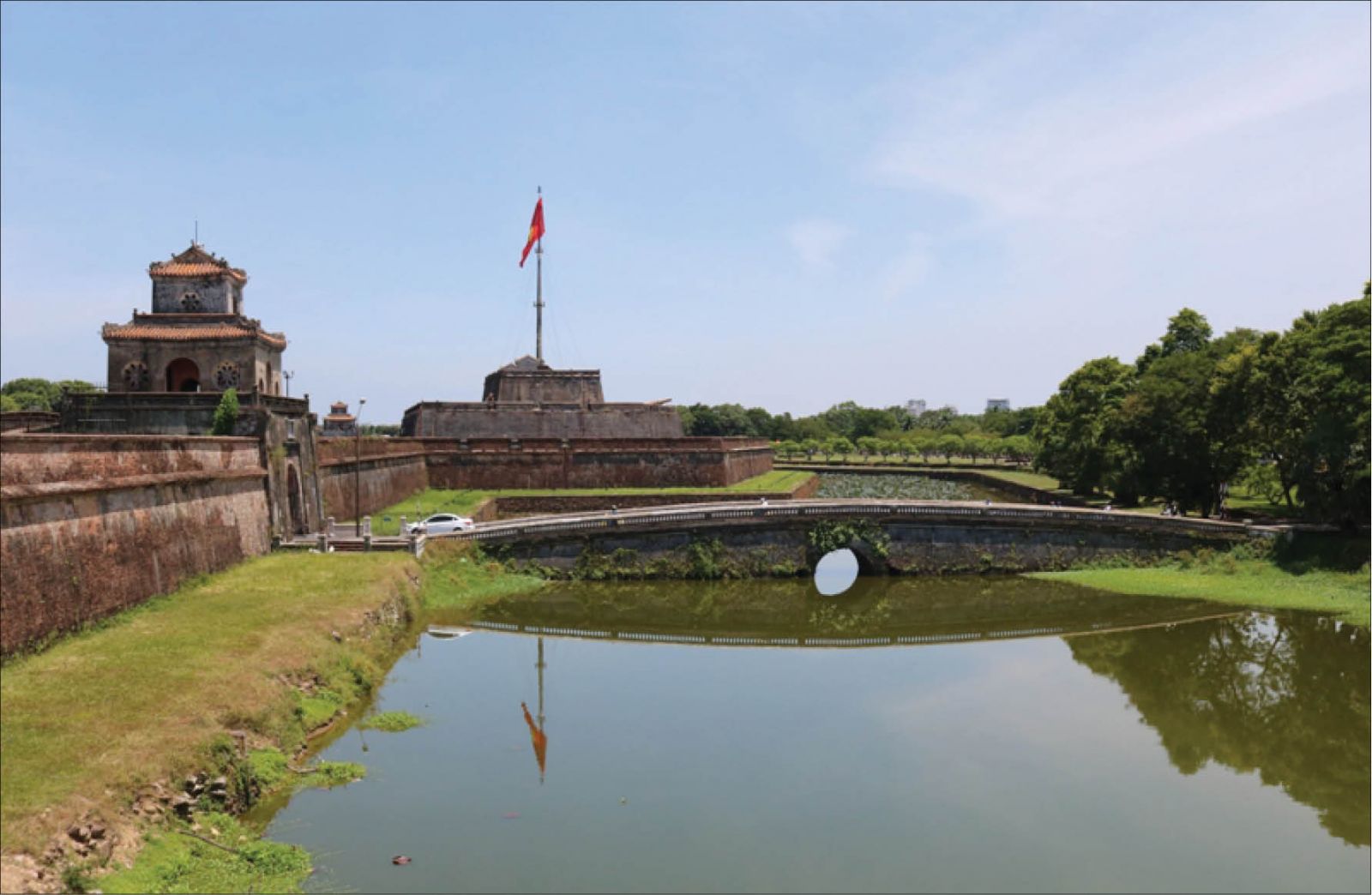
The front of Hue Imperial Citadel
Despite Thua Thien Hue’s great determination, focusing capital on satisfying the needs of the project is not an easy problem. Do you think so?
I see that, and I think that the Hue Imperial Citadel is part of Vietnam's world cultural heritage, so the State certainly has to give support to Hue one way or another. For example, the State can balance the budget portion that the locality contributed through the tourism sector. Recently, I have heard that the Government "suggested" one of the channels for Thua Thien Hue to mobilize resources to implement the project - "extracting a revenue portion from relic-visiting ticket sale". I think it is illogical.
The illogicality is that the Cultural Heritage Law specified that "the receipts from the use and promotion of cultural heritage value" is one of the financial sources to protect and promote the cultural heritage value. Annually, the State capital to support Hue relic restoration and the budget Hue balances the revenue from sightseeing tickets are not enough for Hue to save the heritage. Now if the receipts from sightseeing tickets have to be deducted for resident relocation, relic ground clearance, Hue will be definitely more difficult. I think the State needs to further discuss the budget support for Hue to carry out the project, and this issue needs to be consistent from the Central to provincial level.
As a companion to Thua Thien Hue in the heritage culture field, does Hue Ancient Capital has anything else that makes you preoccupied with?
I think it was a long time that Hue has not made the second nomination for the globally outstanding value of Hue's Cultural Heritage, including the cultural value of the Perfume River’s ecosystem on both banks. In the early 1990s, in an effort to make Hue the first World Cultural Heritage of Vietnam as soon as possible, we temporarily left the ecological cultural landscape on both banks of the Perfume River despite that value of Hue absolutely worth the globally outstanding value. Tens of years have elapsed; Hue has not continued to file the second submission for that value. That's a pity.
In terms of the harmony between artificial architecture and nature, no urban city can match Hue. It is a typical value that many other cities cannot dream of. Ever since Nguyen Lords, Kings Nguyen built the imperial capital, and the French made the plan of this city upon their arrival, they have had a great sense of respect for nature and always endeavored to embellish the cultural landscape on both banks of the Perfume River. Hue should continue to inherit that tradition to implement the current planning ideas in a harmonious and consistent manner.
Thank you for the exchange.
|
According to the project "Resident Relocation, Ground Clearance of zone I, Hue Imperial Citadel" in the period 2019 - 2025, Thua Thien Hue will relocate 4,201 households out of the relic, with the total budget of about VND 2,735 billion.
Phase 1 (2019 - 2021) relocated 2,938 households (nearly 11,000 people), with a budget of VND 1,880 billion; Phase 2 (2022 - 2025) relocated 1,263 households, with about VND 855 billion. Thua Thien Hue proposed that the Central authorities should support the budget of resident relocation and ground clearance in both phases and allow the application of the specific policy framework for compensation, support and resettlement.
|
By Dong Van