 |
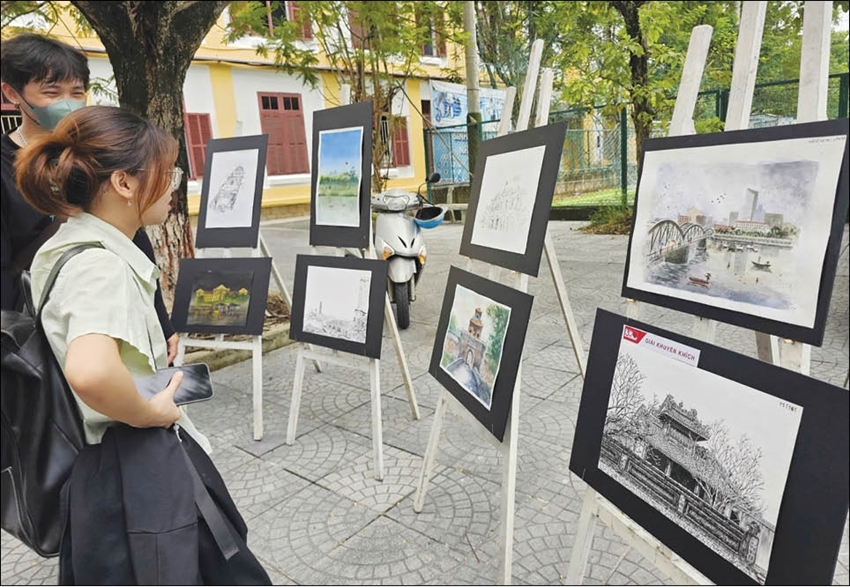
| Sketch works by students from the Faculty of Architecture, University of Sciences, Hue University |
Art enthusiasts in general, and painting lovers in particular, especially those fond of sketching, were very surprised to see the sketch works by students from the Faculty of Architecture (University of Sciences, Hue University) on the theme “Hue, then and now”.
Held as part of a series of events celebrating the 30th anniversary of the establishment of the faculty in mid-September with many events, the sketching contest became a true highlight that captivated everyone who visited the exhibition space. Hue's heritage and architecture are very familiar sketching subjects, drawing the attention of many artists and art students. Therefore, there have been quite a few exhibitions on this theme, but “Hue, then and now” still carried a unique quality, blended with the originality of architecture students’ perspective and artistic talent in every stroke.
Standing in front of the artwork depicting Thien Mu Pagoda, viewers could not help but be overwhelmed by the love that the artist poured into Hue heritage, as the Phuoc Duyen Tower, which appears ancient and solemn from the outside, became even more magnificent in the sketch. A closer look at the work reveals tens of thousands of pencil dots, all harmonizing to create an impressive masterpiece in the eyes of the viewer. Beside it were many other sketches of famous Hue heritage architectural works such as Ngu Phung pavilion, Phu Van Lau pavilion, Ky dai (the Flagpole), Tinh Tam lake, Khai Dinh tomb, Dieu De pagoda, and Truong Tien bridge…, as well as modern architectural works such as Phu Cam church, Hue Railway Station, and even the brand-new Phu Bai International Airport.
Despite the differences in sketching subjects, time, and spaces, one could sense the harmony and the ardent love for Hue in the flow of time, connected to its cultural and historical beauty and the process of urbanization.
Le Ba Phuoc, one of the students from the Faculty of Architecture (University of Sciences, Hue University), brought to the exhibition space a work depicting the Ngu Phung pavilion above the Noon Gate of Hue. Many people curiously asked why Phuoc did not sketch the Ngu Phung pavilion as it is now, but instead he “went back in time” to draw the building in a state of degradation from many years ago.
The student recounted that he had thoroughly researched the architectural work, which is considered one of Hue's symbols. To be the intact structure as it is today, the Ngu Phung pavilion had to go through historical ups and downs, as well as harsh weather, leading to its deterioration before restoration. Therefore, he wanted to tell that story as a reminder of a memory and efforts, as well as the dedication of later generations in joining hands to preserve the heritage.
Phuoc’s work was based on a photograph of the Ngu Phung pavilion in a dilapidated state, supported by scaffolding, yet still retaining its majesty. “Through this work, I want to promote the responsibility of later generations towards the conservation and restoration of the cultural heritage values left by our ancestors. I hope that not only the Ngu Phung pavilion, but also many other typical architectural works of Hue will be revived,” confided Phuoc.
Among the many works on the theme of architecture and heritage on display, one stood out for its freshness and modernity: the sketch of Phu Bai International Airport.
Le Phuoc Nguyen, a student, the author of this work, sincerely shared that Hue's heritage is already very impressive to many, so he wanted to sketch one of the architectural works that carries a modern spirit. And Phu Bai International Airport, an architectural project that has won many architectural awards, was the first idea that came to Nguyen’s mind.
“I had to go back and forth several times to observe and find the feeling to sketch it. It is truly a modern building, but it is still based on traditional architectural ideas, which creates a highlight and changes the appearance of Hue,” Nguyen said and expressed his joy that people highly appreciated the concept behind his work.
Just like that, behind every sketch by these future architects is a story, a thought, and an aspiration, but above all, the goodwill they send to the land where they were born or come to study.