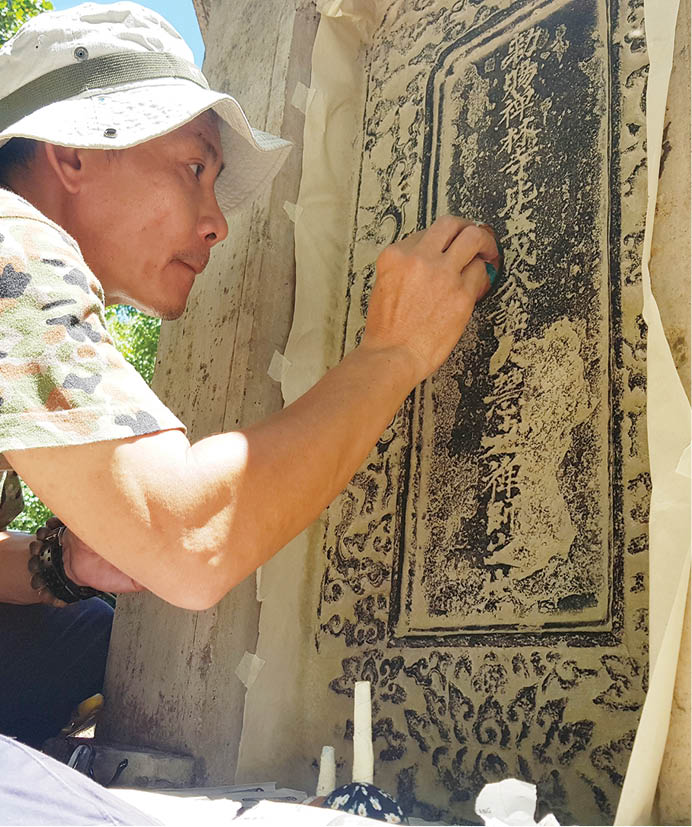
Each stele stamping operation is done in detail and care
For nearly two decades, the researcher Nguyen Phuoc Bao Dan together with the researcher Le Tho Quoc (Sub-Division of National Institute of Culture and Arts in Hue) and many of their associates have quietly pursued such work: Following the steles.
Meticulous and elaborate "game"
“Hello, I’ve just found this very unique stele. I’m about to go up there to stamp, would you like to come along?". Bao Dan's invitation made us excited, and we immediately drove up to the area of the stele.
It was a small alley located on Dien Bien Phu Street in the heart of the vibrant city. Under the large trees leading to Van Phuoc pagoda, the stele was hidden in a stupa, opposite was the tomb of Pham Quynh (a high-official of the Nguyen dynasty).
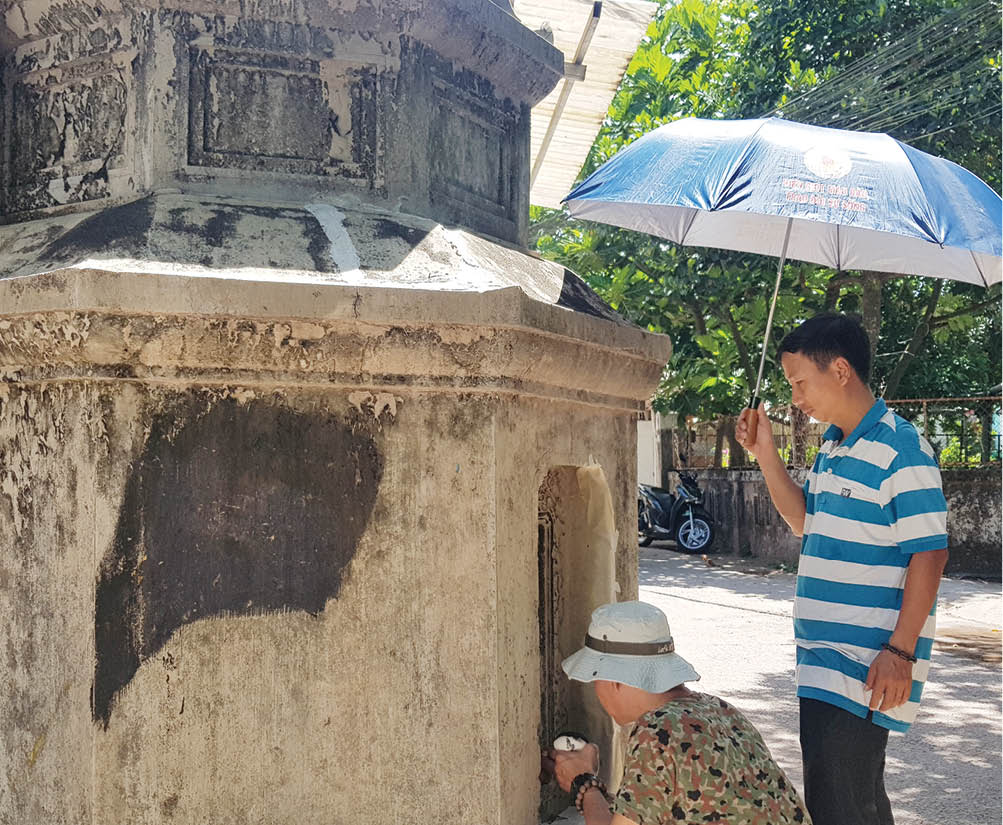
Despite the harsh sun, the two researchers remained silent with their passion for their work
The stele with the Chinese characters was quite intact, around which many motifs and patterns were hidden, showing the virtuosity of the ancient engraver. Some of the characters and patterns had been worn away over time as well as by natural agents. If you are not an expert and well-versed in Chinese characters, it would be difficult to know which monk's stupa it was.
"This is the stupa of a monk in a pagoda a few dozen meters away," Le Tho Quoc skimmed through the letters and informed us.
From the bag, the two researchers pulled out a bundle of many items to prepare for work under the 35oC sun. With just a few actions, Quoc cut the paper to fit the stele frame, pressed and then used glue to keep it in place. As he pressed the piece of paper to the surface, he sprayed water evenly on that section. The paper kept clinging to the surface of the stele.
Sitting next to him, Bao Dan had just finished wrapping pestles of all sizes and mixed ink to work on the next stage.
“Each stage has its own difficulties. From mixing ink and stamping to gluing and removing the paper... all must be done carefully and meticulously. Just a small mistake and it's damaged," Dan said, holding the pestle in his hand and working steadily and decisively on the surface of the stele. As he finished stamping each section, he explained to us the characters and patterns that appeared on it in detail.
The value of the material is extremely important
“Depending on the type of stele, the information, identity, age, pattern, etc., would be different. Especially the pattern system gives us a lot of valuable information about art. As for the steles in Hue, they were often carved deeply and with prominent patterns, so when stamping, many large and small tools are required to produce a complete stamping plate," Bao Dan, with his smeared hands and sweaty face, explained to us while waiting for the stamping plate to dry to peel off.
A peeled stamping plate is viewed as complete but… incomplete. Because according to these two young researchers, after being brought back, more steps must be taken to make the stamping plate hard to stand the test of time before being rolled and kept for documentation.
Not only this stele, but countless other steles in this ancient land related to the Nguyen Dynasty, ancient temples, or family shrines and tombs, etc., have also been stamped by Mr. Quoc and Mr. Dan. There are large steles that take a week to finish, such as the stele of Thanh Duc Than Cong at Tu Duc Tomb, the stele at Thien Mu Pagoda or the stele at Dieu De National Pagoda...
The profession which seems simple but requires technique as well as meticulousness and passion has been pursued by these researchers for more than 20 years. In addition to research purposes, there is an invisible passion.
“In order to achieve the so-called perfect technique like now, we had spent a lot of time researching and studying. Each operation is an experience. Depending on the type of stone and the conditions, we would apply different techniques to produce the desired results," said the researcher Bao Dan. He has also shared these with colleagues from near and far who possess the same passion.
Not knowing how many stamping plates have been successfully completed, both researchers consider it an invaluable asset in their pursuit of research and passion. They are stamping plates of great documentary value. In the scenario that an event causes the stele to be lost or relocated, or for some other unexpected reason, these stamping plates are intact documents to restore the stele to the equivalent 1-to-1 scale.
"The restored stele would only be different in its age. The designs and letters would be identical to the original", Bao Dan affirmed.
Story and photos: Nhat Minh