 |
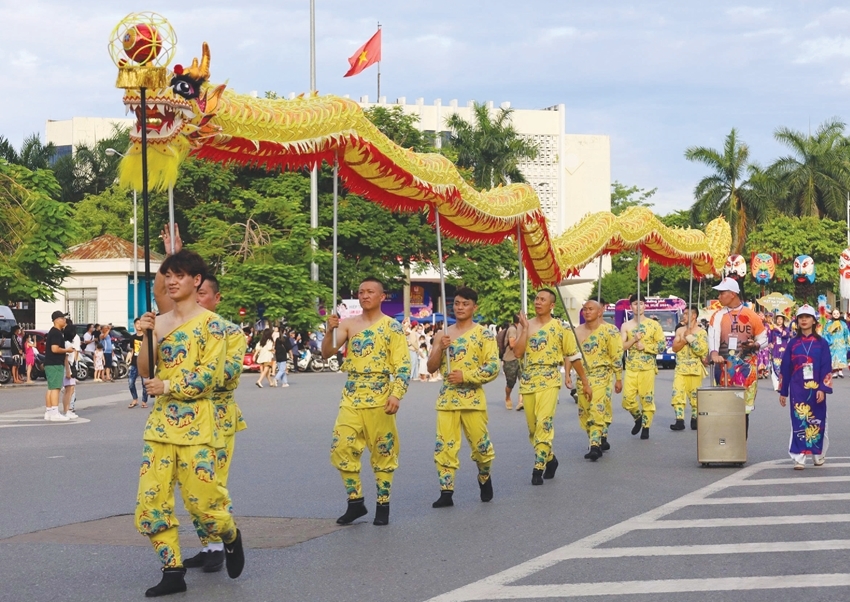
| Hue Festival brings together renowned art troupes from many countries, creating a vibrant festive atmosphere. Photo: P. Thanh |
Many important targets
The plan covers a very broad range of tasks. Its most notable feature is that it places culture and tourism within a single, unified development chain, running from resources and conservation to products, markets, branding and growth.
Now that Hue has become a centrally governed municipality, the task is no longer simply to preserve a heritage city well. Hue must turn its cultural depth into development capacity and its distinctive advantages into competitiveness. The measure of Plan 519, therefore, lies not in the number of tasks it lists, but in its ability to turn each target into concrete products and results in the more than four years remaining until 2030.
The plan quantifies many important targets. For 2026 alone, it requires digitization of 100% of cultural heritage sites ranked at the national and special national levels, completion of the application to join the UNESCO Creative Cities Network in the field of gastronomy, and completion of the dossier nominating Ca Hue (Hue-Singing music) for UNESCO inscription. Spending on culture and sports is set at a minimum of 3% of total local budget expenditure.
These figures only become truly meaningful when they bring about qualitative change. UNESCO should not be seen merely as a system of titles. If Hue aims to become a creative city of gastronomy, it must also build an ecosystem of research, training, knowledge preservation, product standardization, business development, experiential spaces, and international communication. If it prepares a Ca Hue dossier, it must address, in a coordinated way, the artisans and their stories, the passing on of skills, performance spaces, copyright and markets. Likewise, the 3% spending level will only be effective if resources are concentrated on programs with the potential for wide impact, rather than being spread thinly across too many tasks.
Another notable shift is the approach to developing cultural industries. Hue has exceptionally rich resources, but a large gap remains between cultural resources and a cultural industry. Heritage, festivals, cuisine and craft villages only become economic resources when there are standardized products, businesses, markets, copyright protection, technology, distribution systems and the capacity to reinvest.
Resources, therefore, should not be spread evenly. By 2030, Hue needs to focus on a few ‘growth poles’ where it has clear advantages: heritage, the Festival and the performing arts; cuisine, the ao-dai and creative crafts; digital content, film, television, media and design. In that case, Hue’s cultural values would not only be ‘consumed’ in Hue. They could also appear in film, publishing, music, design products, digital platforms, and e-commerce.
In tourism, the targets for 2030 show that Hue has gradually shifted from ‘counting visitors’ to focusing on the quality of growth: 10 - 12 million visitor arrivals, with international visitors making up 45–50%; total revenue of around VND 30,000 billion; average spending of VND 2.5–3 million per visitor; an average stay of 2.5 days; and tourism contributing about 15% of GRDP.
Keeping visitors longer and spending more
To reach these targets, Hue cannot keep relying mainly on day visits to historical sites. It must create more reasons for visitors to stay, spend, and come back. Product clusters need to be organized around specific markets and visitor groups, including: heritage - arts – Festival, cuisine - ao-dai – crafts, resorts – wellness – mountains - sea – lagoons, night-time economy - waterways - heritage city, MICE – events - golf - high-end tourism. Each product must answer three questions: who it is for, how it generates revenue, and how much it extends visitors’ stays.
Digital transformation must be viewed in the same spirit. Digitizing heritage is not about creating another database or replacing leaflets with QR codes. Cultural, heritage and tourism data must become development assets. They should serve research, education, digital museums, film, design, games, virtual reality and destination management. The city needs to decide early which data the State will manage and which will be opened for businesses and communities to use, and how the resulting value will be shared. It also needs to deal with copyright and intellectual property from the outset.
In the end, the decisive factor is still implementation. The plan assigned lead and coordinating agencies, set out resources, and required result-based evaluations. The next step is to build a very clear implementation matrix covering tasks, outputs, responsible agencies, deadlines, resources, and KPIs. It is not enough to write ‘complete the UNESCO dossier’, ‘build a museum’, or ‘develop creative spaces’. Each completion milestone, each year’s outputs, and the final impact must be defined.
Resources also need to be tiered. The State must lead on the conservation of historical sites, baseline data, research and heritage education. Accommodation, entertainment, the night-time economy, cultural commerce and many creative products, by contrast, should draw heavily on business investment, private-sector contributions and public-private partnerships (PPPs).
At the same time, heritage must reach schools and communities. Museums, historical sites, craft villages, Huong River, ao-dai, cuisine, and traditional arts must become ‘open classrooms’, because a cultural center is made first and foremost by its people and by the vitality of culture in everyday life.
Plan 519 gives a fairly complete answer to what Hue needs to do. Between now and 2030, the city must answer more decisively: what comes first; who is responsible through to the end; when each task will be completed; how results will be measured. From its broad set of tasks, the city should select around 10–15 breakthrough tasks to concentrate resources, and review their progress every year.
Plan 519 will truly become a roadmap for action when each target is turned into a KPI; each task has a final output; each institution has a completion deadline; each resource is put where it belongs. Then Hue’s standing as a major and distinctive center of culture and tourism will not be measured only by the number of titles, festivals, or visitor arrivals. It will be measured by the vitality of culture in the community, the quality of its tourism products, its ability to create economic value from heritage, and its increasingly clear competitiveness on the region’s cultural map.