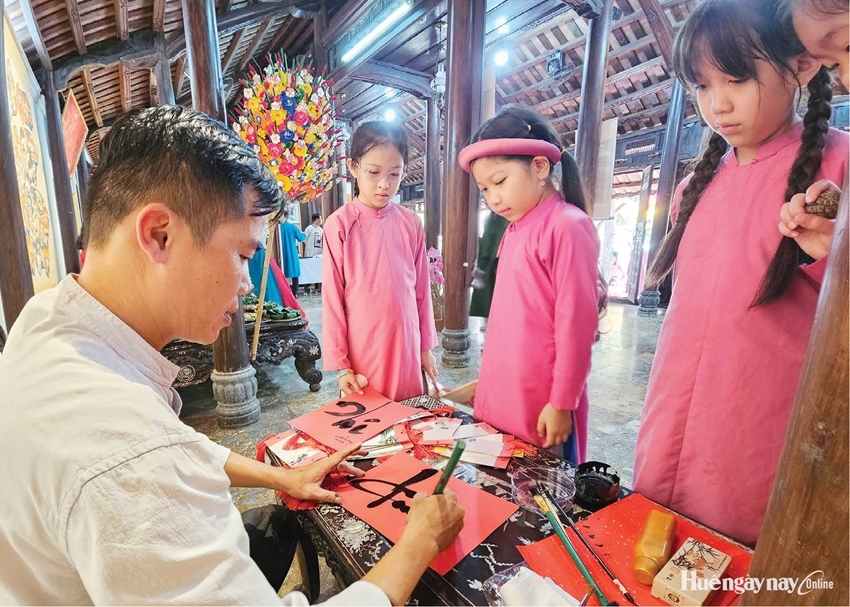
 |
| Vietnam Culture Day is an opportunity for people from all walks of life to engage with and better understand the cultural values passed down by previous generations |
A key occasion linking other important anniversaries
Experts believe that designating November 24th as Vietnam Culture Day is significant in raising public awareness of the role culture plays in national development.
Vietnam Culture Day also serves as a focal point linking several other important occasions: the Great National Unity Day (November 18th), Vietnamese Teachers' Day (November 20th), and Vietnam Cultural Heritage Day (November 23rd). It also promotes the role as active participants of local communities, artisans, artists, schools, businesses, and local authorities.
Mr. Nguyen Anh Tuan, M.A., Chief of the Office of Hue City Historical Science Association, considers the occasion highly meaningful. Looking back in history, November 24th, 1946, marks the First National Cultural Conference, held in Hanoi and attended by President Ho Chi Minh, who also delivered a speech at the event. Choosing this date both commemorates an important milestone in the history of modern Vietnamese culture and reaffirms the responsibility to preserve and promote the nation's cultural values in a changing world.
“In my opinion, the most important question is how to bring the significance of this day into people's everyday lives. Culture is not confined to historical sites, museums, festivals, or artistic performances; it is also reflected in our lifestyles, social interactions, and spiritual lives. Therefore, Vietnam Culture Day should become an occasion for people to have more opportunities to learn about, experience, and directly participate in cultural activities,” Mr. Tuan said.
He also added that the success of the day should not be measured solely by the number of events or the scale of their organization. A day dedicated to culture can only be truly meaningful if it brings lasting changes in public awareness and behavior.
Meanwhile, Full-time Deputy Head of the delegation of Hue City National Assembly Deputies Nguyen Thi Suu believes that November 24th should not be viewed simply as the addition of another public holiday. More importantly, it conveys a policy message from the State: culture must be accorded a status commensurate with that of the economy, politics, and society. Culture should not merely be a field requiring preservation; it must genuinely serve as the spiritual foundation of society, an endogenous source of strength, and a resource for development.
This principle is reflected in National Assembly Resolution No. 28/2026/QH16, which designates November 24 as Vietnam Culture Day, granting employees a paid day off. The resolution also provides for exemptions or reductions in admission fees and service charges at public cultural and sports facilities on that day, subject to decisions by the competent authorities.
Ensuring everyone has the opportunity to access cultural values
Speaking further about expanding opportunities for people to enjoy culture more fully and meaningfully, the female National Assembly deputy observed that workers may have incomes, housing, and adequate material conditions. However, if they lack spaces to appreciate the arts, read books, visit museums, take their children to historical sites, attend music performances, watch meaningful films, or participate in community festivals, their lives may still lack balance.
Ms. Suu said that economic and cultural development are not competing priorities for limited resources. Rather, they should support and reinforce each other. A developing economy enables people to afford cultural experiences, while a rich cultural life improves the quality of human resources, strengthens community bonds, fosters creativity, and ultimately contributes to productivity and economic value.
As an example, in 2025, she cited, when Hue hosted the National Tourism Year. The experience demonstrated how cultural heritage, festivals, and creative products could be organized into an ecosystem with a far-reaching influence. That year, Hue welcomed approximately 6,3 million visitors, an increase of more than 61% compared with 2024. Total tourism revenue was estimated at over VND 13 trillion, up by more than 64%.
“Of course, I do not believe that all of this revenue growth was generated by culture alone. However, these figures show that when heritage becomes more appealing, festivals are well organized, and music, ao-dai, cuisine, and performing arts are transformed into experiences, culture can generate tangible economic value. Therefore, Vietnam Culture Day must truly be ‘a day for the people,’ rather than merely ‘a day for the cultural sector.’ Whether they live in urban or rural areas, whether they are young or old, work as factory workers or civil servants, or have high or low incomes, everyone should have opportunities to access cultural values suited to their needs,” Ms. Suu said.
|
|
|
Numerous events for Vietnam Culture Day
According to the plan announced by Hue City Department of Culture, Sports and Tourism, a range of activities will be held to mark Vietnam Culture Day. Highlights include a flower-offering ceremony in tribute to President Ho Chi Minh; artistic performances celebrating Vietnamese and Hue cultural heritage; community cultural experience spaces; and exhibitions promoting the heritage sites and cultural values of the Complex of Hue Monuments.
These activities aim to inspire patriotism and national pride while strengthening the community's responsibility for preserving and promoting Vietnamese culture and human values. They will also link heritage conservation and transmission to creativity, tourism, and the development of cultural industries. Through these efforts, the city seeks to spread the cultural values of Hue, promote Ho Chi Minh's thought on culture and humanity, and reaffirm Hue's position as a heritage city and one of Vietnam's distinctive festival cities.
|