 |
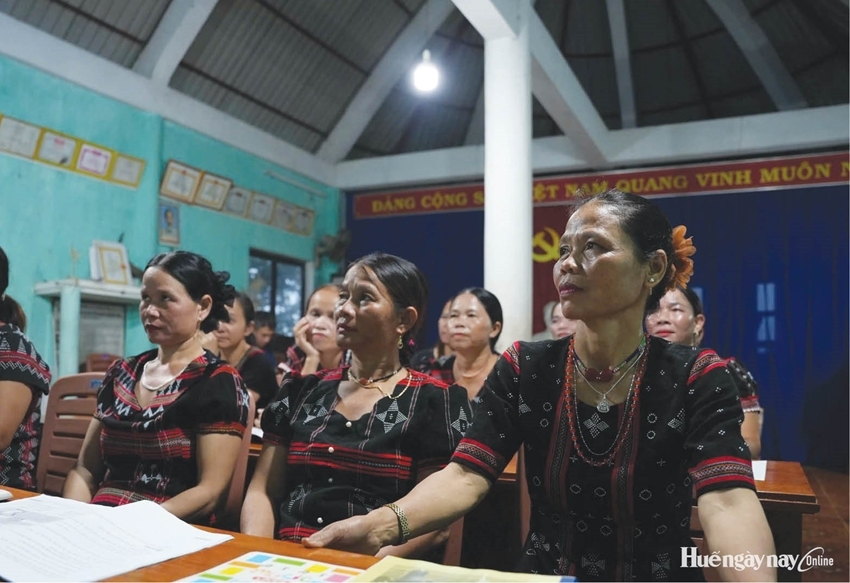
| An evening literacy class taught by teacher Dinh Nhu Huy |
From mobilizing students to teaching literacy to adults
Alongside teaching high school mathematics and serving as a homeroom teacher, he has also been assigned to oversee universal education and literacy eradication in the Nam Dong area, while coordinating with and supporting colleagues in Long Quang and Khe Tre communes. Recalling the early days of opening classes in the former Thuong Long commune area (now Long Quang Commune) in August 2020, teacher Huy said: “When we first approached the area, the whole group could only persuade about five students to attend. Undeterred, my colleagues and I coordinated with local authorities, taking advantage of the fact that a commune official and a village head were my former students to campaign together.
It was teacher Huy’s approachability, understanding of local customs and traditions, and motto of proactively reaching out to learners and bringing classes closer to the people that helped the movement overcome difficulties. Many students had intended to drop out of school to work for hire, but thanks to that persistent, gradual approach, they returned to school. Tran Thi Gau, a 10th-grade student, shared: “Because of my family’s difficult circumstances, I once planned to quit school to earn money. Thanks to teacher Huy and other teachers visiting my home many times to encourage me and explain that only education can open up a brighter and more sustainable future, I changed my mind and became determined to stay in class.
Beyond maintaining high school enrollment, teacher Huy’s journey has also extended through evening literacy classes for older adults. In the 2026–2027 academic year, the Center organized 17 literacy classes with 229 learners, most of whom are women and ethnic minorities over 40 years old. Persuading older adults to attend school is twice as difficult due to shyness and self-consciousness, as well as being busy with farming work during the day. To help local residents understand that learning to read and write enables them to sign their own names, handle paperwork, and manage expenses, teacher Huy gradually convinced people to come to class, adopting a hands-on teaching approach.
Ho Thi Ban, a student in a literacy class in Long Quang Commune, beamed as she shared: “Before, I didn’t know what the letters ‘a’ or ‘o’ even were, and I always had to use my fingerprint for paperwork. Since the teacher started guiding me so attentively, I now know all the letters, can read, and can sign my own name. Coming to class is a joy, and villagers are deeply grateful to the Party, the State, and the teachers.
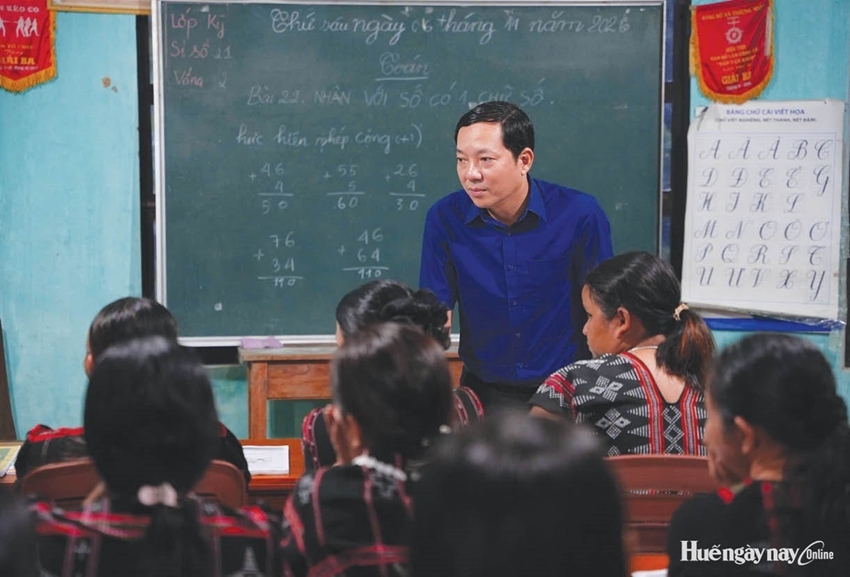 |
| Teacher Huy teaches a class |
AI integrated into class hours
Teacher Huy always keeps in mind: “Aside from professional expertise and love for the profession, to teach ethnic minority people, one must first understand their culture and know the local language in order to truly empathize and share.”
Beyond mobilizing older residents to attend class and teaching them letters and numbers to apply in daily life, he also seeks ways to help his regular-program students access lessons through effective information technology applications right in class. Specifically, he has applied information technology and artificial intelligence (AI) to teaching mathematics, turning dry numbers and graphs into visual and lively elements that help highland students absorb knowledge easily. Thanks to this, the Trinh Cong Son teaching site - Facility 7 has maintained stability for many consecutive years with a high school graduation pass rate of 100%.
Nguyen Toan Thang, Deputy Director of the Region 3 Continuing Education and Vocational Training Center, stated that maintaining highland teaching sites is a major determination of the school’s collective staff in order to create conditions for 100% of ethnic minority students to cross mountain passes and slopes to attend class, fulfilling the goal of leaving no one behind.
The over-two-decade journey of sowing the seeds of literacy by Nam Dong native Dinh Nhu Huy is not only measured by statistics or graduation rates, but is also visible in the radiant eyes of a Co Tu woman when writing her own name by hand, and in the confident smiles of highland students on their path to conquering knowledge. That flame of passion and love continues to warm the villages day and night, turning literacy into a bridge that leads local people toward a bright future.