 |
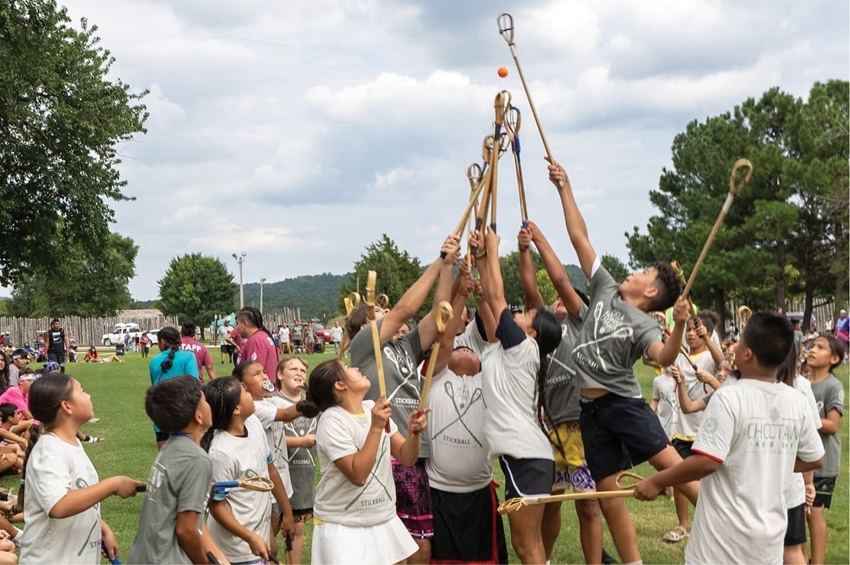
| Stickball, a sport that has been part of the Choctaw community for generations |
From the Choctaw festival
From where I live in Texas, it takes about four hours to drive to Tvshka Homma, the historic capital of the Choctaw Nation in Oklahoma. The road took me through forests and sparsely populated residential areas before opening onto an unexpectedly lively festival ground.
I came to the place for the Choctaw Nation Labor Day Festival, an annual event that brings members of the Choctaw community from different places back to a land of special significance in their history. Tvshka Homma is not a bustling city, but during the festival, the Capitol Grounds become a gathering place for visitors from near and far.
There, I saw many young women wearing colorful traditional dresses, along with beaded jewelry and handicrafts made by indigenous artisans. Traditional wooden houses with thatched roofs had been recreated beneath the shade of old trees. Craft stalls and traditional cultural activities were located just a short distance from the fairground, with games, music, and modern family-friendly amenities. It was this blend that made me realize how the Choctaw people are preserving their culture through everyday activities: children can play, young people can wear traditional clothing, elders can share stories of the past, and visitors can directly take part in the activities.
Remembering mountainous villages in Hue
In the past, I made many working trips to the western area of Hue, traveling through A Luoi and Nam Dong to highland villages, where ethnic minority communities live and preserve their distinctive cultural traditions in their clothing, music, cuisine, festivals, and community life. Those trips, together with my experience at the Choctaw Nation many years later, have led me to one thought: culture feels closer when people can take part and share in it directly.
A traditional outfit tells more stories when visitors meet the person who wove it, or someone who wears it. A local dish or a jar of local wine becomes more memorable when visitors hear about the ingredients, the preparation, and the life behind the food and drink. A dance, the sound of gongs or drums, or a traditional craft also becomes much closer when visitors have the chance to join in.
My experience at the Choctaw Nation has kept me thinking about the potential for regular cultural events that could become reasons to visit the mountainous areas of Hue, rather than leaving them associated, in the minds of many visitors, mainly with charity trips, as has long been the case.
These events do not necessarily have to be large-scale festivals or costly construction projects. They could take the form of regular cultural weekends, with local communities at the heart of the activities, introducing their cuisine, handicrafts, costumes, music, folk games, and stories. Local children could take part alongside their grandparents and parents, while visitors could have the opportunity to experience the culture rather than merely watch.
What I learned at Tvshka Homma is that indigenous people must be the ones telling their own story, not performers in a show staged solely for visitors. Visitors from afar, like me, have the opportunity to immerse in a cultural life that already belongs to the community. If similar spaces were developed appropriately in A Luoi, Nam Dong, and other mountainous areas of Hue, the benefits could extend beyond cultural preservation.
Mr. Dang Dinh Si, a long-time tour guide in Hue who regularly organizes experiential tours in mountainous areas, believed that better communication is needed to promote programs at these destinations, as it would be too late for visitors to learn about them only after arriving in Hue. Visitor reception at festival venues also needs careful preparation, from parking and trash bins to restrooms. When these facilities are provided, destinations can leave a positive impression on visitors. He also noted that local communities’ cuisine is a draw in itself, thanks to its distinctive and delicious flavors.
During festival seasons, I have noticed that many visitors still spend much of their time exploring the central area, including the Imperial Citadel, royal tombs, Thien Mu Pagoda, the Huong River, and other familiar attractions. These are irreplaceable assets of Hue, but to encourage visitors to stay longer, Hue needs more experiences beyond the usual itineraries. Regular weekend cultural gatherings in A Luoi, Nam Dong, and the surrounding areas could open up such itineraries, connecting natural landscapes with community life.
The development of tourism products in these areas could also help distribute visitor flows, ease some of the pressure on traffic and services in the city center during peak periods, and extend the benefits of tourism to more communities. This would also give those visiting Hue for a second or third time new reasons to return.
Looking back from Oklahoma, I suddenly realized that the mountainous areas of Hue have many such ‘gatherings’, nestled among villages and forests, and in the memories of communities that have lived on this land for generations. Perhaps what is missing is more occasions for visitors to come, talk, and live within each of those stories.