That “intimacy” was well expressed on the patterns on the Nguyen dynasty’s relics. Among many kinds of patterns, chrysanthemum motifshelp people realize the amazing meanings of life when beholdingthem.
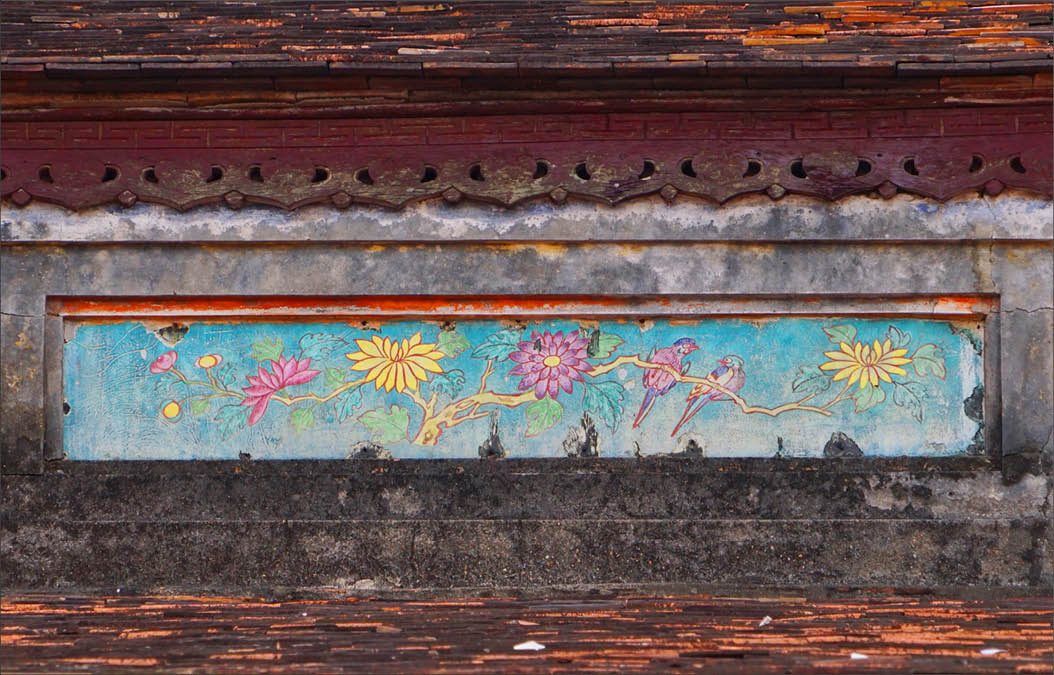 |
| Chrysanthemums at Thai Hoa palace |
The symbol of everlasting power
The motifs on the decorative blockworks below the roof edge of Thai Hoa palace
are usually objects and plants. Below the roof edge there are 25 decorative blockworks, the themes of which includeConfucianism’s eight holy objects combined with peonies and chrysanthemums. Chrysanthemums represent a desire for eternality, stability, happiness and fulfillment. Decorating chrysanthemums on parts of Thai Hoa palace expresses the desire for the eternality and strength of the institution.
Visitors can come across the symbol of chrysanthemums not only on the decorative motifs in Thai Hoa palace, but also on those in Long An palace, Can Chanh palace and other monuments. The pattern of chrysanthemums is usually decorated at places lower than the edge of the roof. On eight thick wooden blocks at the ceiling’s edge in Long An palace, stylized images of chrysanthemums were intricately carved on two sides. Chrysanthemums covered most of the wooden blocks’ area, with different techniques of carving that created excellent pieces of arts. The details of the petals, stamens and sepals were stylized, making the flowers and leaves look strong, but remarkably gentle and elegant.
When coming across the chrysanthemums here, visitors can easily associate them with the connection between Heaven and Human. Chrysanthemums represent the autumn. In the traditional perception, the autumn is the season when the summer meets the winter, the weather is cool, and it is also the rice and other crops harvesting season. The brightly golden chrysanthemum symbolizeswealth and royalty. Moreover, chrysanthemums are in bloom later than and not competitive with other kinds of flowers, and thischaracteristic signifies the personality of a noble man who tolerates loneliness, and despises worldly success and honor.In the Nguyen dynasty, chrysanthemums were considered the best of flowers (as stated in a poem written in Khai Thanh palace, Khai Dinh Tomb).
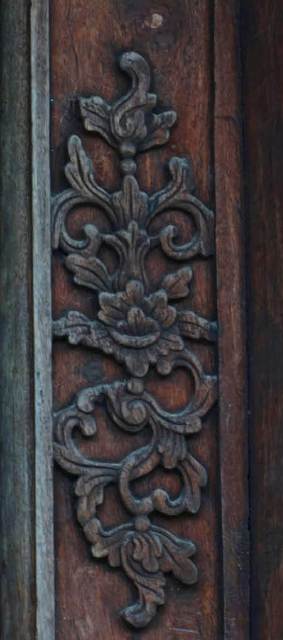
Decorative motifs at Long An palace
Enlightenment on the impermanence
The book titled “Hue Royal Decorative Patterns” that presents L. Cadiere’s collection of prints, drawings and paintings of traditional Vietnamese decorative sculpture dedicates many pages to chrysanthemums. As commented by L. Cardiere, when beholding decorative patterns on Hue relics, people should understand the quartet of seasonal flowers and plants which are “apricot, lotus, chrysanthemum, bamboo”: The apricot flower represents the spring, the lotus the summer, the chrysanthemum the autumn, and the bamboo the winter. In the floral decorative patterns, plants are often transformed: the peach (or plum) is transformed into the phoenix, the bamboo (or pine) into the dragon, the orchid into the dragon, and the chrysanthemum into the unicorn.
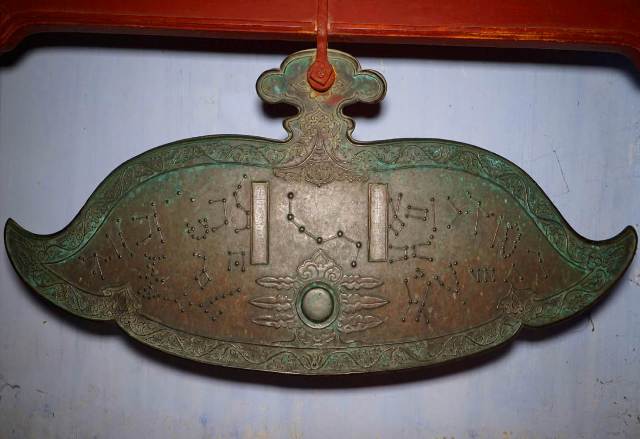
Two strips of chrysanthemums on a bell at Thien Mu pagoda
Artisans’ imaginations enable plants to combine with the sacred objects. Sometimes on a branch there are leaves of different plants: “a branch has long chrysanthemum leaves at its root; then it has short and round peony leaves in the middle, and at the top it has plum flowers” (L. Cadiere). In the folk perception, natural transformation is endless, and humans in harmony with nature should be aware of this truth.
On a sunny afternoon, a tourist found his way to the Thien Mu pagoda. He beheld the two ribbons of chrysanthemums meandering along the edge of a bell. Chrysanthemum patterns decorated around the bell seemed to fly with the wind in the late afternoon, and all of a sudden, the beholder seemed to obtain the enlightenment of impermanence.
By Ho Hoang Thao. Photo: Bao Minh