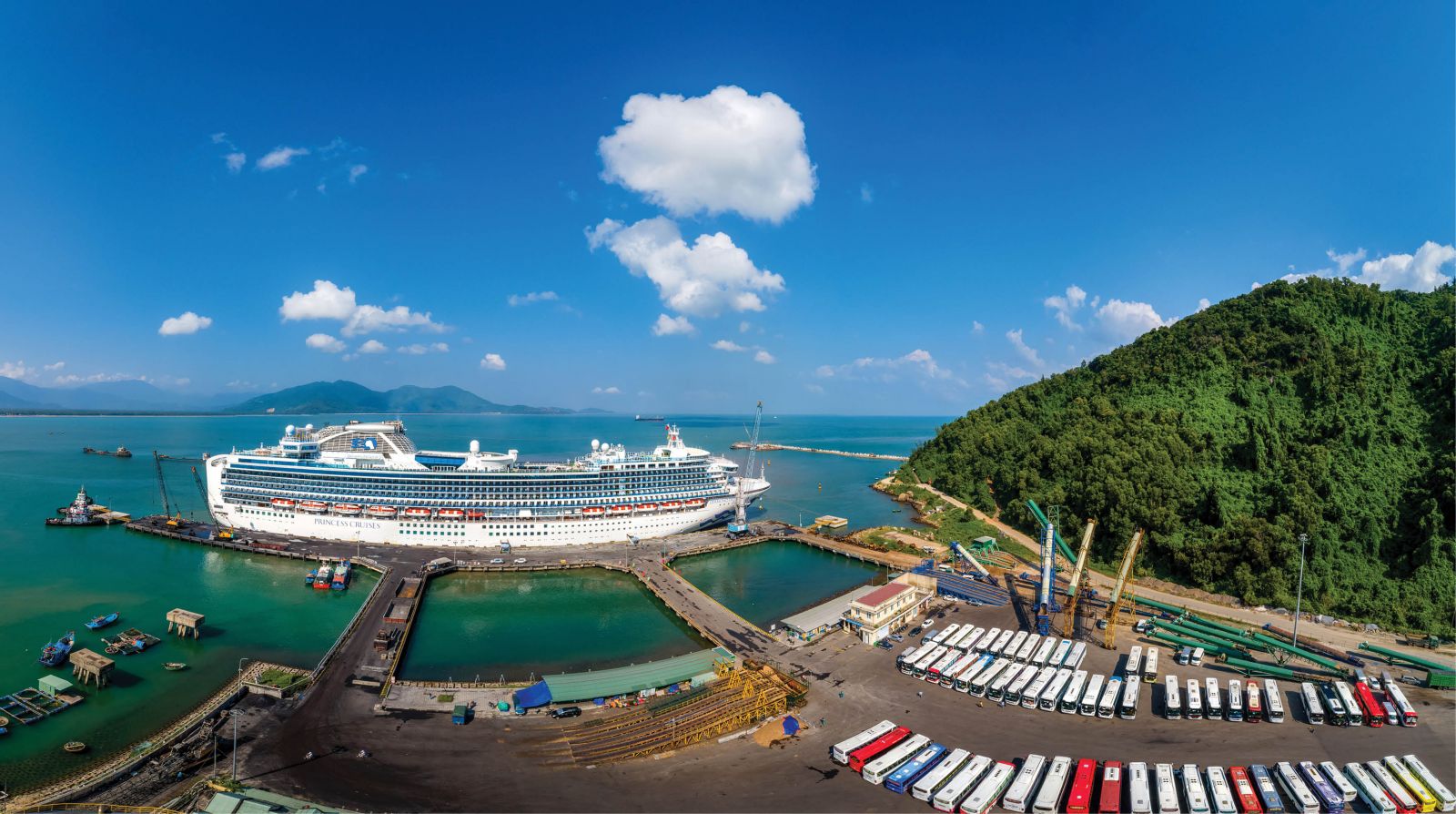
Chan May Port welcoming large ships. Photo: Nguyen Phong
Opportunities created by Chan May Port
Recently, Chan May Port has successfully welcomed an international container ship named Deltic Dolphin (Malaysia) for the first time, affirming the capacity of a deep-water port.
Since its establishment, Chan May Port has been considered the closest and most convenient gateway to the East Sea for regions in the East-West Economic Corridor area (connecting Central Vietnam with Central and Lower Laos, Northern East Thailand, and Myanmar). This is also a major port in the middle of the sea route connecting Singapore, the Philippines, and Hong Kong (China).
With such potential and advantages, Chan May Port has met the needs of both cargo and international passenger ships. However, unlike the bustling seaports in the region, Chan May has not witnessed significant changes to really be called the “giant” of Vietnam's maritime industry.
The problem at this time for Chan May Port is the infrastructure. Specifically, Chan May does not have an area to welcome its own tourists, but has to share the aisle with cargo ship. In addition, there is no large-scale passenger terminal, product display and sale area. In other words, there is no true cargo port of Thua Thien Hue at Chan May - Lang Co Economic Zone and 6 industrial parks, with more than 80 large and small enterprises exporting and importing goods by container ships. Nevertheless, these enterprises have to make use of Da Nang Port, or even take advantage of transshipment at Saigon or Hai Phong ports.
As estimated, about 195,000 Teus (the measurement of cargo capacity according to container) passes through Chan May Port every year (to and from Da Nang Port from Quang Tri, Quang Binh, Thua Thien Hue and Laos). In case such goods pass directly through Chan May Port, about 70km is spared (equal to a one-way truck drive). In other words, it is estimated that about 70 USD would be saved per round trip for not having to travel through the Hai Van Tunnel system.
Perhaps Chan May Port has made slow but timely advances, especially when it has recently been oriented according to the master plan of Vietnam's seaport system by the ministries and central branches until 2030, with a vision to 2050. Since then, along with the existing wharf 1, Chan May now has breakwaters and three wharfs operating with a total length of about 910m, in which berths 1 and 2 can welcome container ships, etc.
Currently, berths 4, 5 and 6 are added to Chan May Port, and the policy of assigning the construction of berths 4 and 5 to operate container cargo with a total length of 540m for ships up to 70,000 tons to VSICO Maritime Joint Stock Company (Hanoi) has been approved.
In addition, the Province has registered with the Ministry of Industry and Trade to implement the planning of a first-class logistics center with an area of about 20 hectares in Chan May – Lang Co Economic Zone with an expected investment of VND 1,500 billion. With this strategic infrastructure, Chan May Port has many good opportunities to receive and transship goods from the world's largest and most modern cargo, container and passenger ships for most of the year.
Recently, the Provincial People's Committee has held a large-scale conference on investment promotion of container shipping lines to invite businesses and shipping lines to Chan May port. On this occasion, Mr. Nguyen Van Phuong, Deputy Secretary of the Provincial Party Committee, Chairman of the Provincial People's Committee, affirmed that the province had goodwill with the highest determination to create favorable conditions for enterprises and shipping lines to contribute to the development of Chan May as a modern, friendly and safe international seaport.
New impression with Phu Bai Airport
Phu Bai Airport has been the default “brand” of air traffic in the Central Region since the country's years of renovation. At this time, along with Noi Bai, Tan Son Nhat and Da Nang airports, Phu Bai Airport became one of the four largest airports in the country, with the capacity to welcome Boeing 737, A321 aircrafts.
With such favorable factors, Phu Bai Airport was recognized by the Ministry of Transport as an international airport in 2007, becoming one of the airports in Vietnam to welcome many big aircrafts from China, Austria, Siem Reap (Cambodia), Indonesia, etc.
With the mission of creating a driving force to promote local and regional socio-economic development, Phu Bai International Airport has continued to invest in and upgrade infrastructure to match its position, such as expanding the terminals, the runways, and parking lots systems, etc., in which the terminals were expanded, the ticket offices, waiting rooms, service counters were upgraded and embellished… to meet the travel needs of domestic and international passengers.
However, after many years of operation with the existing design, the port has recently ceased to meet the increasing number of passengers. In 2017, the number of passengers to the port reached 1.75 million; and, the estimated number of passengers at the time of opening operation exceeded capacity in 2019 and in recent years despite the impact of the COVID-19 epidemic.
For the above reasons, Airports Corporation of Vietnam (ACV), in cooperation with Thua Thien Hue Province, invested in the project of Passenger Terminal T2 at Phu Bai International Airport with a total capital of VND 2,250 billion (from the Development Investment Fund of ACV) in 2019.
The project includes many items, such as constructing new passenger terminals, fence system and roads, expanding aircraft parking lots up to 8 available aircraft parking positions, enlarging the car park and installing ancillary items like the exterior lighting, water supply and drainage system, as well as planting green trees and landscaping.
Currently, the project of Passenger Terminal T2 has basically completed the items, and expected to be completed and put into operation in early 2023. In the immediate future, Passenger Terminal T2 has all the conditions to welcome 5 million passengers/year; including 1 million international visitors. With the orientation to 2030, Phu Bai International Airport will continue to expand its capacity to welcome 9 million passengers/year.
Mr. Nguyen Duc Tien, Director of Phu Bai International Airport, informed that welcoming many international flights with the existing capacity at the port is just a necessary condition to head towards the above goal. In addition to the efforts of relevant units, departments and sectors, active solutions from local authorities, ranging from promoting to advertising to attract tourists, contribute to fulfilling the “sufficient” conditions to turn Hue into an attractive destination for large international investors and corporations
By Song Minh