 |
| Mr. Cung Trong Cuong, Director of the Hue Institute for Development Studies |
According to Mr. Cuong, in recent years, the city has collaborated with international organizations and businesses to introduce various services such as electric taxis, “Grab cyclo,” and public bicycle systems. These initiatives aim to expand transport options in a way that reduces reliance on private vehicles and moves toward building a green, eco-friendly city.
Could you share the city’s direction in promoting green transport?
The transition to green energy in the transport sector is a major direction for the city in modernizing and ensuring the sustainable development of its transportation system, while keeping pace with global trends. The long-term goal is to achieve net-zero greenhouse gas emissions by 2050. Alongside encouraging the use of public transport and reducing private vehicles, the City People’s Committee has issued a plan to transition from private vehicles to public passenger transport, both buses and intra-provincial coaches, to electric vehicles in the period 2025-2030.
Under this plan, from 2025 onward, 100% of newly invested or replaced buses must use electricity or green energy. Between 2025 and 2030, 60% of taxis operating in the city will be electric vehicles, while 30% of newly invested or replaced contract for passenger transport vehicles will also be electric. At the same time, the city aims to complete a network of electric vehicle charging infrastructure across the entire area to meet the needs of individuals and organizations.
What role does the institute play in this transition process?
While we do not directly invest in infrastructure or carry out technical implementation, we focus on research and policy advisory related to sustainable and environmentally friendly transport. We organize workshops and scientific forums to connect experts, policymakers and businesses, and propose roadmaps for green transport transition aligned with emission reduction commitments. In our policy recommendations, we prioritize the development of green public transport, reducing dependence on private vehicles, especially fossil fuel-powered motorbikes, and restructuring urban space to favor pedestrians and cyclists.
The institute also collaborates with relevant stakeholders to pilot green mobility models, such as the urban bicycle system (SmartBike Hue), which encourages zero-emission short-distance travel habits, and the “Grab cyclo” model for tourism and urban mobility, particularly in heritage areas, helping to reduce pollution and noise. These models serve as social experiments that lay the groundwork for behavioral change.
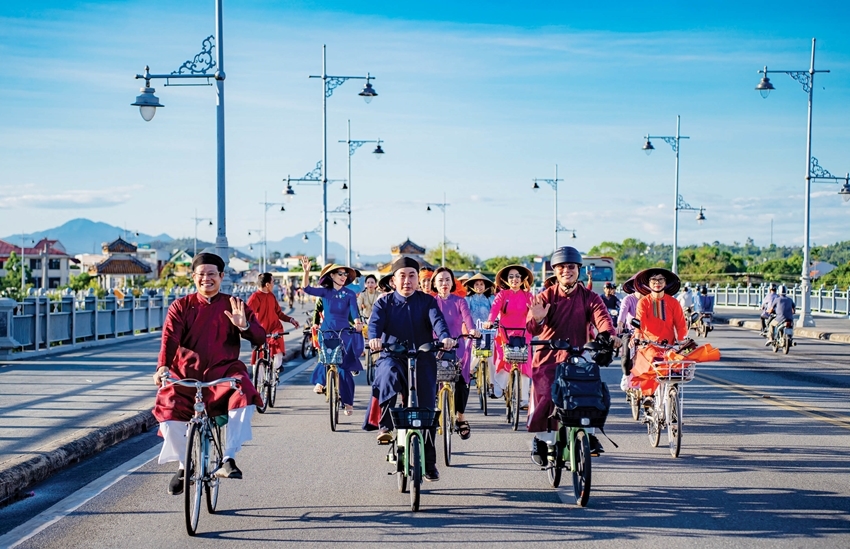 |
| Cycling-based tourism promotion activities have created positive community impact. Photo: Dinh Hoang |
What are your expectations for these pilot models in reducing fuel consumption and emissions?
Our approach goes beyond simply increasing the number of green vehicles. It aims to change mobility behavior. Models such as “Grab cyclo” and public bicycles are key links in this transition.
For example, “Grab cyclo” not only improves the efficiency of zero-emission transport and replaces short trips typically made by motorbikes or cars in heritage areas, but also enhances attractiveness, encouraging users to shift away from private vehicles. Meanwhile, the public bicycle system can fully replace motorbikes for short distances (1–3 km), helping form habits of low-emission mobility, reducing noise and air pollution, and contributing to shaping Hue as a green city.
What green models is the institute currently promoting?
At present, the institute is working with partners to develop electric-powered tourist boats, aiming to reduce environmental emissions while promoting greener inland waterway transport. This also helps ease pressure on road traffic and enrich tourism experiences. In addition, we are collaborating with international organizations and businesses to research and propose further pilot models for green transport in the near future.
In your view, what are the biggest barriers to green transport transition?
In my opinion, one of the biggest barriers is awareness and behavior. Infrastructure and investment capital also play significant roles. However, while infrastructure can be built and investment can be phased, if people and businesses are not ready to adopt new mobility habits, it will be difficult to shift away from fossil fuel-based transport.
What policies are needed to promote green transport?
As mentioned, awareness and behavior are central to the transition. Therefore, communication efforts to raise awareness, along with pilot models that provide real-life experiences, are essential to driving behavioral change. At the same time, the city should implement communication campaigns targeting both residents and businesses, clearly outlining the roadmap, policies and benefits of transitioning from fossil fuel-powered vehicles to electric ones.
 |
| Hue residents refueling motorbikes |
In addition, improving the legal framework and policy mechanisms is crucial. The city needs to introduce supportive and incentive policies to encourage transport enterprises to invest in and transition from fossil fuel-based vehicles to electric ones.
What solutions should be prioritized to achieve green transport goals?
It is necessary to adjust transport infrastructure to prioritize green mobility. Specifically, developing bicycle lanes, safe pedestrian spaces and infrastructure supporting electric transport; these are solutions that can be implemented quickly, at relatively low cost, yet have a direct impact on people’s travel behavior. When infrastructure is aligned with this direction, green vehicles will have more favorable operating conditions. People will begin to see that using electric vehicles or bicycles is not inconvenient, and businesses will recognize new investment opportunities. At that point, green transport will naturally become the preferred choice for both residents and enterprises.
Thank you for your exchange.