.JPG)
The gorgeous red sala flowers adorn the ancient space of some Hue pagodas.
In Hue, there are three pagodas which grow these sala trees: Thien Mu, Huyen Khong and Sang Quang.
There is much debate about the name of this flower. People say that there are other names such as Vo Uu ( Saraca Indica), or Dau Lan (Unicorn’s Head), Ham Rong (Dragon’s Jaw)... Many visitors to Thien Mu pagoda are surprised by the beauty and scent of the sala. The tourist guides do their best to introduce the origin of these trees as well as why they are present at this temple.
"The sala trees in the temple grounds are beautiful. They have become a popular destination for many visitors. During our tour to Thien Mu Pagoda, we cannot ignore this point, " a tour guide said. The sala tree inside Thien Mu pagoda was brought from Ho Chi Minh city by the monks more than 10 years ago. The flowers bloom the most in summer, lasting more than 2 months.
"This is the first time I have seen such a beautiful flower. And of course I will take a photo of it right now to post on my personal social media site to show it to my friends. They will be curious and very interested," said Dana, a Canadian visitor.
.JPG)
According to the Buddhist concept, sala flowers signify empathy and an untroubled, unprejudiced, pure outlook on life.
Meanwhile, in front of the gate of Huyen Khong Ha Pagoda (Huong Ho Ward, Huong Tra Town), two ancient sala trees are also visited by many people coming to the pagoda. Although the trees do not have as many flowers as before, the flowers here are very fragrant, and many people pick the fallen ones to display in their home. According to the monks at this temple, the two main sala trees at the gate were brought from India almost 40 years ago. Previously, the trees blossomed a lot during this season. However, as the trees grow older and the weather gets more severe, the number of flowers has decreased.
A sala tree is not only beautiful because of its flowers, but also for its luxuriant foliage, shading a large area, which is a stopping place for many tourists. The sala tree also produces fruit, but its fruit is inedible and only used to plant new trees.
According to Buddhism, Buddha was born under this kind of tree in the garden of Lumbini (Nepal). When he entered Nirvana, two ancient trees spread their shade over him and sent out a lovely scent throughout the garden. Sala trees are found in India, south of the Himalayas, and later in parts of South Asia and Southeast Asia.
|
|
Video clip of blooming sala flowers in Thien Mu pagoda
|
The sala is a hardwood tree. Its scientific name is Couroupita Guianensis, belonging to the Dipterocarpaceae family. The sala can grow up to 15 meters high. The flowers only grow from the main body. They are orange, red and pink, growing in clusters on the long stem which can sometimes reach up to 3 meters.
As the flowers die, the sala fruit will grow. It is round, grey, and has an unpleasant smell. Each fruit contains 4 to 8 spherical seeds. Only when the inner core becomes rotten can people take the seeds to plant. This process is exactly in line with the traditional concept of birth, death and regeneration in Hinduism.
.JPG)
A female visitor admiring the sala flowers in the courtyard of Thien Mu Pagoda
.JPG)
Capturing images of the lesser-known flowers
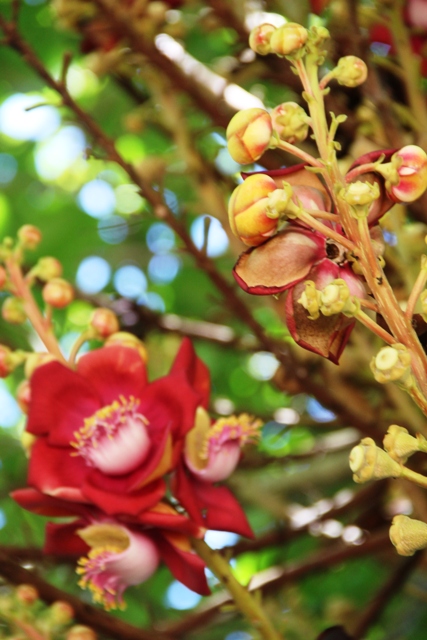
The sala flowers, which have a very fragrant aroma, signify calm and serenity.
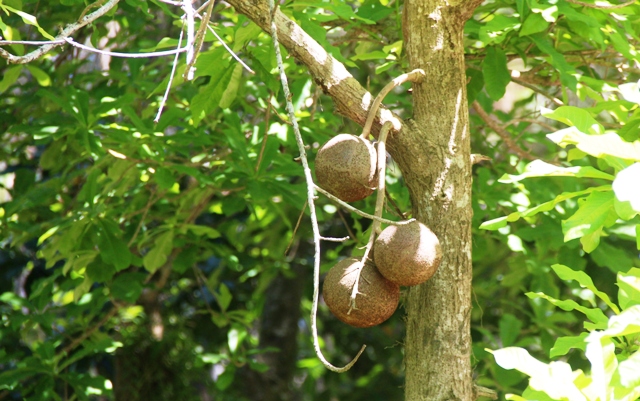
As the flowers die, the sala fruit will grow. It is round, grey, and has an unpleasant smell. Each fruit contains 4 to 8 spherical seeds.
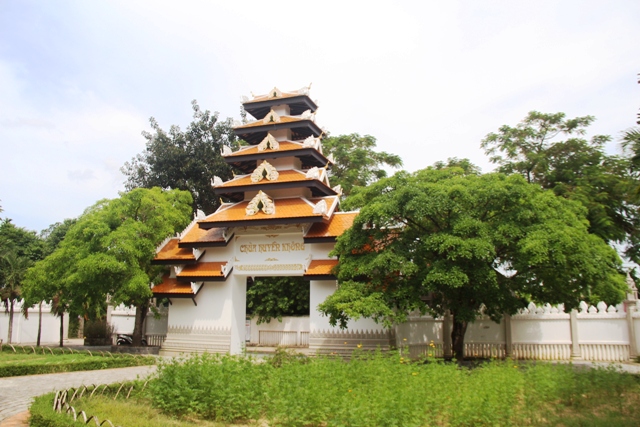
The two main sala trees at the gate of Huyen Khong Ha Pagoda were brought from India almost 40 years ago.

For many tourist guides, the sala trees inside Thien Mu Pagoda or Huyen Khong Ha Pagoda have become highlights in every Hue pagoda tour.
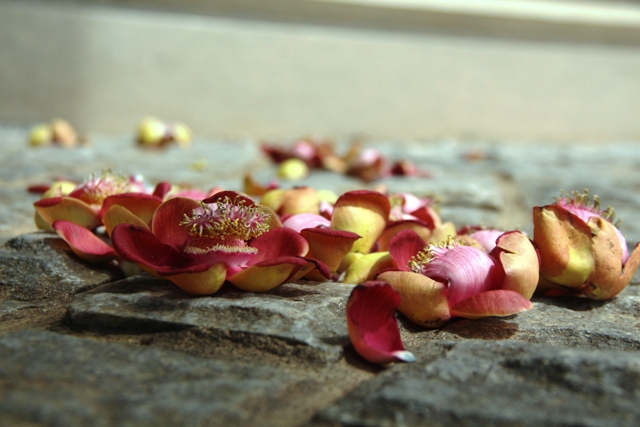
Fallen sala flowers on the temple grounds
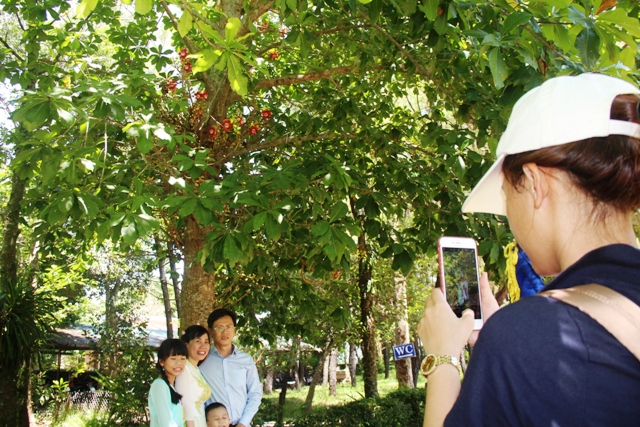
Many families have their photograph taken besides the sala tree. They think that this flower will bring them good luck and peace.
|
| Video clip of tourists recording and taking photos of the sala flowers to remember their time visiting Hue pagodas |
By PHAN THANH