 |
| Patient Vu Quynh C. in the bone marrow transplant room |
The journey of revival
On the afternoon of September 8, Hue Central Hospital held a discharge ceremony for 6-year-old Vu Quynh C. from Bac Ninh - the 11th Thalassemia pediatric patient to successfully undergo a bone marrow transplant using stem cells from her mother, despite a blood type mismatch. This was one of the special transplant cases, marking an important milestone in Vietnamese medicine. After 28 days, Quynh C. recovered and was discharged in the overwhelming happiness of her family. Her father, Mr. Vu Dang Quan, shared emotionally: “From now on, my daughter can live healthily, play, and study like other children of her age. That is the greatest joy for our family.”
At the Pediatric Center of Hue Central Hospital, the clear laughter of the children echoes behind the doors of the bone marrow transplant room. For little Nguyen Huy H., 2 years old, from Bac Ninh, simple joy now means being able to run and play with other children in the hospital courtyard, instead of lying exhausted in bed due to anemia. Previously, H.’s parents had to travel to Hanoi every month for blood transfusions, with the burdens of daily life never easing. Now, after a successful transplant, the family feels as though they have entered a new chapter.
Mrs. Vi Thi Quynh, H.’s mother, shared tearfully: “In the past, both mine and my husband’s work were constantly disrupted because we had to take our child for blood transfusions twice a month. Now that our child is healthy, it feels as if our whole family has been reborn.”
That same joy has also come to many other families from provinces such as Dak Lak, Gia Lai, and Quang Tri. Mrs. Luong Thi Hop, mother of little Bui Thuy D. (from Dak Lak), recalled emotionally: “My daughter used to be hospitalized more than 20 times a year. Now, after the bone marrow transplant, she is healthy and can sing and play like other children. Watching her happily perform on stage, I can only cry tears of joy.”
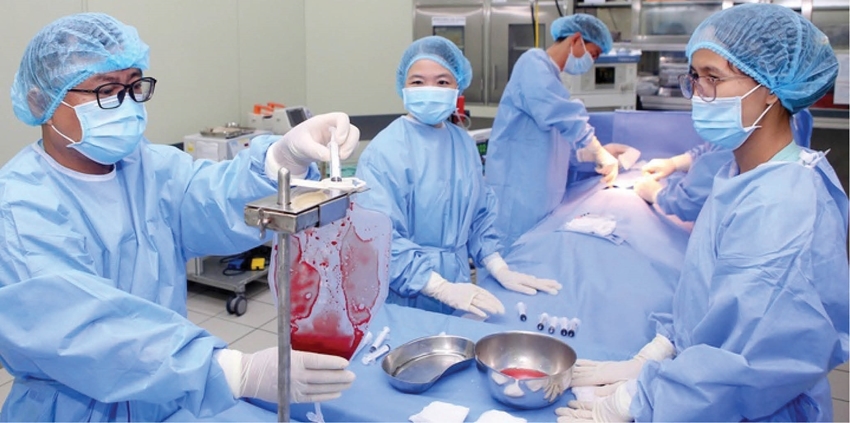 |
| The bone marrow transplant technique at Hue Central Hospital has given new life to children suffering from serious illnesses |
Hematopoietic stem cell transplantation - the key that unlocks life
Thalassemia is a hereditary hematologic disorder in which the body cannot produce enough normal hemoglobin to sustain life. Children with the severe form of the disease must undergo lifelong regular blood transfusions. Each year, Vietnam records about 2,000–2,500 new cases. Blood transfusions and iron chelation therapy can only sustain life but cannot cure the disease. As patients grow older, iron overload causes complications in the heart, liver, kidneys, and endocrine organs, making it difficult for many to live beyond the age of 25 without medical intervention.
Hematopoietic stem cell transplantation (bone marrow transplantation) is a procedure in which stem cells are collected from a donor (bone marrow, peripheral blood, or umbilical cord blood) and infused into the patient after the diseased marrow has been destroyed through chemotherapy and/or radiation therapy. Once the new stem cells “engraft” and begin to grow, they produce healthy red blood cells to replace the defective ones, freeing the patient from lifelong dependence on blood transfusions.
The greatest challenge in bone marrow transplantation is finding a donor with compatible HLA (human leukocyte antigens). Typically, the compatibility rate among siblings is only about 20%, while the rate with parents is below 5%. To address this, Hue Central Hospital has implemented transplants using stem cells from parents—and even from donors with blood type incompatibility - by applying advanced immune tolerance techniques. Many of these transplants have been successful, expanding opportunities for children who previously had very limited treatment options.
Professor Pham Nhu Hiep, Director of Hue Central Hospital, affirmed: “Success in hematopoietic stem cell transplantation not only brings new life to patients but also demonstrates that Vietnam’s medical capabilities are on par with international standards.”
Since 2019, Hue Central Hospital has performed more than 61 hematopoietic stem cell transplants for children, including 11 allogeneic transplants for patients with congenital hemolytic anemia (Thalassemia). All have recovered and are no longer dependent on blood transfusions. Each successful transplant is a “medical miracle,” rekindling hope for families and the community.
To meet the growing demand, the hospital has expanded its transplant facilities, now capable of performing procedures for four pediatric patients simultaneously. In the future, haploidentical (half-matched) HLA transplantation will also be introduced, giving more children with Thalassemia the chance to live healthy lives - even when a fully compatible donor cannot be found.
Not limited to Thalassemia, hematopoietic stem cell transplantation also offers promising treatment prospects for other conditions such as aplastic anemia, congenital immunodeficiency, leukemia, and relapsed lymphoma. This stands as clear evidence of the remarkable advancements in Vietnamese medicine.
Simple happiness
In the hospital courtyard, little Bui Thuy D. cheerfully runs and plays, her cheeks glowing rosy under the sunlight. Watching her child laugh and play, the girl’s mother is moved to tears: “All we wish for is that our daughter can live a healthy life - go to school, sing, and play like other children. That is our greatest happiness.”
The joy of families like Mr. Quan’s, Mrs. Quynh’s, and Mrs. Hop’s is not just their personal story. It stands as a testament to the power of science and medical ethics - a message of faith and hope: that children with Thalassemia can indeed live normal lives. And along this journey of nurturing life, Hue Central Hospital continues to “open the door to the future,” bringing smiles, joy, and happiness to thousands of families across the country.
Dr. Nguyen Thi Kim Hoa, PhD, Deputy Head of the Pediatric Oncology - Hematology - Bone Marrow Transplant Department at Hue Central Hospital, recalled: “There was a child who went into septic shock, with a very high risk of death. But thanks to the perseverance of our medical team and modern medicine, many pediatric patients were saved and grew up to be healthy, normal children. Seeing the smiles of the parents as they held their children tightly in their arms, our joy was multiplied many times over.”
Not only do the doctors treat the illness, but they also become friends to the young patients. They sing together and play games in the transplant room to help the children feel less stressed and painful. This closeness reassures the parents and gives the children extra strength to overcome the suffering caused by their illness.
Ms. Watanabe, Chairperson of the Asian Child Care Federation (ACCL), said: “Not only do these successes bring hope of survival to children with congenital hemolytic anemia, but they also open up significant prospects for treating other conditions such as bone marrow failure, congenital immunodeficiency, and recurrent cancers requiring allogeneic bone marrow transplantation. In the future, I hope that Hue Central Hospital will continue to develop and improve its technical infrastructure, with the goal of providing life-saving opportunities to more children across the country suffering from these conditions.