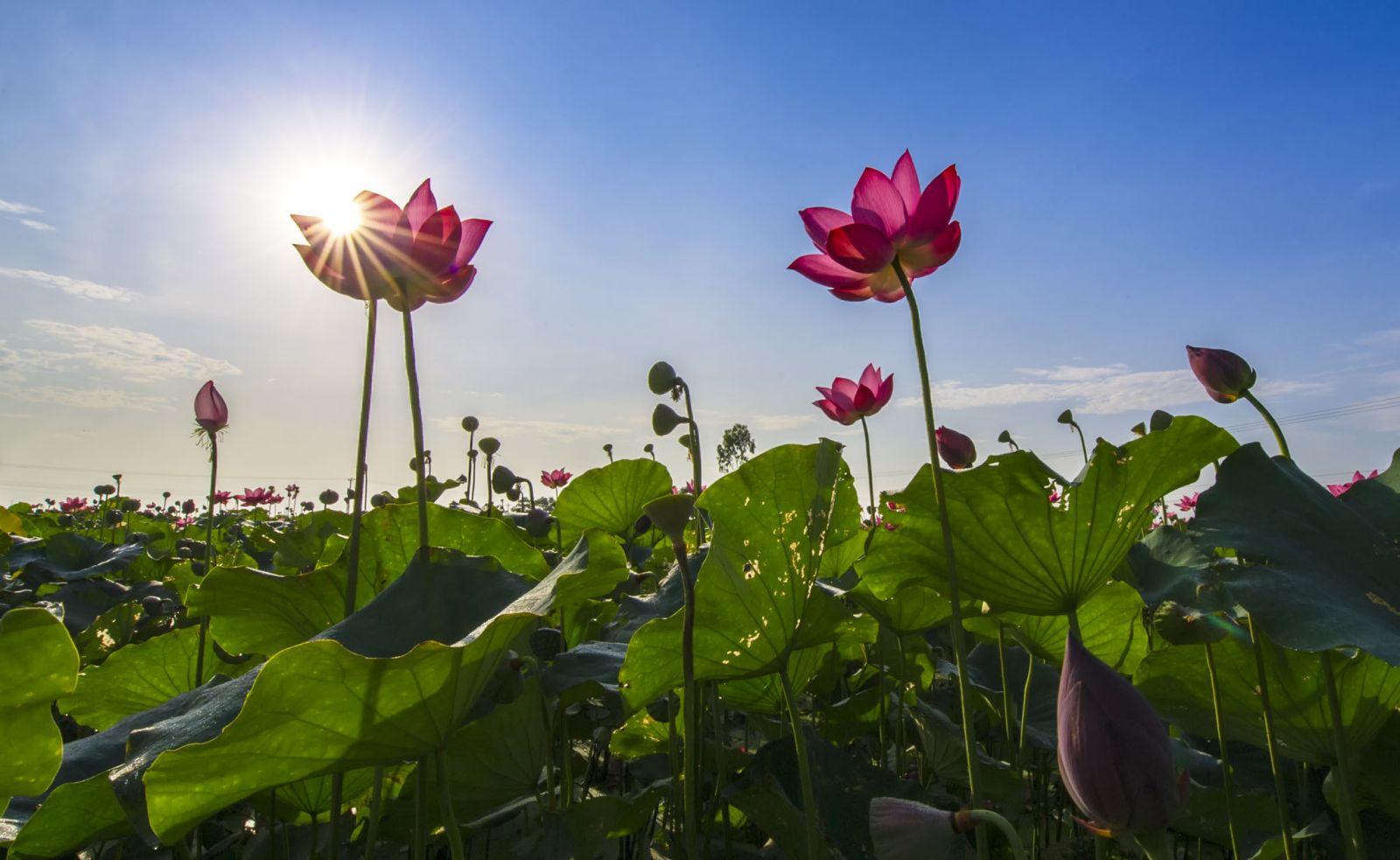
Lotus season in Hue. Photo: Le Huy Hoang Hai
I can remember there used to be only one lotus pond right in front of the village. The pond was build to add in more beauty to the scenery of the temple. When the lotus blossom season comes, the flowers are picked to offer to Buddha on the first or fifteenth lunar day. I do not know when the pagoda was built . The species of plants and fruit trees and flowers are much the same as those in other pagodas in Hue.
In the 80s, as the country’s economy was tough, fewer and fewer people went to the pagoda. The children and even the adults of the village went to the pond digging up the roots. Within a few days, the lotus pond which had existed for several decades before was gone. .. And then even the fig and the flamboyant trees got withered because there was no one to take care of them.
The pink color of the lotuses are no longer seen in the pond so now on Buddha’s birthday, the village’s natives now living in Hue are asked to help send lotuses to the village to offer them to Buddha. Bunches of lotuses arrive the afternoon boats in time for them to give off fragrance in front of the statues of Buddhas. The fragrance blends itself with the scent of the hays and the chants of the villagers. All these are my reminiscences about the peaceful Buddha's birthdays in the old pagoda of my village..
2. A girl friend of mine, born and grew up in Gia Hoi Ancient Town, told me her own story : “ As we still remember, in the old time when advanced machinery and high technology were not yet available, the job of making dried lotus seeds still could feed up so many families. My home is in Gia Hoi Quarter , and my family has produced dried lotus seeds for 3 generations; so now, as a member of a new generation, I also ought to have joined in making dried lotus seeds when I was only a couple years old.
When I finished second grade, my grandmother taught me how to make dried lotus seeds. Her source of lotus seeds later failed to supply enough seeds for her own business, and she had no choice but worked as satellite dried lotus maker for Old Mrs. Vinh in Dap Da (Stone Dam).
Technically, lotus seeds are firstly put in and dried up until they get brownish by burning coals in a trét ( an big earthenware pot) put at the bottom a standing curved bamboo sheet (Black lotus shells can be used as coal instead). Occasionally, the lotus seeds ought to be turned by picking up the basket and shaking it hard in a up and down or round direction. The seeds are then left to dry until they get crispy, but not burn. The shells of the seeds are then peeled off on a block of hard wood called ‘cục kê’ with a knife .
After black shells are peeled off, the nuts inside turn brown. These nuts are dried again, (this time more quickly and with more care to avoid making them get burnt, which make it impossible for them to be strung together ). They are later soaked in water and left in one to three minutes. The brown skin is then peeled off, usually with a small sharp knife called ‘dao díp’, which elderly country women often use to peel or cut areca nuts. Each cut on the lotus seeds leaves a mark looking like a lotus petal...
My friend went on: “ I was among the ones of the family that could peel lotus seeds with a fast and regular rhythm so as to make the inside of the seeds look nice and to avoid much waste of it. Old Mrs. Vinh loved the lotus seeds we processed for her as they were clean, heavy and had a nice look. Whenever we finished a batch, my mother asked me to bring the processed seeds to Old Mrs. Vinh; and there then would appear on the street leading from Gia Hoi Bridge to Dap Da Wharf near Dong Ba Market a little girl of about 9 or 10 years of age with a bag of 5-7 kilos of lotus seeds on her hip like a peddler carrying ‘bánh lọc’ cakes in a round plastic container. She had to quicken her steps as she used to feel tired at the hip due to the heaviness of the seeds. It would be fine if I arrived in time for the ferry boat; if late, I had to wait for it till I got blue in the face.
I cannot remember how much the boat ride was by that time as it was a very long time ago. The only thing I do not forget is that the boat riders did not charge me sometimes as I was their permanent customer, and especially because I was a very little girl.
Hue is now in lotus season, and I am a married woman already. My present home is on Phuong Bay Street, right in front of some ponds in the Citadel. Whenever I look out I see the blooming lotuses , which raise in me so deep a reminiscence of my childhood.
By Phi Tan