1. In October 1997, while studying in Japan, I participated in an international fair organized by Matsue City on the occasion of the annual Sport Day. The fair took place at the City Hall square with many booths from France, Brazil, USA, China, Korea, the Philippines, Thailand, Vietnam, etc.
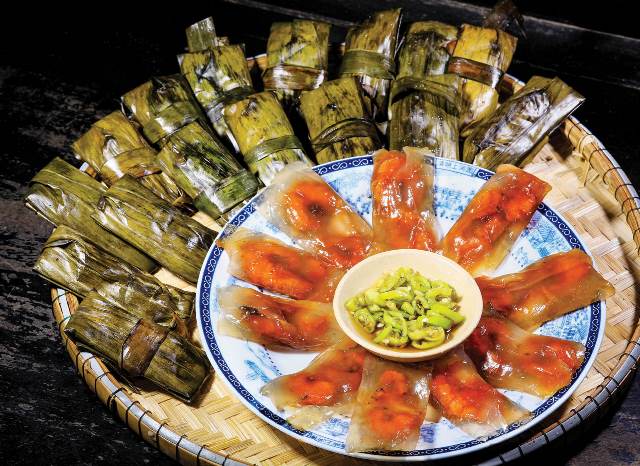
There were only four Vietnamese people in Matsue at that time, and together we ran a stall selling Northern fried spring rolls and banh bot loc Hue (steamed refined manioc flour dumpling).
We invited Kageyama and Machiko to join us and be in charge of “advertising and marketing.” Most of the ingredients could be purchased in Matsue, but rice paper and refined manioc flour must be ordered from Vietnam.
We formed two groups. Kim Nhung (from Hanoi) and the two Japanese friends were in charge of fried spring rolls, named Betonamu harumaki (Vietnamese spring rolls). My Phung (from Saigon), Dang Quang (from An Giang,) and I were in charge of banh bot loc.
I looked up in the dictionary for the Japanese words for banh bot loc to enter the menu, but I could not find any. Eventually we named it ebimaki. In Japanese, “ebi” means “shrimp” and “maki” means "roll, wrap.”
Calling banh bot loc ebimaki is not very accurate because besides shrimp, there are also pork and wood ear in the filling. But it would be too long a name to include all the ingredients.
The fair started at 9:30 a.m. on October 10, but by 11:30 a.m., all of our 1,000 spring rolls and 500 banh bot loc had been sold out. Diners waited in the 3 lines in front of the two frying pans and the pot of boiling water to buy fried spring rolls and banh bot loc.
We had to quickly stir, stir-fry, make sauces while keeping saying sorry for making people wait so long. Although the profit from selling spring rolls and banh bot loc was not much, it was an interesting business experience and a chance for us to practice making spring rolls and banh bot loc.
I learned how to make banh bot loc from my grandmother when I lived with her as a child. My grandmother was a “top-notch” cook. She made lots of dishes for New Year’s Days and death anniversaries. Among her dishes was banh bot loc.
2. Banh bot loc is a popular dish in Central Vietnam. Banh bot loc with the filling made from shrimp and pork wrapped in banana leaves can be found everywhere from Quang Binh to Binh Dinh.
Banh bot loc can serve as a main course or as a snack. It is also suitable for picnics because it is easy to make, carry along, and arrange when eating. But only in Hue does banh bot loc become a specialty. Even the mention of its name makes Hue people (in and out of the city) and visitors crave.
Banh bot loc - a delicious dish of Hue
Banh bot loc are of two types, with and without wraps of banana leave. As for ingredients, there are banh bot loc with shrimp and pork, with mung bean, and vegetarian (with the filling made from mung bean or wood ear and tofu.)
3. No one knows how many banh bot loc shops in Hue and how many street venders traveling around the city selling banh bot loc for afternoon snack time. No one knows how many restaurants in Saigon, Danang, Nha Trang, Hanoi include banh bot loc in their menus. All we know is that the skillful hands of talented Hue people have turned a popular cheap dish into a special dish that appeals to people everywhere.
Today, from Hue, banh bot loc is made, then frozen and shipped to other provinces across the country, accompanied with processed fish sauce and fresh chili. After just about 15 minutes of steaming frozen banh bot loc, people can enjoy the famous dish of the former imperial capital.
Particularly, banh bot loc without the wrap is mainly served on the spot because it does not last long and is therefore difficult to ship.
Recalling the days when I studied in Japan, I often bought boxes of Chinese dumplings, which was similar to banh bot loc, and stored them in the fridge. Just a few minutes of steaming or frying, the dumplings were ready to eat.
At that time, I wished banh bot loc would also be ready-made and sold in supermarkets like what Chinese people did with their dumplings, so that Vietnamese people living far away from home would have chances to enjoy the specialty of Hue in a convenient manner.
About 15 years ago, during a lecture on Hue cuisine to students of Phu Xuan University in Hue, I told them the above-mentioned story and my desire about bringing banh bot loc to the world.
In 2018, in a meeting with Phu Xuan University alumni of Class One, a Hue girl student came to me and said: "Sir, I have fulfilled your wish. After my graduation, I started a business supplying ready-made food to restaurants and supermarkets. I have succeeded in making boxed banh bot loc as the Chinese do with their dumplings.”
Banh bot loc by that student sell well and many supermarkets in Thanh Hoa and Hanoi agree to sell it to those who love it but do not know how to make or have no time to make.
So my dream of "spreading the dish of my hometown” comes true by my old student. Hopefully some day banh bot loc will be sold in supermarkets in Japan, Europe, North America, etc., where there are many Vietnamese people who desperately crave the “divine” dish of Hue.
Story: TRAN HUYEN - Photos: NGUYEN PHONG