Stable against waves, water, and tides. Photo provided by the character
The lagoon homeland
Ever since he was a boy, Le Anh Tai's life has been attached to mountains, rivers and the lagoon. The most realistic images of Loc Dien's homeland with trees, rivers, mountains, and houses..., along with his passion for fine arts, were all brought into Tai’s paintings.
Choosing the University of Sciences, Hue University to fulfil his dream, Le Anh Tai became the salutatorian of the Faculty of Architecture’s entrance exam – the K39 intake. It was also from this university where Anh Tai eventually chose and bravely made one of the most difficult decisions of his life.
After 6 months of studying at the University of Sciences, Le Anh Tai decided to apply for the Ho Chi Minh City University of Architecture. The 1997-born young man says: “For me, both universities have good learning environment. However, I want to further challenge myself and create more opportunities for my experience and learning. From this decision, I was very lucky that while I was studying at Ho Chi Minh City University of Architecture, I was always receiving enthusiastic support from teachers and friends of Hue University of Sciences - the first place I sent my dream.”
Constantly burning with passion, Le Anh Tai has continuously won many awards, marking his outstanding efforts since 2016. In 2019, Le Anh Tai won the first prize in Vietnam and ranked the top 8th at the Asian Contest of Architecture Rookie’s Award. In 2020, Tai participated and ranked the Top 20 of Vietnam’s field hospital design contest.
Successes
In 2021, surpassing talented groups of students from 21 different countries such as Japan, Singapore, China, Thailand, Korea, Le Anh Tai and his colleague Vo Dong Nhu excellently won the Gold prize at the Asian Contest of Architecture Rookie’s Award 2021 (ARCASIA) with the project themed “On the floating leaves”.
“The team’s design was inspired by the story ‘Diary of a Cricket’ by the writer To Hoai. In the story, the character cricket goes everywhere with his friend on a free-standing raft boat, floating like the cultural nature of the floating market on Mekong Delta; therefore, to us, this design is not only an architectural work, it also has a bold and characteristic imprint of a land and culture and people,” shares Le Anh Tai.
Also with a rich blend of art between architecture, people and landscape, Le Anh Tai's recent architecture graduation project – “Tam Giang lagoon center for cultural activities” has appeared in the top 50 finalists for the International Graduation Projects of the prestigious award in the field of architectural design - Tamayouz Award 2022.
Not only symbolizing a land, this project is also a collection of memories and a beautiful childhood from Loc Dien, the countryside that nurtured the architect dream of Le Anh Tai as a young student.
Le Anh Tai confides: “The image of Tam Giang - Cau Hai lagoon and the peaceful and poetic beauty of Hue homeland are always the precious medicine, soothing me after stressful studying and working hours. Yet, such beautiful land of mountains and rivers not only carries a peaceful beauty, hidden deep in the vast space of mountains and water, but also is a livelihood of local fishermen who struggle with their fishing jobs and have a floating life on the lagoon to chase the fishes.”
“Therefore, I aspire to contribute and bring my efforts to my homeland to create a project that connects people with people, people with nature as much as possible, with an absolute respect for the nature. That is the origin and birth for the ‘Tam Giang lagoon center for cultural activities’,” says the young architect.
Dream comes true
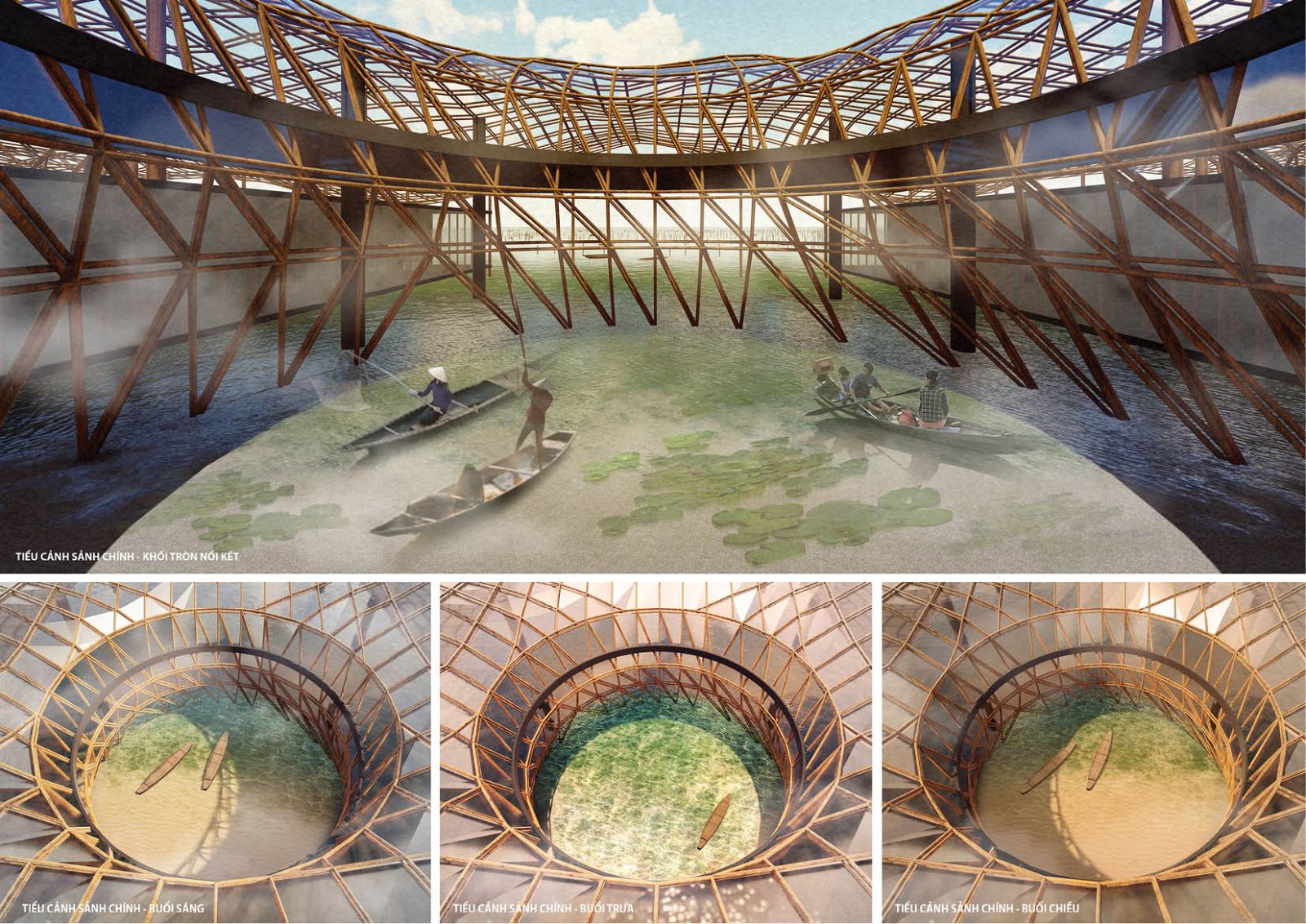
The project designed by Le Anh Tai includes exhibition spaces for the Tam Giang lagoon ecosystem combined with an educational space to help local people and tourists understand how to protect the nature. The main building blocks are arranged along the existing terrain axis, which makes them a part of the nature.
As for the bearing structure, the “Tam Giang lagoon Center for cultural activities” is surrounded by a large mesh roof to ensure that the small blocks below are protected against extreme weather patterns in Hue.
“In addition, this grid system is interwoven with eucalyptus wood bars (a local indigenous material), inspired by the traditional bamboo and rattan. This ensures that local people can easily repair damaged parts after each storm,” analyzes Le Anh Tai.
The most unique feature of this project is that the floor plates are alternately arranged with reminiscences about the inherent floating market scene of lagoon fishermen. Several floors are designed with different heights, allowing water to reach the building naturally during high tide. From there, fishermen can easily access the structure through the water. This helps to blur the boundary between a large public building and local people.
Not only successfully ranked in the Top 50 and considered by the organizers of the Tamayouz Award 2022, Le Anh Tai graduated as a valedictorian with the architectural graduation plan of “Tam Giang lagoon Center for cultural activities, and became a visiting lecturer at Ho Chi Minh City University of Architecture.
“I am very happy because I am trusted and given the opportunity to spread the fire of my profession to future generations of architects. In the future, I will continue my hard work, look for more opportunities to study and improve my knowledge so that I can devote myself to my passion for architecture.”
By MAI HUE