 |
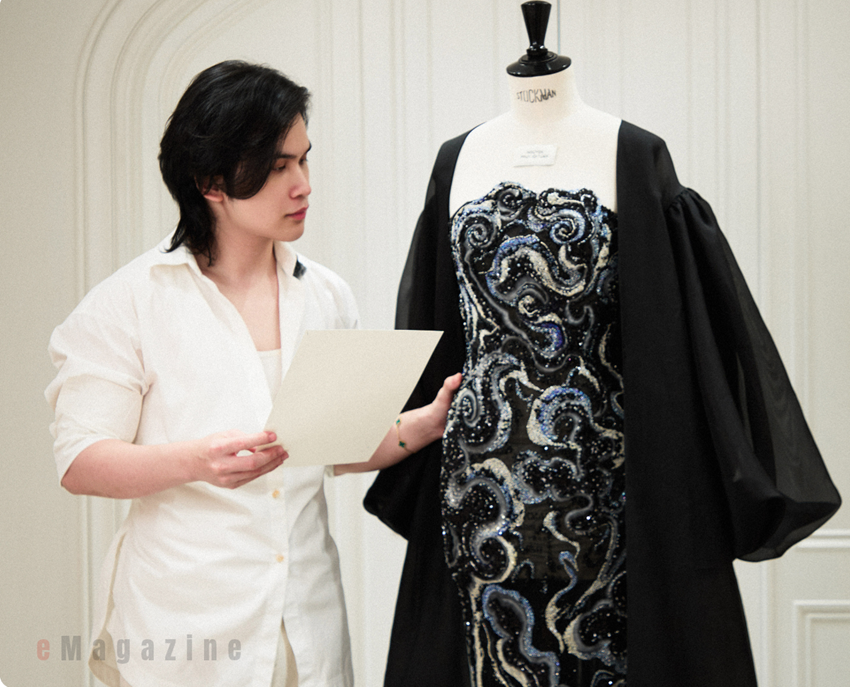
| Hue and its characteristic rain inspired the collection ‘The Dance of the Ancient Capital’ |
Where did ‘The Dance of the Imperial Capital’ begin? When developing the concept, what story did you want to tell about the place you call home?
For me, the story began with a black raincoat. When I was young, my mother often took me on her bicycle. On rainy days in Hue, she would wrap me in a raincoat and have me sit behind her. I would lower my head and look at the road, watching raindrops fall and hoa tro blossoms scatter beneath the bicycle wheels. Outside, it was raining; inside the raincoat was a warm, sheltered darkness.
I had been nurturing this idea for nearly two years. The rain in Hue does more than bring back childhood memories; it also feels like a way of washing away the pressures of everyday life. Whenever I return to Hue and stand in the rain, I feel a sense of relief. Through those memories, I wanted to tell the story of an everyday Hue: a child sitting on the back of a bicycle, old tiled roofs, and a long rainy season. I named the collection ‘Numéro 6: The Dance of the Ancient Capital’.
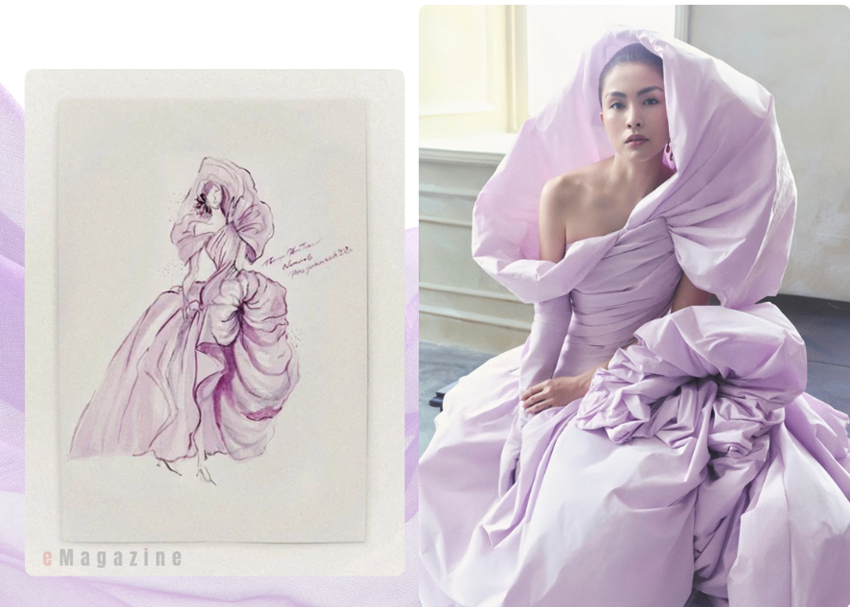 |
| Watercolor sketches by Nguyen Phuc Tuan, inspired by the raincoats his mother wore in his childhood memories of Hue |
How did you incorporate that image into your designs?
The entire collection uses Bao Loc silk, including organza, taffeta, and silk velvet. The embellishments are all handcrafted. Crystal strands that sway with the models' movements evoke falling rain, while organza strips along the hems of the skirts create the impression of rain being blown sideways by the wind.
The colors follow the changing weather in Hue. The collection opens with white and black, then moves into deeper shades of black and midnight blue as the rain intensifies. When the rain begins to ease, shades of gray, gold, blush pink, and misty blue appear, suggesting sunlight returning to the Huong River. The finale features pastel purple and daffodil flowers.
My architectural training helps me work out the structure of the garments, particularly dresses with voluminous shapes, oversized bows on the shoulders, or long trains. I have to calculate every detail to ensure that the garments retain their intended forms while still moving naturally.
The design inspired by my mother's raincoat made me think the most deeply. It features an oversized hood, a voluminous skirt resembling a raincoat billowing in the wind, crystal droplets representing raindrops, and handcrafted hoa tro blossoms. It was the most challenging design conceptually because I wanted to translate an intimate personal memory into the shape of a garment, allowing viewers to experience it in their own way.
The show took place on the evening of September 30th, Paris time, at the Maison de l'Amérique Latine. Initially, I planned to present 20 out of the 25 designs. However, just before the show, I decided to put the entire collection on the runway. In the end, 31 designs were presented. I felt that as I had brought Hue's story all the way to Paris, I should tell it in its entirety.
When the opening white ao-dai appeared, I remembered the ao-dai shows by Ms. Minh Hanh, a designer, in Hue. As a child, whenever I heard she was holding a show, I would do everything I could to attend. On one occasion, I even got to be a model, walking behind the others while carrying a flower basket. That memory has stayed with me, and it was also where my love for the ao-dai began.
When the raincoat-inspired design appeared, I stood backstage thinking of my mother. At the moment I held the hand of the model wearing the wedding dress as she stepped out to greet the audience, I could barely hear anything around me. Only when the applause began did I realize that I was actually standing in Paris.
I chose Paris because Hue and the French capital share longstanding cultural and architectural connections. The ‘Merci Paris’ design is my way of expressing gratitude for that cultural dialogue. Starting with inspiration from the traditional Vietnamese ao yem (a traditional bodice), I developed it into an evening gown, combining architectural imagery from both Paris and Hue through crystal and sequin embellishments. The handcrafted embellishment work alone took approximately two months.
I hope international audiences will see a living, breathing Hue, with people and stories that continue to unfold in the present. Viewers in Paris may never have heard of the Huong River. But if they recognize something of their own emotions in the collection and become curious to learn more about Hue, I believe the story will have traveled far beyond the boundaries of a fashion show.
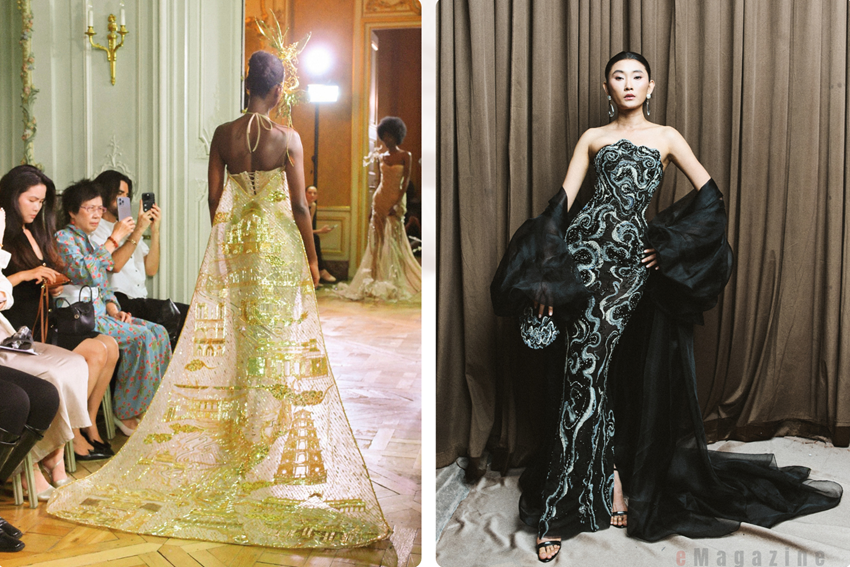 |
| The design combines architectural imagery from Hue and Paris through crystal and sequin embellishments |
Which reactions to the show have stayed with you the most? Did any of them make you reconsider how to tell Hue's story through fashion?
The response I remember most was to the design inspired by my mother's raincoat. After the show, I told a guest about my childhood memory of sitting behind my mother in the rain, watching raindrops and hoa tro blossoms on the road. The guest was surprised and then decided to buy the design. I was deeply moved that such a personal memory from a child growing up in Hue could touch someone living halfway around the world.
Feedback about wearability also gave me a great deal to think about. Some designs are highly conceptual, with exaggerated silhouettes suited to the runway or special occasions. I understand that I need to strike a better balance between creative ideas and the needs of the people who wear my clothes, developing more designs that fit naturally into everyday life.
I remember the advice Vu Viet Ha, a senior colleague in the fashion industry, gave me before I left: “Create your collection with love. Don't borrow someone else's story about a place; let the audience experience it for themselves”. I want every detail on a garment to have a reason for being there. Sometimes, a single image placed in the right position is enough to open up a story. Too many symbols can make it difficult for viewers to grasp what truly matters.
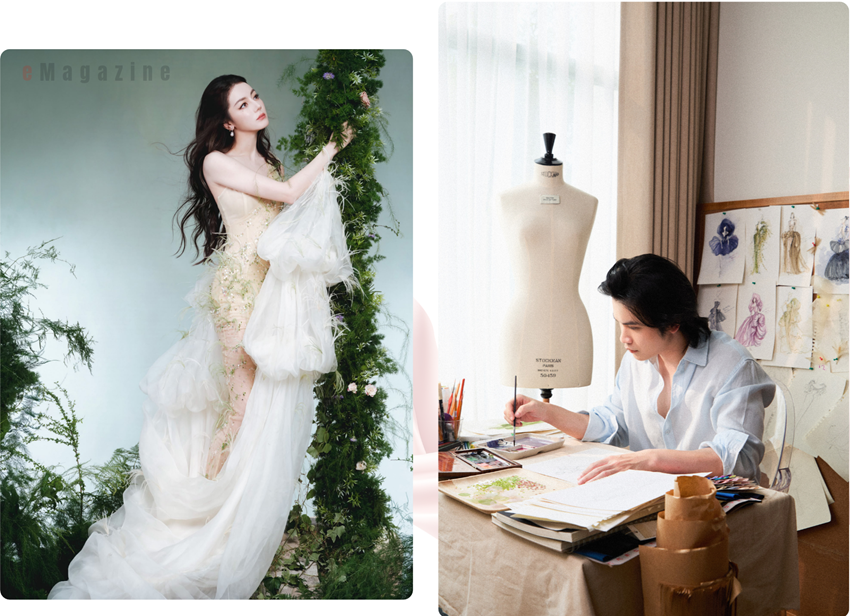 |
| Nguyen Phuc Tuan will continue exploring Hue's cultural heritage through his fashion creations |
What are your plans after ‘Dance of the Ancient Capital’?
I will continue telling stories about Hue.
I believe this city has many layers of culture that remain to be explored. The Complex of Hue Monuments was recognized by UNESCO as a World Cultural Heritage Site in 1993, while Hue Royal Court Music was inscribed by UNESCO in 2003. These cultural treasures offer many perspectives and sources of inspiration for creative work.
With Dance of the Ancient Capital, I told the story of rain. Future collections may explore other aspects of Hue, depending on my own experiences and the life I have lived. I also want to develop a distinctive visual language for my brand. Daffodils are flowers I particularly love, and I incorporated them into the finale of the Paris show. I hope details like these will become recognizable signatures, allowing audiences to identify the spirit of my designs.
In the coming years, I want to pursue two directions: concept-driven collections that express the brand's creative voice, and more practical designs suited to a wider range of occasions.
Paris Fashion Week was an important milestone, but it has also set new expectations for a young brand. I want to continue refining my creative identity, gaining a better understanding of the market and the people who choose to wear my designs.
After all, the first thing I want to do when I return is still to see my mother in Hue. The farther I travel, the more I realize how deeply I belong to that place. The rain I brought to Paris has now returned to Vietnam with the collection. If a light shower were to fall on the tiled roof of the house where I grew up, I think that would be a truly beautiful ending to this chapter of the story.
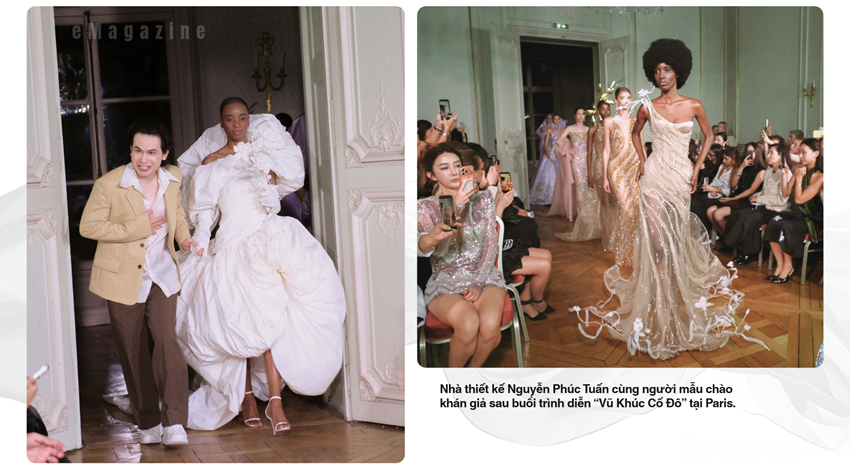 |
| Fashion designer Nguyen Phuc Tuan and the models greet the audience after the ‘Dance of the Ancient Capital’ show in Paris |
Thank you for sharing your story with us!