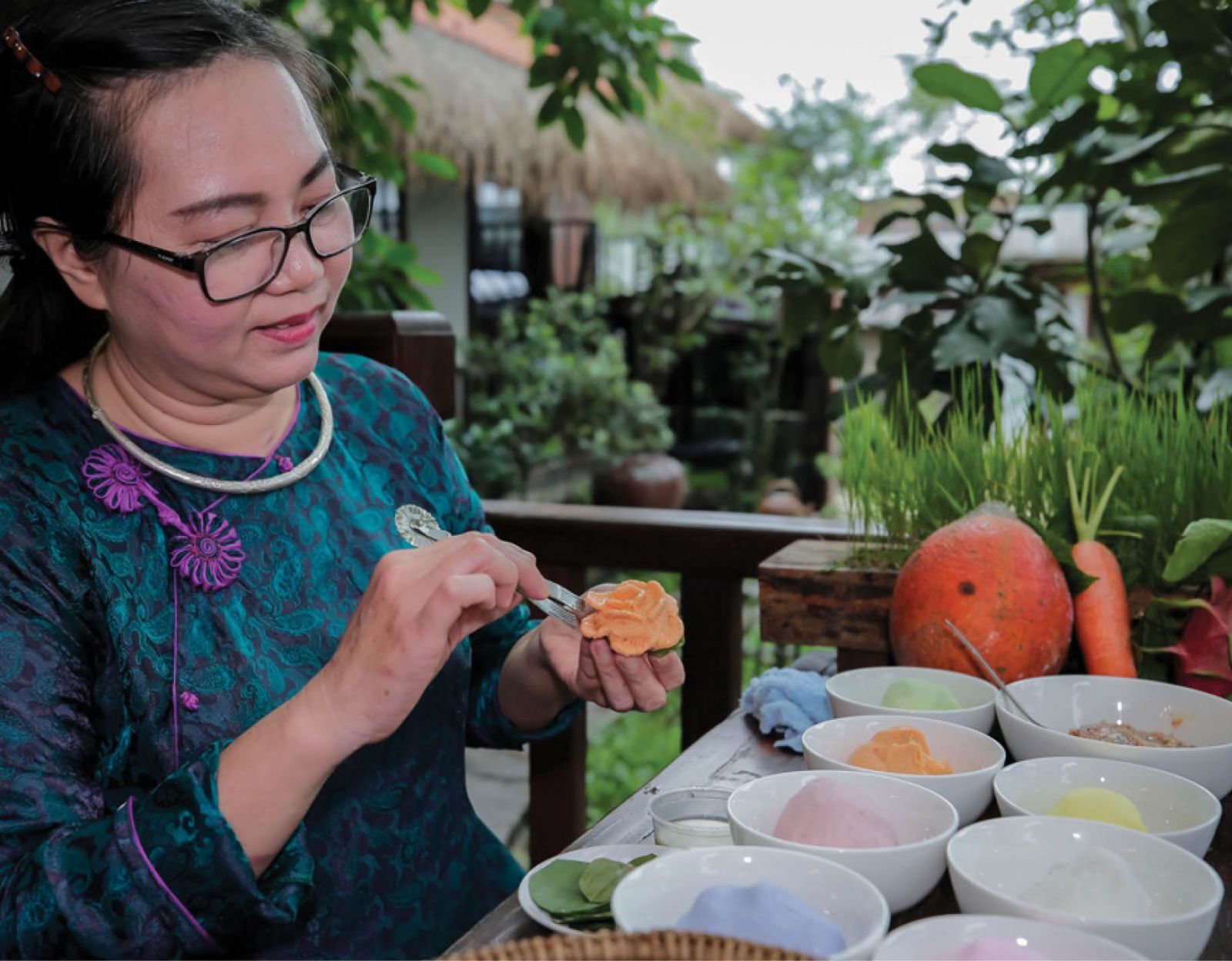
Carefully shaping the petals
Being the descendants of a Nguyen Dynasty minister and a well-known female owner of Hue specialties then, Huong and her sisters learned to make different intricate foods and sweets.
“The rose dumpling is a popular Hue royal dish in the old days. It was used in important events such as year-end and Lunar New Year Eve worshipping rituals and engagement and wedding ceremonies,” said Huong while putting on the table the ingredients such as magenta plant leaves, blue pea flowers, dragon fruits, carrots, spinach and baby jackfruits.
“The magenta plant leaves are used for purple, carrots for yellow, baby jackfruits for orange, spinach for green, dragon fruits for pink and blue pea flowers for blue. Producing colors for the dumplings is most laborious and time-consuming. It requires minute care for good shaping as desired,” she explained with her soft voice when she realized I was staring at the blue pea flowers and magenta plant leaves on the kitchen table.
.jpg)
Each flower-shaped dumpling is an artwork
To have the ingredients for colors and for the dumplings, Huong went to the market very early to select the best vegetables. She also picked the blue pea flowers and magenta plant leaves on her own. The main ingredient for the dough wrap of a dumpling is rice flour.
But Huong said rice flour was not enough to make good rose dumplings. It is essential to add some tapioca starch and glutinous rice flour. The amount of these ingredients must be accurate to make the dough sticky. It is very hard to shape the dumpling if the dough is too dry or too limp.
The flavor of rose dumplings is in both the dough and the pie. The pie is made from meat, shrimps or pounded shrimp. In order to have tasty pie, the meat and the shrimps must be fresh.
The peeled shrimps must be pounded (not minced) until it gets sticky, and it is mixed with many other ingredients and colors such as meat, onion leaves, purple onions, fungus and carrots which are all finely chopped. Before the pie is wrapped, the mixture is fried, which produces very nice flavor all around the kitchen.
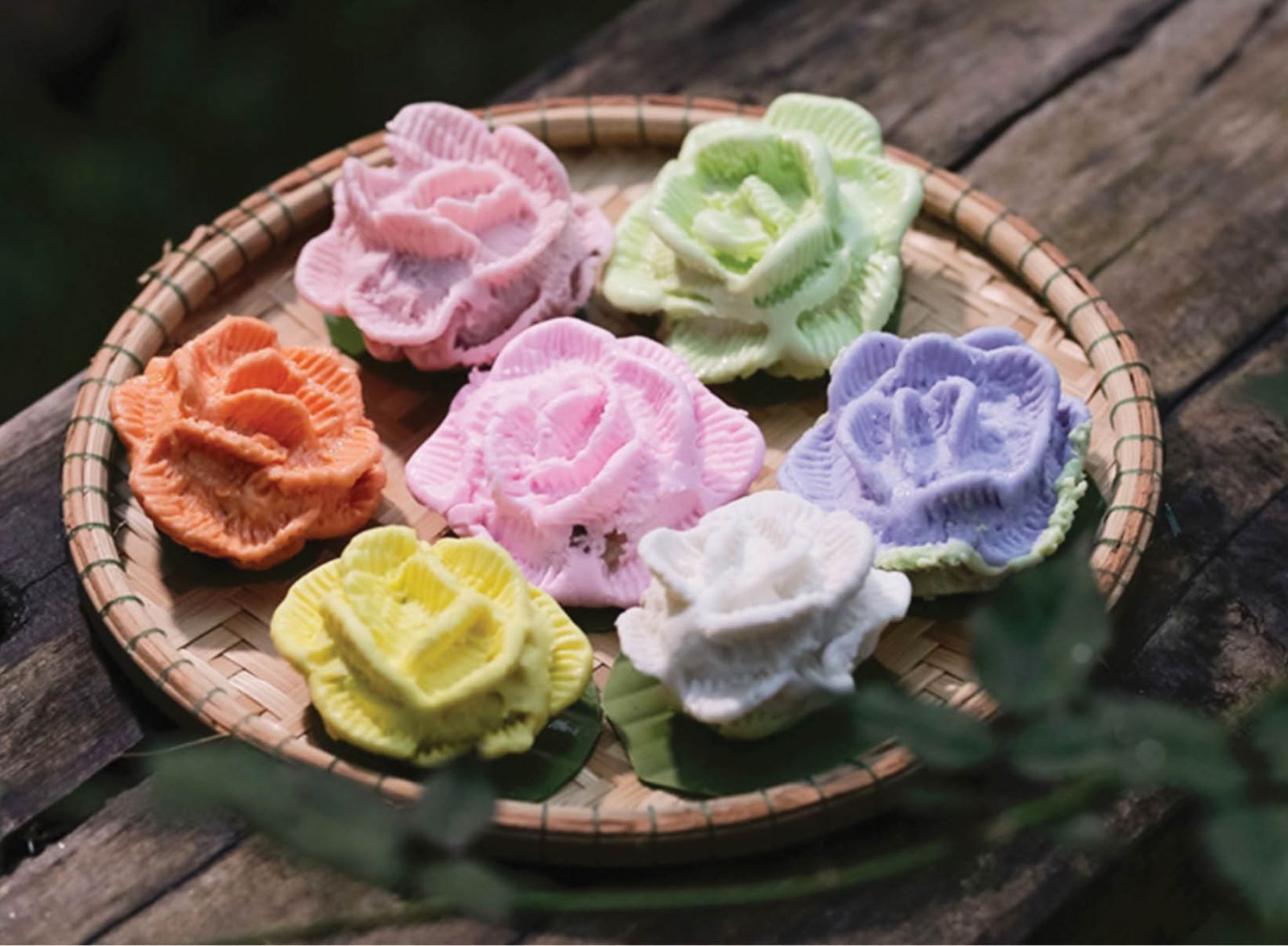
Beautiful roses have been shaped
Making rose dumplings is not as simple as we think. It takes about two hours to prepare the ingredients and shape the roses. This implies how intricate Hue cuisine is. I spent the afternoon observe Huong carefully completing each phase of the dumpling-making process. I realized the dedication of a typical Hue woman to the dish she makes.
“There is a tip to make the dumpling delicious whether it is served hot or cool, and avoid it getting hard. “Before mixing with glutinous rice flour, it is necessary to add two spoons of oil to the mixture of rice flour and tapioca starch and boil the mixture while stirring regularly until it gets thick,” Huong said while stirring the mixture on the oven.
The most exciting to me was the dumpling shaping. Huong showed me how to divide the dough into pieces of a lime size, then flatten the piece, make it slightly sunken to put pie in, and zip the edges together.
After that, Huong used a tool to shape the rose petals, pressed in to form a pistil and zipped four symmetric petals together into asymmetric layers. When all layers are done, there appeared a rose that really excited me. With her skillful hands, Huong soon made beautiful roses of many colors.
After being steamed for 5-10 minutes, the wrap of the rose dumplings got transparent. The dumplings taste and look good if the wrap is thin enough to cover the pie like this,” Huong pointed to the steaming hot “roses” on the brown wooden table.
In the green space of the garden and the winter rain, the steaming hot rose dumplings made a corner of the corridor warm. I felt hungry but I hesitated to eat those artworks because they are shockingly beautiful.
“Rose dumplings are served with a Hue style sauce made from a mixture of fish sauce, sugar and vine or lime juice, and sometimes a few slices of green chilly. To be convenient, they are sometimes served with soy sauce with chilly or chilly sauce. They are still tasty,” Huong gently said.
I brought home some rose dumplings Huong gave me in excitement, thinking that my children would be very amazed to see the dumplings that looked like real roses.
The year-end worshipping ritual in my home was special with the presence of the rose dumplings on the tray. At last, in response to the children’s eagerness, the clock bell rang to signal the New Year Eve. My family sat around the table to enjoy the delicious rose dumplings.
My daughter chose a pink rose dumpling, whispering a wish for a lucky new year, while my son chose a blue one, smiling: “Blue is the symbol of hope, isn’t it, mommy?” I chose for myself a pink rose dumpling and wished a new year that would be as pinky as the dumpling and a year full of happiness and hope.
“... and we are welcoming the lunar new year eve, quietly waiting and listening to the beat of the spring ...” The lyric of a Vietnamese popular song “Listening to the coming spring” is heard here and there. Spring has come close to the doorstep.
Story: Ngoc Ha – Photos: Trung Phan