 |
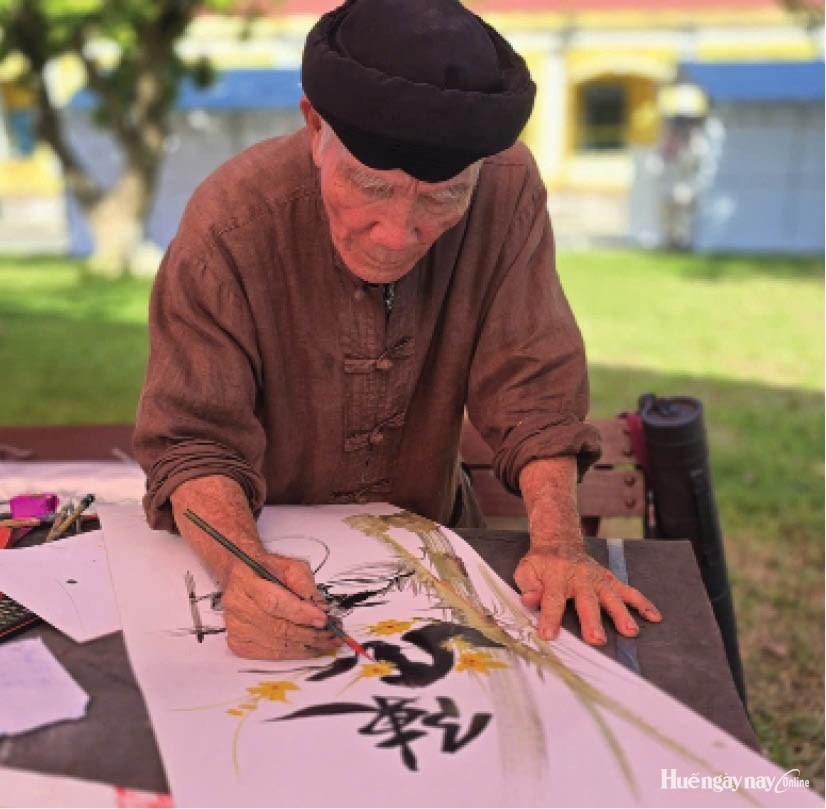
| Mr. Ho Viet Xanh carefully worked on every brushstroke of his calligraphy painting |
A love for calligraphy and painting
Amid the lush greenery of the Co Mat Vien (Privy Council) - Tam Toa relic site, Mr. Ho Viet Xanh carefully moved his brush across the paper, with strokes that were sometimes gentle and flowing, sometimes firm and decisive. At the age of 78, the hands of the artisan from Dai Loc, Quang Nam (now part of Da Nang), remain remarkably skilled after more than 60 years devoted to calligraphy and painting. Onlookers gathered around and followed every movement of his brush. Everyone waited eagerly for the piece to be finished so that they could ask him to take it home.
Mr. Xanh’s works stand out for their varied and expressive ink strokes. The green of bamboo and touches of yellow and red against white paper, together with stylized lettering, create paintings that combine both images and characters. “Coming to Hue for the calligraphy festival, I am very happy to introduce calligraphy art to everyone. Whenever I finish a painting, someone appreciates it and takes it home; that is a joy to me,” said Mr. Xanh.
Mr. Xanh’s affinity for calligraphy and painting began in childhood, when his father and grandfather taught him to read and write. In the hardship of those days, he sharpened bamboo chopsticks into brushes and practiced on banana leaves and alluvial sand, drawing everything from shrimp and fish to lotus flowers and banyan leaves. From those simple strokes in his hometown, the farmer taught himself, trained, and gradually developed his own calligraphy style, blending writing with painting.
Meanwhile, 24-year-old Pham Van Chien has already spent 15 years pursuing calligraphy. Fascinated by written characters from an early age, he studied and researched the art before opening classes in Hanoi. His students span all ages, the oldest 80 and the youngest just in third grade.
In Hue for the exhibition, Chien spent time guiding young people who wanted to try calligraphy. He watched how each person held the brush, showed them how to set the tip on the paper, and demonstrated how to shift from thin strokes to bold ones.
For Chien, learning calligraphy is not only about mastering the technique or creating beautiful handwriting. It also requires understanding the meaning of each character and conveying the writer’s emotions and inner spirit through every brushstroke. This is what he hopes to pass on to his students. “This is my first time in Hue. I hope to share the traditional cultural values that I have studied and devoted myself to over the years,” said Chien.
After trying calligraphy with a calligraphic brush, Ho Bao Ngan, from Phu Xuan Ward, was impressed by the sense of relaxation that came from focusing on each stroke. “I find calligraphy very interesting. It feels as though everything around me slowed down, making me feel more relaxed,” shared Ngan.
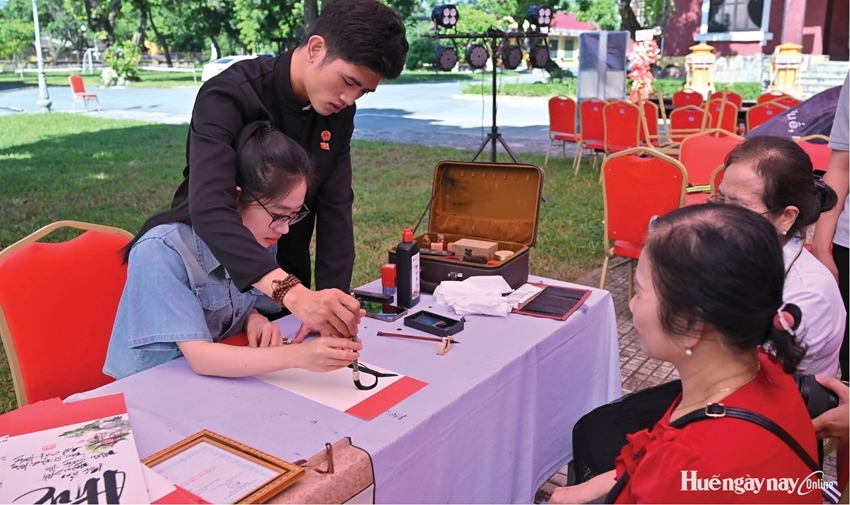 |
| People experienced writing calligraphy with calligraphic brush |
Towards regular gatherings
The first Vietnam Calligraphy Festival, themed ‘Vietnamese Soul through Brushstrokes’, was held as part of Hue Festival 2026, offering people and visitors an opportunity to explore the art of calligraphy. Through exhibitions and hands-on activities, visitors could admire the artworks, try holding a brush and grinding ink themselves, and experience how to make their very first brushstrokes.
Taking place from October 22 to 26, the festival showcased 31 selected works from more than 100 submissions, featuring the art of Han - Nom (Sino - Vietnamese Demotic characters) and Quoc Ngu (Vietnamese Scripts) calligraphy. It also provided an opportunity for artisans, researchers, and calligraphy clubs to meet and exchange experiences in the art.
From the art of Han - Nom to Quoc Ngu calligraphy, artisans used different writing systems to create their works on paper. With the Han - Nom characters, the strokes associated with the script were once widely used in official documents, poetry, literary works, parallel sentences, and various Vietnamese cultural records. The Quoc Ngu calligraphy, meanwhile, uses the familiar Latin alphabet, but artisans still pay close attention to brush movements, variations in stroke thickness, the composition and the harmony between characters. Despite their differences in writing systems, both forms require artisans to refine their techniques and carefully consider how each work is presented.
Mr. Le Ngoc Dung, Chairman of Vietnam Association of Artisans and Brands, said that Hue was chosen to host the festival because of the historical and cultural values of the Ancient Capital. The Organizing Committee hopes to work with Hue Monuments Conservation Center and relevant units to maintain the event while gradually expanding its scale and improving its quality.
According to Mr. Hoang Viet Trung, Director of Hue Monuments Conservation Center, calligraphy is closely associated with the notion that ‘one’s handwriting reflects one’s character’, embodying humanistic values related to morality, lifestyle, and national cultural traditions. The Center aims to organize the festival regularly, with a view to expanding it into a national and international event. The festival has also been included in the draft plan for Festival 2027.