 |
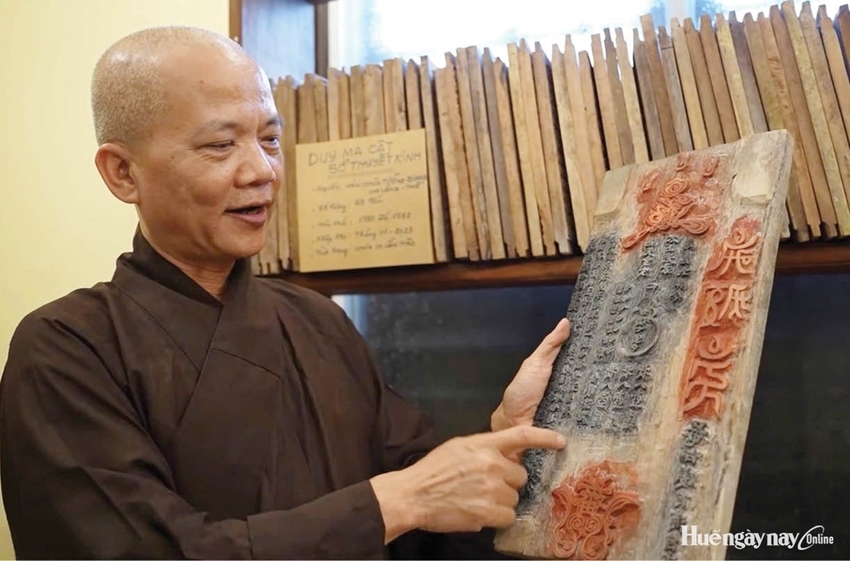
| Thị wood (Diospyros decandra) is used to carve the small characters on the wooden sutra blocks. |
Valuable historical documents
Of the approximately 60 original blocks once belonging to a collection of Diamond Sutra woodblocks dating from the 19th year of the Chinh Hoa era (1698), during the reign of Lord Nguyen Phuc Chu, only one remains today. More than three centuries have passed, yet the characters and decorative patterns are still relatively clear on both sides of the block, which contain the beginning and ending sections of the sutra.
The block is currently preserved at the Vietnam Buddhist Academy in Hue, together with more than 1,000 woodblocks collected from pagodas such as Thien Mu, Tu Hieu, Bao Lam and Tu Dam. Their contents include Buddhist sutras, monastic rules, treatises, ritual texts and illustrations used in religious ceremonies. Most are written in Chinese characters, while some documents are in the Chữ Nôm (Nom script) and Sanskrit.
To produce a printed page of scripture, artisans had to carve each character in reverse. On boards made from fine-grained thị wood, every stroke of the carving knife not only reproduced the text but also reflected the calligraphic, artistic and traditional printing techniques of the time. As a result, these woodblocks embody multiple layers of value: sources of Buddhist knowledge, Sino-Nom script heritage, historical evidence and products of creative craftsmanship.
Venerable Thich Hai An, Rector of the Vietnam Buddhist Academy in Hue, said that the decision to bring woodblocks from various pagodas to a central storage facility stemmed from the need to protect the artefacts from weather-related damage while also facilitating research and study. However, ensuring their long-term preservation still requires coordination in terms of expertise, resources and management responsibilities. Given their wooden material, Hue's hot, humid climate and heavy rainfall pose ongoing challenges. Mould, termites, warping, cracking and breakage can gradually destroy the carved inscriptions. In addition to the collection held at the Academy, woodblocks are also preserved at numerous religious establishments and in private homes. At Thai Toc Ancestral Hall, located at 120 Nguyen Phuc Nguyen Street, for example, the family is safeguarding eight particularly valuable Buddhist woodblocks.
Preserving and promoting their value
The immediate priority is to establish exactly where each artefact is located, assess its condition and determine the level of intervention required. Inventory work must go hand in hand with assessments of deterioration and guidance on appropriate storage and preservation. Woodblocks at high risk of damage should receive priority treatment, with the involvement of qualified specialists. Digitization should also be undertaken as soon as possible. Each digital record should be linked to a unique identification code and include information on dimensions, material, content, date, provenance and physical condition. The data must be sufficiently detailed to allow the inscriptions to be read, compared and studied, while also being regularly backed up and updated. Digital copies can help reduce direct handling of the originals, but the physical conservation of the wooden artefacts must continue.
Another important issue is the ability to coordinate efforts among cultural authorities, Buddhist organisations, researchers and those currently holding these heritage items. Respect for ownership rights, religious spaces and the voluntary participation will provide a foundation for information sharing and technical support. Conservation activities can take various appropriate forms, with every institution or individual holding these artefacts having access to the necessary knowledge and preservation conditions.
According to a survey conducted by the Lieu Quan Buddhist Cultural Center, a total of 2,933 carved surfaces have been documented at 13 locations. Of these, Tu Dam Pagoda has 1,319 carved surfaces, Thien Mu Pagoda has 529, Tu Hieu Pagoda has 280, and Dao Ly Phuong Vien Ancestral Hall has 314. These figures provide an initial basis for identifying the scale of this documentary heritage collection, while also highlighting the need for further reviews and standardization of the data. In particular, it is essential to clearly distinguish between the number of wooden boards, the number of carved surfaces and the number of scripture sets to avoid confusion when presenting and evaluating the collection.
Hue has identified the immediate priorities as completing surveys, inventories and research, as well as preparing a nomination dossier to propose the inclusion of Hue Buddhist woodblocks in the National Register of Documentary Heritage. This process requires scientific evidence establishing their origins, dates, authenticity and integrity, together with feasible management and conservation plans.
Mr. Nguyen Thien Binh, Deputy Director of the Hue Department of Culture, Sports and Tourism, emphasized that the nomination process must be accompanied by substantive conservation efforts. This direction needs to be translated into concrete tasks, clearly assigned responsibilities, funding arrangements and implementation schedules.