
Sunday, 05/07/2026 17:34
(GMT+7)
Paying tribute to Martial Lord Nguyen Phuc Khoat, honoring the value of the traditional Ao Dai
HNN.VN - Within the framework of the community Ao Dai Week - “Hue in Autumn” Festival 2026, on the morning of July 4, the Department of Culture and Sports, in collaboration with Hue Monuments Conservation Center, organized a ceremony to offer incense and flowers in commemoration of Martial Lord Nguyen Phuc Khoat, and holding a procession of gratitude to Martial Lord Nguyen Phuc Khoat, and Emperor Minh Mang.
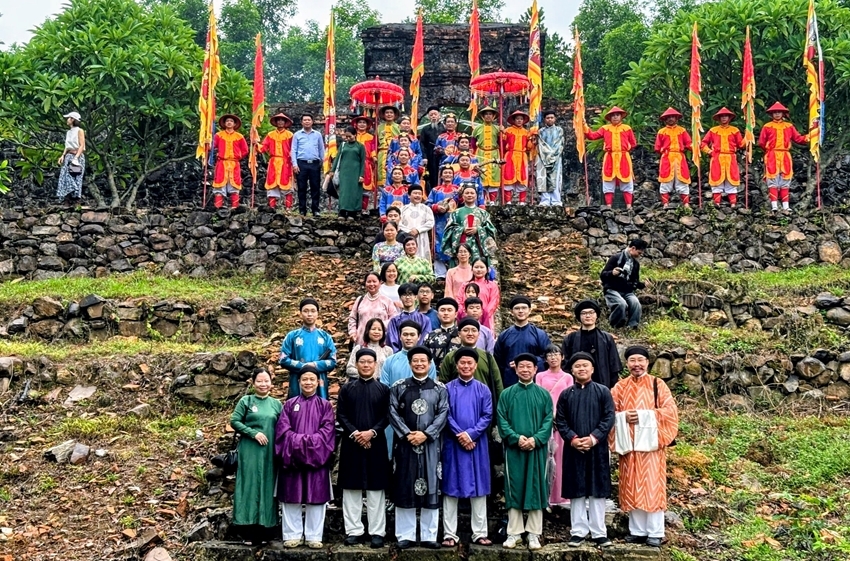 |
| Truong Thai Tomb - the resting place of Martial Lord Nguyen Phuc Khoat |
This year, July 4 coincided with the death anniversary of Martial Lord Nguyen Phuc Khoat (the 20th day of the fifth lunar month). At Truong Thai Tomb, his resting place, the delegation offered flowers and incense to pay tribute to the Lord, whose contributions helped shape the nation’s cultural identity. Following the ceremony, the delegation proceeded to Hue Imperial Palace to conduct tribute rituals at Trieu To Temple and Thai To Temple.
Martial Lord Nguyen Phuc Khoat was the 8th Nguyen Lord, who ruled the Inner Realm. In 1744, he issued a decree reforming costume that established the five-panel ao-dai as the official costume of the people in the Inner Realm. This reform is widely regarded as a significant milestone in the formation and evolution of Vietnamese traditional costume.
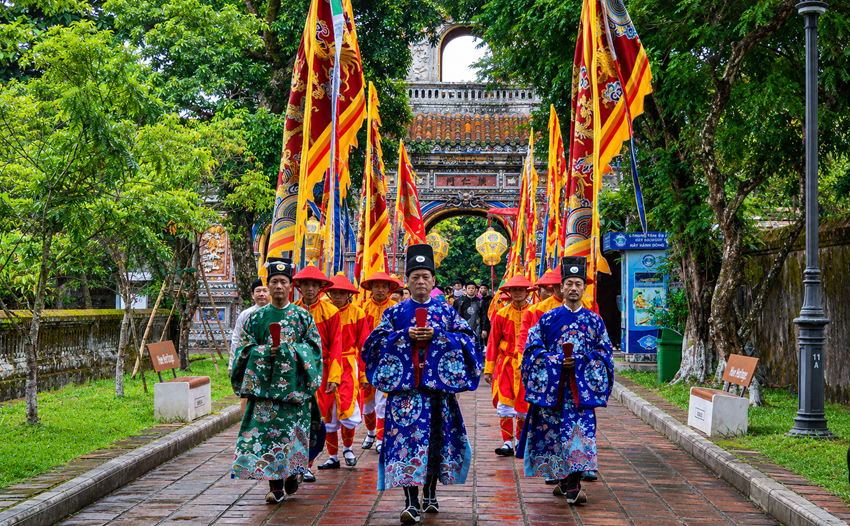 |
| The procession passed through Hien Nhon Gate |
In 1827, Emperor Minh Mang issued regulations popularizing the five-panel ao-dai throughout the society. Through centuries of historical transformation, this costume has helped shape the distinctive look of the Vietnamese Ao Dai as it is known today.
In recent years, the tribute to Martial Lord Nguyen Phuc Khoat has been held annually in Hue, gradually becoming a community cultural tradition tied to the preservation and promotion of the value of the traditional ao-dai. The occasion serves not only to honor the contributions of the ancestor but also to help spread the appreciation for the nation’s cultural heritage, particularly the five-panel ao-dai - a cultural symbol deeply intertwined with the formation and development history of the Ancient Capital.
By Lien Minh