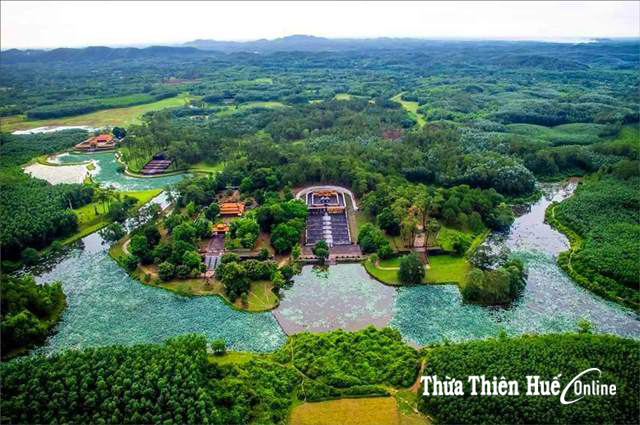
The View of King Gia Long’s Mausoleum
King Gia Long’s Mausoleum is just a shortened appellation of a complex of mausoleums belonging to the king and his relatives, the core of which are King Gia Long’s and Queen Thua Thien Cao’s. This complex of tombs stretches out over 42 small, large hills and mountains with their own names, the largest of which is Đại Thiên Thọ Mountain (Great- Longevity- Mountain), chosen as the front screen for the mausoleum and regarded to represent the entire group of mountains: Thiên Thọ Mountains (Longevity Mountains).
The whole complex of mausoleums is divided into the 3 areas. At the center lie the King Gia Long’s and Queen Thua Thien Cao’s Mausoleums. On the right are the royal temples, the most important of which is Minh Thanh Temple built for the Emperor and his first Queen’s worship. On the left is Bi Dinh (Stele House). There remains now only a large stele with the inscription “Thánh đức thần công” (The Virtue of a Saint, Merits of a Deity) erected by King Minh Mang in honour of the father king.
According to researcher Tran Duc Anh Son, Le Duy Thanh, afeng shui master (scholar Le Quy Don’s son) is the person who found the site for this complex of mausoleums. He perceived, “This is the place where all positive energy radiating from numerous surrounding hills and mountains converge, and the energy will last for ages, in 10 thousand years.
For years, partly because of difficult traffic conditions, and partly because the mausoleum was almost left unrepaired, people coming here for a visit did not have to pay any entrance fees. However, at present, after the restoratiom of various parts of Thien Tho Palace, the burial site as well as the worship section have been completed, the mausoleum is officially recognized as fit for sightseeing and entrance fees are collected in accordance with the stipulation passed by the provincial People’s Committee.
This information after being shared has caught the public attention. In fact, tourists, even a lot of local people, still find King Gia Long’s Mausoleum amazing since they are not well aware of the way leading to this historical relic, and here they still find the surrounding pristine beauty of nature almost intact.
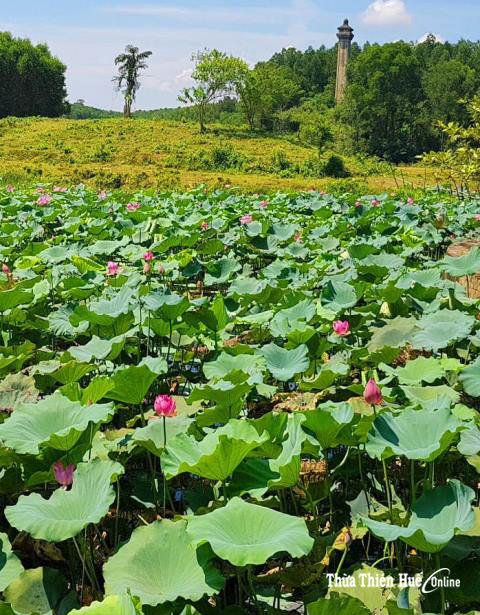
Vast lakes with lotus flowers surrounding the mausoleum
The road to King Gia Long’s Mausoleum is not as convenient as that leading to the mausoleums Minh Mang, Tu Duc, or Khai Dinh, but this mausoleum is accessible both by boats and vehicles. The road is large enough for medium-sized cars, but it is ideal for visitors to come on motorbikes.
This means affords visitors with two options: ride to King Gia Long’s Mausoleum from Huong Tho Commune (Huong Tra Town) for an easier way to King Minh Mang’s Mausoleum, or start from Thuy Bang Commune (Huong Thuy Town) to reach this tomb via King Khai Dinh ' s Mausoleum.
Riding motorbikes also offers visitors the opportunity to meander through the village lanes to enjoy the sights of some of the Nguyen Lords’ mausoleums nearby such as the mausoleums of Cơ Thanh, Truong Thai, Vinh Thai, Vinh Phong and so on.
To respond to the public favour for ecotours, an option to visit King Gia Long’s Mausoleum through ecotours has just been piloted by a group of Japanese experts (Hue Monuments Conservation Center’s partner) and received positive response from the locals. Aiming at the development of tourism to preserve and improve the environment, this tour enables tourists to blend themselves with the charming, natural scenery of the countryside at the upper part of the Perfume river.
The tour from Hue City center to King Gia Long’s Mausoleum boasts at least 8 stopovers. Furthermore, at each stopover, visitors not merely take some rest for the next leg but also listen to stories about the scenery, the villages they pass by throughout the tour. Tourists will find the route to King Gia Long's Mausoleum so charming with the sight of rice fields and indigenous inhabitants, the scenery of mountains, and the way how the people in the old times procured water and filter them for the Moon Lake.
Depending on the season, visitors will be invited to enjoy local farm produce harvested on site such as grapefruit, lotus seeds ... And last but not least, the storytellers are none other than the locals who are prestigious and knowledgeable about the indigenous traditional culture.
As was suggested more than 60 years ago by Leopold Cadierè, an expert on Vietnamese studies, editor of the magazine Des Amis du Vieux Hue, visitors should visit King Gia Long’s Mausoleum in the afternoon. It is the moment to contemplate the sunset appearing on the other side of the lake. Sparkling in the yellow sunshine are the rustling, whistling pine trees reflected on the rippling surface of the lake. Only then can visitors fully sense the grandiose and majestic beauty of this mausoleum.
However, if visitors do not come in a large group, a sunny morning is the ideal time for a visit to King Gia Long’s Mausoleum. It will enable visitors to have enough time for the different sites of the mausoleum as well as to take time enjoying the natural beauty of tranquility and grandiosity
Story: Dong Van. Photos: Hue Monuments Conservation Center