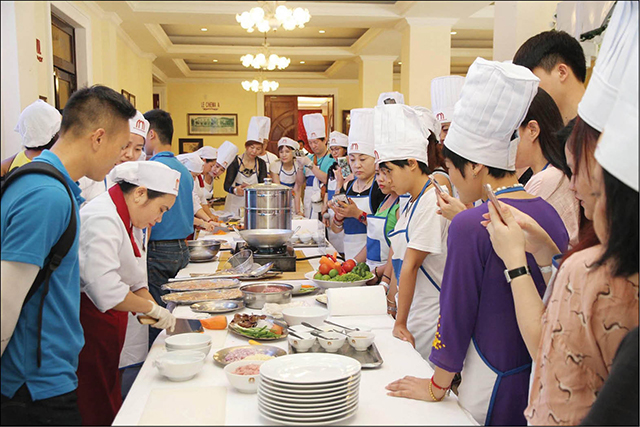
Not only enjoying the food, tourists always want to learn how to cook the local cuisine. Photo: Saigon Morin Hotel
There are no specific statistics, but in addition to visiting the scenery, most of the visitors to Hue have in their itinerary destinations related to food tourism. In Hue tours, food is an attractive invitation for visitors.
In Hue, artisans of royal descendant have established restaurants. The beauty of Hue cuisine is that it can satisfy many different types of guests.
Guests with more “sophisticated” requirements will go to restaurants and garden houses to look for old dishes. Young people who like to explore the sidewalk cuisine can look for the stalls of Beo cake (water-fern shape cake), Loc cake (tapioca dumpling), noodle soup...
For vegetarians, unique vegetarian dishes are re-created by restaurants and pagodas as royal dishes that are not only delicious but also aesthetic and safe. The cooking class is also popular with many restaurants and hotels with guests who want to experience how to cook Hue food.
A few years ago, I accompanied a family of businessmen in Vung Tau to Hue for a tour. After exploring Sinh village culture, they were very excited to be able to grind their own flour, make leaf cake and eat meals with a Hue family.
Simply with the home-cooked dishes from homegrown vegetables: spinach soup cooked with crabs, mixed figs, braised snakehead fish, stir-fried vegetables... through the skillful hands of hosts had become strangely delicious!
Ngan, a member of the tour group, said: “I have come to Hue many times and visited all the sights so this time, I just want to join the cultural exploration of the village in Hue, especially to explore Hue cuisine. The culinary arts of Hue are worth to remember”.
Following in the footsteps of Hue people, Hue royal and folk dishes came to the world. The Ancient Capital Restaurant of Prof. Dr. Thai Kim Lan in Germany has become a destination in the München city guide.
According to Prof. Dr. Thai Kim Lan, in order to succeed in the foreign land, the Ancient Capital Restaurant emphasizes the characteristics and strengths of Hue cuisine, royal court as well as rustic folk dishes. The dishes are prepared properly, not in a “mixed-up” way. We kept the old Hue cooking style.
The grilled spring rolls restaurant chain of Mrs. Luong Thi Vy on Thai soil is also a typical story about the attraction of Hue cuisine. This restaurant chain was honored by the Thai press as the most successful restaurant of Vietnamese people in Thailand when "covering" 30% of Thai territory. This dish is also included in the Royal Thai menu and is very popular with Thai princes and princesses.
In Ho Chi Minh City as well as in many other provinces and cities and even abroad, Hue traditional beef noodle stalls also appear throughout the crowded streets. They are testament to the attractiveness of Hue cuisine.
A Polish travel brochure published in 2016 introduces 97 tourist destinations of countries around the world, but for Vietnam, the book introduces the image of a royal meal.
Many foreign television studios have also come to Hue to make culinary films. For example, the film introducing pork leg bound in a rabbit shape made by the artist Ton Nu Thi Ha of NHK TV, Japan, won the first prize when attending an international culinary film festival.
Having participated in many promotional activities, introducing Hue cuisine abroad, Ton Nu Thi Ha (artisan) said, Western guests enjoyed the decoration of Hue royal dishes: “Many years ago, I cooked for a party of hundreds of employees of a French business. At the end of the party, a Frenchman asked to meet me, the one who cooked Vietnamese food. He said: When I enjoyed these dishes, I realized that the French had not understood anything about the Vietnamese cultural strength".
Minh Hien
Part 3: Menu for Hue dishes