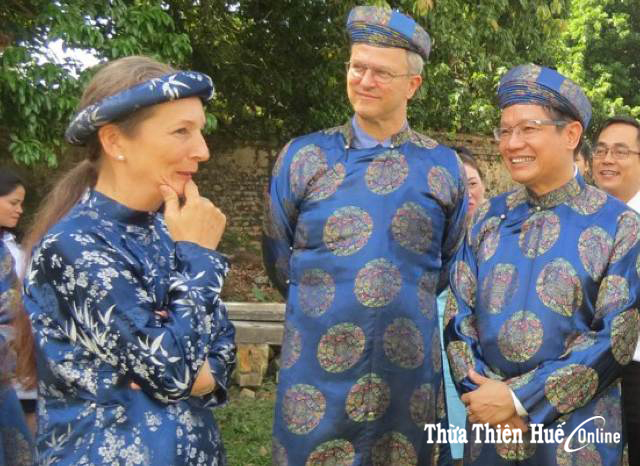
Mrs. Andrea Teufel, Ambassador Christian Berger and Dr. Phan Thanh Hai are discussing the project.
In 2017, the Ministry of Foreign Affairs of Germany, in cooperation with the German Embassy in Vietnam, continues to sponsor the project of conservation and restoration of the gate, the screen and the rockery at Phung Tien Temple, helping train experts on this field in the process. Mrs. Andrea Teufeul, a representative of the Fluda Cultural Heritage Conservation Society in Germany, is the project head. She is one of the German heritage conservationists who helped carry out the previous projects in Hue such as the restoration of Khai Tuong Pavilion at An Dinh Palace, the gate and the screen at Tu Duc Tomb, Toi Linh Tu and Ta Vu in the Imperial City.
Phung Tien Temple was built in the 10th year of Minh Mang's times (1829). It was to worship kings and queens of the Nguyen Dynasty. Being one of the five most important shrines, (the other four are Trieu Mieu, Thai Mieu, Hung Mieu and The Mieu), Phung Tien was the only place where women were allowed to come and attend ceremonies. Phung Tien Temple includes five main structures, which had been repaired many times. Unfortunately the main hall was completely destroyed in 1947. Only the foundation and supplemental structures such as the gate, the screen, the rockery tank, etc. remain, but they are in ruins.
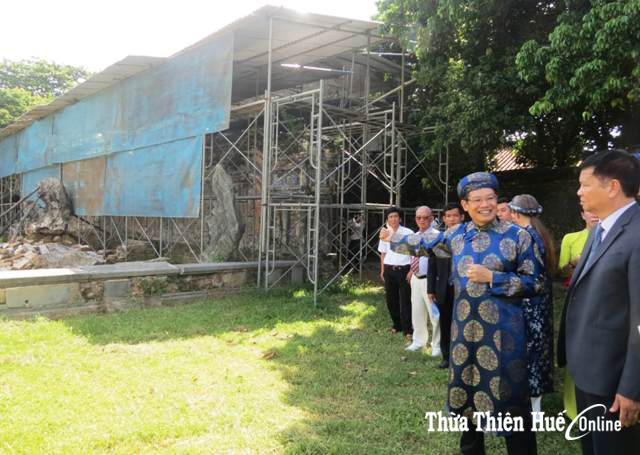
Dr. Phan Thanh Hai is introducing the construction site.
"Although the damage has not yet changed the basic structure of the construction, the potential danger is predictable. This project is therefore very necessary with a view to rescuing a unique construction in accordance with feng shui principles. Phung Tien Temple is also a typical original construction of the early days of the Nguyen Dynasty being conserved," said Dr. Phan Thanh Hai, Director of Hue Monument Conservation Center.
In 2003, after analyzing in Germany a sample taken from the original murals in An Dinh Palace, Mrs. Andrea Teufel discovered the art of mural painting there was quite similar to what she had studied in Italy. It is the fresco painting style. In order to do it, the painter must work very fast with watercolor while the plaster is still wet. With the setting of the plaster, the painting becomes an integral part of the wall. That is also the best way which European artists often do to make their paintings last. The traditional fresco technique was mainly used to decorate the surface of gates, screens and walls. In Vietnam, this technique has been completely lost and until now there has been no way to restore it.
Phung Tien Temple was selected to apply and develop the method of accurate restoration using fresco technique for architectural constructions with colored plaster. At the same time, 6 non-professional artisans in Hue will be trained and certified in the process.
"Many people think that a conservationist is like an artist, an artisan or a craftsman. In fact, it is more than that. He is just like a physician," says Andrea Teufel. "We study, analyze the materials and the symptoms carefully and determine the appropriate treatment. Phung Tien Temple is of great spiritual significance. Even though the main hall is no more, I am aware of your trust when you give me this treasure. It is a privilege and also my responsibility to try my best to fulfill this mission."
Being in Hue City on the last days of September to attend the inauguration ceremony, Mr. Christian Berger, Ambassador of the Federal Republic of Germany in Vietnam, said happily that he and his wife visited Hue for the first time in 1991 and were really fascinated with what Hue possessed. "I find it is not only the history of Hue, but also part of our responsibility. It is also a pleasure to work with you to preserve the heritage for future generations. I think the most important thing is we combine the conservation of this construction with intensive training for artisans. Not only do we need qualified bachelors and masters, but also experienced workers. Let us see this project as a glue to reinforce the relationship between the two countries," Ambassador Christian Berger emphasized.
Story and photos: DONG VAN