 |
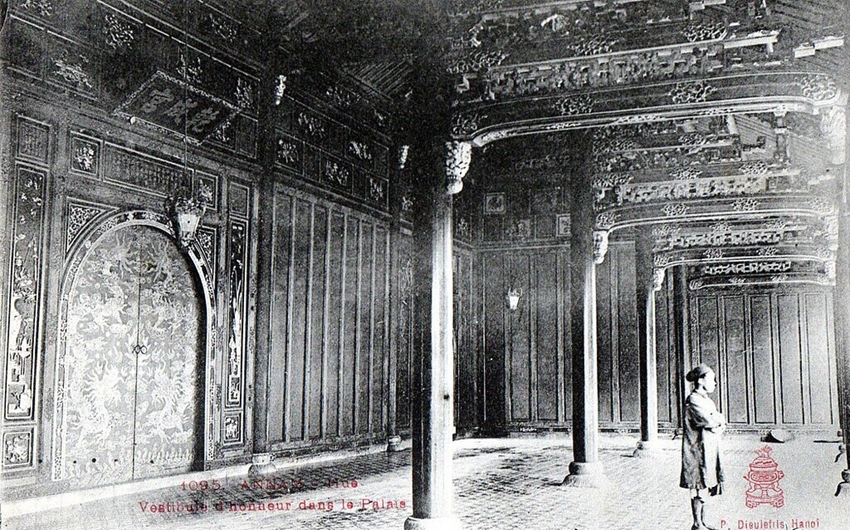
| Photo of Dai Cung Mon inside Hue Imperial Citadel during the Nguyen Dynasty, taken by the French - Archival photo |
Dai Cung Mon, the main gate of the Forbidden City - the residence and workplace of Nguyen Dynasty emperors and their consorts within Hue Imperial Citadel - is set to be reconstructed following the excavation.
Built in 1833 under Emperor Minh Mang, Dai Cung Mon originally had five bays without lean-tos and three entrances, with the central gate reserved exclusively for the emperor.
Dai Cung Mon was constructed by the most skilled artisans of the Nguyen Dynasty, with remarkable craftsmen. Its front was lavishly decorated with red and gold gilding, and the panel sections featured classic motifs (such as the Eight Weapons, Four Sacred Creatures...) interwoven with poems. The back side had two corridors connecting to the Ta Vu (the Left Compartment) and Huu Vu (the Right Compartment). These corridors were nine compartments long, faced north, and roofed with glazed blue tiles. Above Dai Cung Mon hung a sign board reading “Can Thanh Cung” - the emperor's residence within the Forbidden City. In 1947, Dai Cung Mon, along with Can Chanh Palace in Hue Imperial Citadel, was completely destroyed during the war, leaving only the foundation.
Previously, the Ministry of Culture, Sports, and Tourism issued Decision No. 1266/QD-BVHTTDL permitting Hue Monuments Conservation Center to collaborate with National Museum of History to carry out archaeological excavations at the Dai Cung Mon site within the Hue Imperial Citadel.
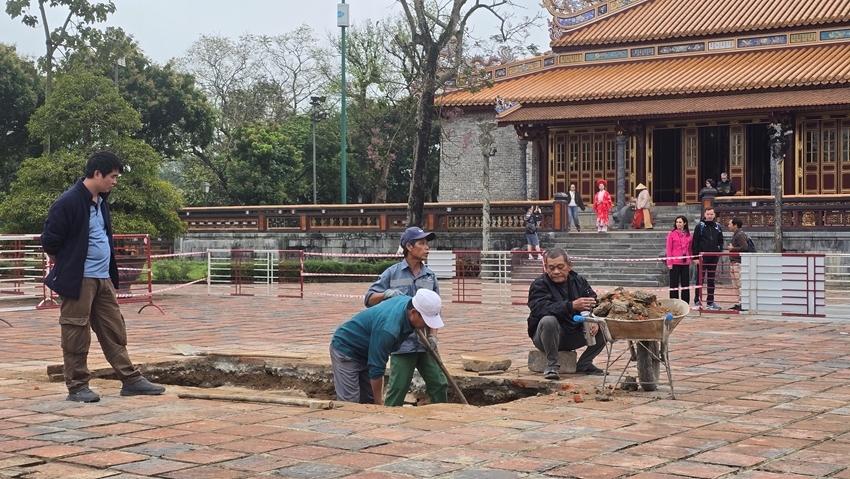 |
| Archaeological survey excavation at Dai Cung Mon |
Accordingly, the total excavation area is 60 square meters, consisting of three pits, each measuring 20 square meters. The excavation was led by Ms. Nguyen Thi Thao Giang from the National Museum of History. The artifacts collected during the excavation process are to be preserved and safeguarded by Hue Museum of Royal Antiquities and Hue Monuments Conservation Center to prevent damage or loss.
The restoration and reconstruction of this structure play an important and meaningful role in fully restoring the architectural appearance of Hue Imperial Citadel complex, bringing significant benefits to tourism services, education, and research.
At the end of 2024, the Provincial People’s Council (now the City People’s Council) passed a resolution approving the investment policy for the reconstruction project of Dai Cung Mon under the Nguyen Dynasty within the Hue Imperial Citadel. The approved restoration project of Dai Cung Mon has a total investment of over 64.6 billion VND, sourced from Hue city’s budget.
The project will restore the building’s foundation using “vo” bricks, Thanh stone pillar bases, and Thanh stone paving for the floor and steps. The walls will be reconstructed using “vo” bricks plastered with traditional three-component mortar and colored with traditional finishes. The main structure of Dai Cung Mon to be restored includes the wooden frame, roof, wooden walls, carved horizontal and vertical beams, and doors made of Group II wood. These components will be intricately carved, lacquered, and gilded. The wooden elements will be treated for moisture resistance and termite protection.
The project is expected to begin in 2025 and will be carried out over a span of four years.