 |
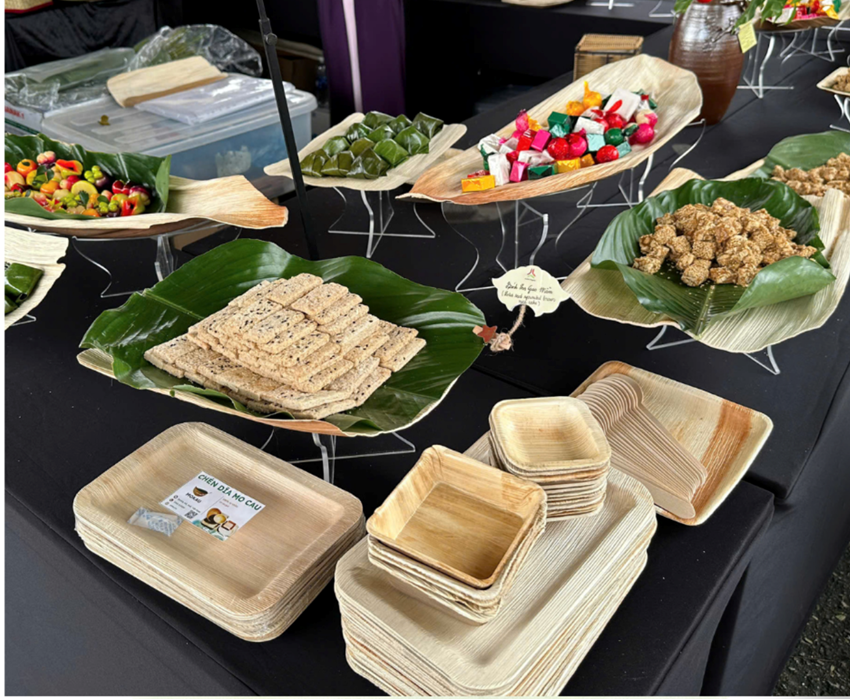
| Areca sheath bowls and plates |
Return to Hue with a “green” direction
After graduating in marketing from the University of Economics, Hue University, Truong Van Toi worked for a company specializing in agricultural drones. The job took him to many provinces in the Mekong Delta, where he interacted with farmers, cooperatives, and various agricultural production models. It was through these trips that Toi began paying attention to by-products that are often “forgotten” after harvest.
In many areca-growing areas, areca sheaths are not utilized; they are usually left to rot in gardens or burned. Meanwhile, in India and some other countries, areca sheaths have long been used to produce biodegradable bowls and plates for daily use. This contrast made Toi think deeply about the possibility of making use of materials readily available in his own hometown.
At the beginning of 2025, Toi decided to return to Hue. At that time, Hue City was selected to host the National Tourism Year, with a rapidly increasing number of visitors; this led to a growing volume of household waste, especially plastic waste and single-use products. From this reality, the idea of an environmentally linked startup gradually took shape.
“I think that doing business without connecting it to what the locality already has is very hard to go far and be sustainable. Hue is both a tourism center and a place with many agricultural areas that still have development potential,” Toi shared.
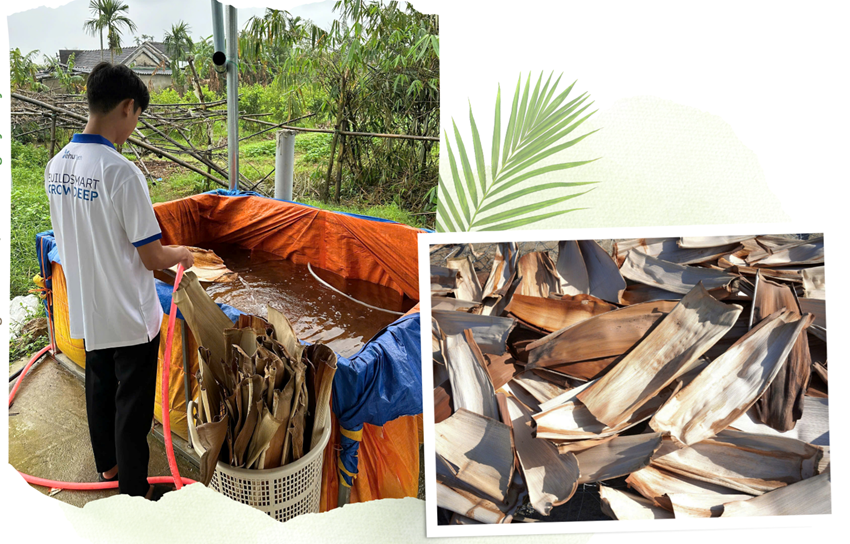 |
| Purchased areca sheaths |
Through surveys, he found that Nam Dong, Long Quang, and Khe Tre (formerly of Nam Dong District) are areas with large areca plantations. Areca sheaths there are abundant but lack stable outlets. Toi began purchasing them, both creating additional income for local residents and securing raw materials for production. In addition, he also sources areca sheaths from Quang Nam, where materials are plentiful and transportation costs are relatively low.
During his research process, Toi studied models of producing areca sheath bowls and plates in Vietnam and India. According to him, although this is not a new direction, most domestic and foreign enterprises currently focus mainly on export markets and pay little attention to the domestic market. This “gap” is precisely why he chose to first serve domestic consumers.
“Vietnamese people are still using a lot of plastic and single-use paper products. I want to create products that are safe for health, suitable for hot food, and practical for daily use, then think about export later,” Toi said.
To implement the idea, Toi used his savings and took out a bank loan to invest in machinery and production equipment. He leased a 1,600 m² plot in Thanh Vinh residential area, Duong No Ward, as a production facility. In May 2025, YeHu Vietnam Joint Stock Company was officially established, putting the model into operation.
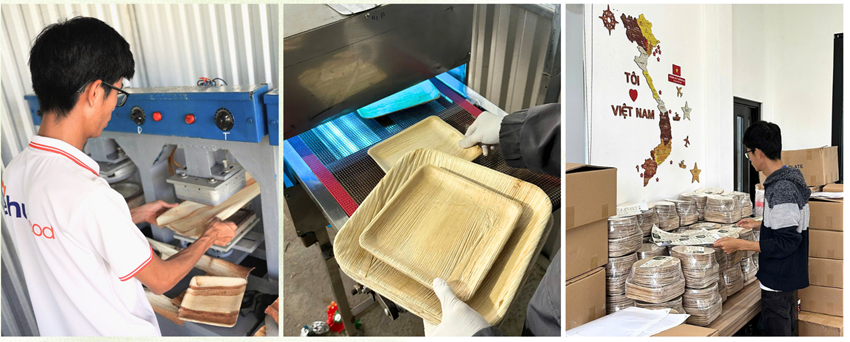 |
| Pressing and production processes for areca sheath bowls and plates |
Finding a “place” for areca sheaths
The early days were far from simple. The pressing stage requires precise mold shaping and careful adjustment of temperature and timing. Meanwhile, the process was not yet automated, making defective products hard to avoid.
At the same time, Hue was hit by successive heavy floods, with high humidity causing raw materials to spoil easily. For a newly established production facility, this created significant pressure in terms of both costs and timelines.
“I see those incidents as lessons learned. Only by doing it do you realize that without investing in technology from the start, it’s very difficult to control quality. However, in the coming time, I will research automating more production processes to reduce time, labor, and output costs,” Toi said.
The current production process is carried out in the following steps: Areca sheaths are collected from gardens, sun-dried, gathered at the warehouse, and stored in humidity- and heat-insulated rooms. They are then washed clean, heat-pressed to form shape, blown to remove fine dust, surface-cleaned, and put through a UV irradiation machine for sterilization. Finished products are packaged in sets of 10 using POF film, a type of film that is naturally biodegradable, instead of conventional PE film.
According to Toi, compared with products made from paper or sugarcane bagasse, areca sheath bowls and plates have the advantage of retaining food longer, especially wet foods. The products use no chemicals, detergents, or adhesives, and can be used in microwave ovens, air fryers, or for steaming without deformation.
Currently, YeHu Company produces a wide range of bowls and plates in different sizes. The products have been trusted and used at many major events such as Miss Cosmo with representatives from nearly 80 countries, the Hue Culinary Festival, Yen Tu Festival, and the Hue - Da Nang Heritage Train.
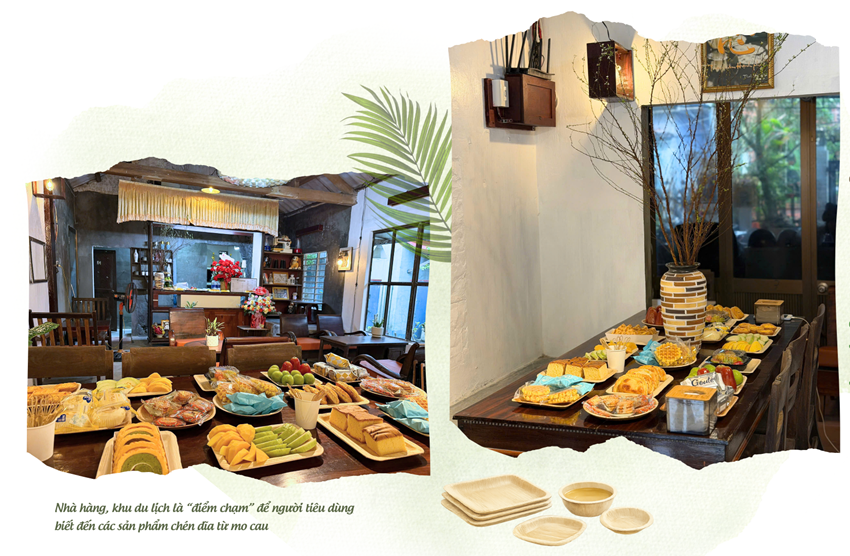 |
| Areca sheath bowls and plates used at events |
At the same time, YeHu cooperates with partners such as Hue Onefood to package vacuum-sealed banh ep products together with areca sheath plates. Consumers only need to reheat the food to use it immediately, making it convenient for various dining and daily needs. Alongside consumer products, Toi is also aiming to develop souvenir items from areca sheaths, such as fans engraved with images of Hue landmarks, to serve tourists and help promote the local image.
Currently, YeHu’s production facility supplies about 30,000-40,000 products per month to the market, generating revenue of approximately 70-80 million VND per month. Although not large yet, this serves as a foundation for the company to sustain and expand operations.
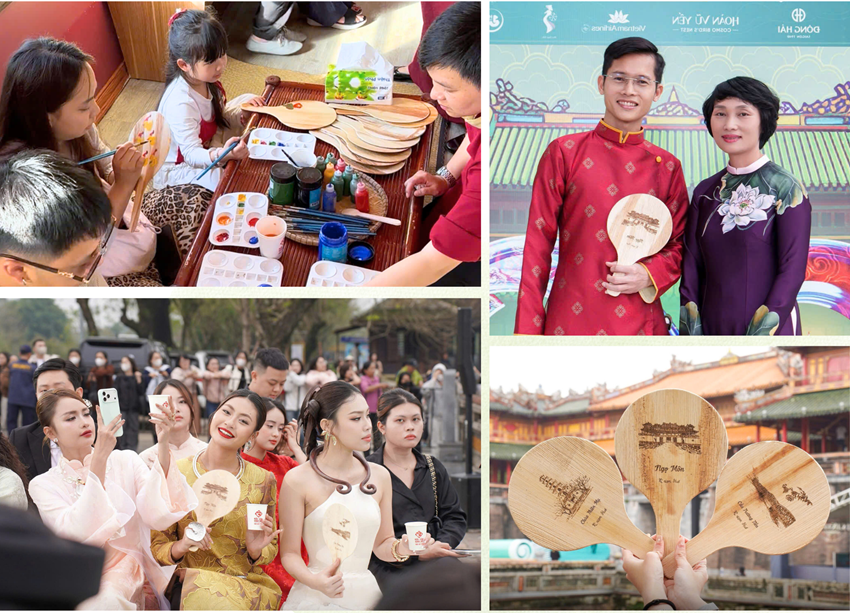 |
| Areca sheath fans; images of areca sheath fans used at events |
In 2026, Toi plans to build a greenhouse-style drying system and invest in machinery to automate the production process, aiming to reduce costs by 30 - 40% and lower the defect rate to around 10%.
YeHu has secured its first export order to the United States with 50.000 products. If the market response is positive, the plan for 2026 is to continue exporting more than 300.000 products. Toi has also established a communication channel on TikTok to promote the products and introduce the production process to reach domestic consumers. In addition, online sales channels such as TikTok Shop, Shopee, and plans to expand to Amazon are being developed in parallel.
“When I first posted videos introducing the products, there were many opinions saying that areca sheath bowls and plates would be hard to compete because the market already has many paper and bagasse products. However, I believe that if we focus on quality and do communication properly, consumers will gradually understand and choose products that suit their needs,” Toi commented.
According to Toi, the biggest challenge is changing consumer habits. He believes that tourist areas, restaurants, and hotels are appropriate “touchpoints” to spread green consumption habits.
For a heritage city like Hue, combining areca sheath bowls and plates with traditional dishes is a suitable direction in a context where experience-based tourism is increasingly emphasized. When products go beyond mere functionality and become part of the culinary cultural space, users are more likely to accept them. According to Truong Van Toi, starting from restaurants, eateries, and tourist sites, areca sheath bowls and plates can gradually replace single-use items, thereby contributing to the reduction of plastic waste and the formation of environmentally friendly consumption habits.