 |
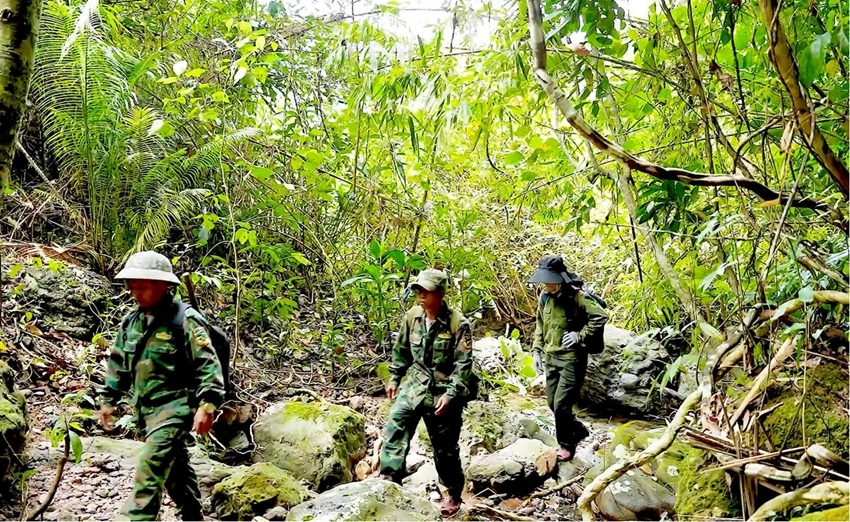
| Household groups set out to patrol the forest at the beginning of the rainy season |
Sustainable livelihood
For generations, A Luoi people have been closely connected to the forest. The forest provided firewood, bamboo shoots, and medicinal leaves, etc., a source of life for many generations. However, this dependence once made it difficult for them to escape poverty year-round. With the implementation of the ERPA policy, the forest is no longer just a place for subsistence, but has become a resource for people to improve their lives.
The family of Ms. Le Thi Thuy Dung (41 years old, La Tung hamlet, A Luoi 4 commune) is an example. Previously, she often went into the forest to gather firewood and dig for bamboo shoots to sell. The limited income meant her entire family struggled to make ends meet. For the past two years, thanks to participating in the ERPA, Ms. Dung has had an additional regular payment.
“The payment, not much but consistent, has helped my family worry less about running out of rice, buy medicine, and pay for our children to go to school. More importantly, we clearly understand that the forest provides us with water, fresh air, and the future of our descendants. Protecting the forest now is not just for money; but also for the protection of life,” shared Ms. Dung.
According to her, since the ERPA was implemented, the entire hamlet's awareness has markedly changed: “Before, forest patrol was the job of just a few people; now, the whole hamlet is ready to join in. Every time we have a hamlet meeting, we remind each other: Protecting the forest is protecting our own livelihood.”
Currently, La Tung hamlet is assigned to manage more than 140 hectares of forest. The community divides into rotating groups to patrol, ensuring the forest area is not encroached upon. In 2024, the hamlet received over 42 million VND in payment, along with 50 million VND for livelihood support; in 2025, the first advance payment was over 28 million VND. Although the amount is not large, it has become a driving force for the people to stay committed. For many consecutive years, there have been no cases of illegal encroachment or exploitation of forest.
Not only in La Tung, many other communities are also changing thanks to the forest. The community forest protection group in hamlet 2, A Luoi 2 commune, is assigned to manage over 70 hectares of natural forest. The group has 14 members, divided into 2 patrol teams. “Our group receives over 60 million VND per year from the forest environmental service. This is an income source distributed equally to the members, helping everyone feel secure in covering their living expenses,” said Mr. Tran Van Hieu, the group leader.
According to the A Luoi Protection Forest Management Board, in 2025 alone, the locality has been allocated over 4.2 billion VND. To date, 15 village communities have been allocated to manage nearly 1,800 hectares of forest, receiving over 1 billion VND in payment. Additionally, there is 750 million VND for livelihood support, and nearly 2 billion VND for silvicultural measures. Though these payments are not large, they are an important support for the people to feel secure in their commitment to the forest.
Enhanced awareness
Along with the community, the forest management system in A Luoi is also being strengthened. After the local government transitioned to two-tier local government model, the A Luoi Area Forest Protection Department was established, replacing the former District Forest Protection Department. The unit is currently coordinating closely with the authorities of 5 mountainous communes to enhance forest fire forecasting, disseminate information to every hamlet and village, and implement numerous forest restoration projects.
Mr. Ho Van Sao, Head of A Luoi Area Forest Protection Department, stated: To date, over 20,200 hectares of natural forest have been allocated to 39 communities, 191 household groups, and 26 households for management. “After the allocation, forest encroachment has significantly decreased. All household groups have developed patrol plans and coordinate well with the forest rangers. The better the community manages the forest, the higher the awareness of the local people becomes,” emphasized Mr. Sao.
Across the entire city, the impact of ERPA is increasingly evident. The forest coverage rate currently stands at 57.18%. Over 205,500 hectares of natural forest have been included in the emissions reduction payment program, with a total cost of over 135 billion VND for the period of 2023 - 2025.
Mr. Nguyen Tat Tung, Director of Hue City Forest Protection and Development Fund, affirmed: “The ERPA not only generates income for people, but also is a new financial mechanism, transforming the value of carbon absorption into specific benefits. Thanks to this, forest owners have additional funds to sign contracts with the community, while also implementing silvicultural activities like forest zoning, regeneration, and enrichment. Payments made through banks, e-wallets, or public postal services also ensure transparency and convenience.”
According to statistics, in 2024 alone, Hue City disbursed nearly 43 billion VND, reaching 98% of the plan. By July 2025, the payment rate also reached 95% of the plan. After 3 years, the total payment amounted to 123 billion VND, of which over 15 billion VND was paid to communities, household groups, and households; over 5 billion VND to commune People's Committees and organizations; and over 102 billion VND to 11 organizational forest owners. Nearly 31,000 hectares of forest allocated to communities have been effectively protected.
The important thing is that people's awareness has changed. They no longer consider forest protection merely a duty, but an essential part of life: Protecting the forest to have food, and protecting the forest to have water and clean environment for future generations. That is the long-term journey that Hue City is persistently pursuing, so that every stretch of forest serves simultaneously as a green shield for the environment, and a solid foundation for the livelihoods of thousands of mountainous households.