 |
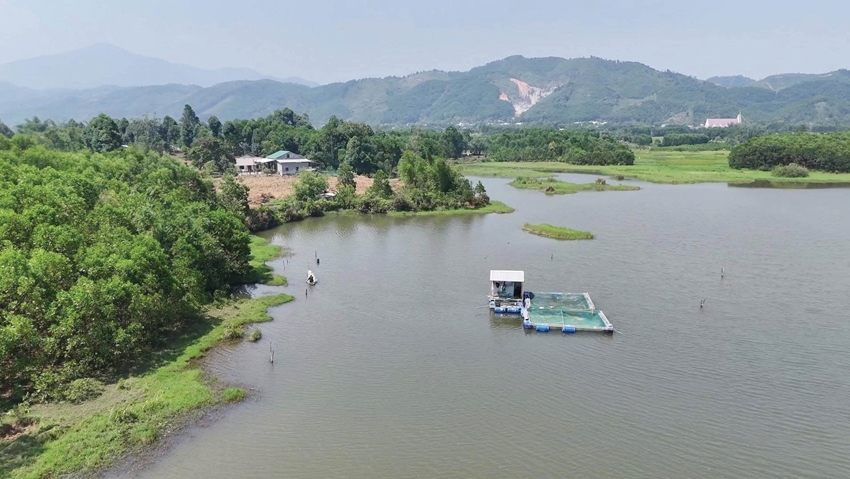
| The A Sap River flowing through A Luoi. Photo: Minh Tam |
Opportunities for highland residents
A Luoi is home to two rivers, A Sap and A Lin, both flowing into Laos. Since 2009, a dam has been built across the A Sap River in the A Luoi area to retain water for hydropower generation. As a result, the A Sap has become a vast reservoir nearly 47 kilometers long, covering an area of up to 331 square kilometers.
With support from the Project on Enhancing Women’s Capacity in Building Sustainable Livelihood Models Based on Effective Water Resource Management in the Upper A Sap River Basin in A Luoi District (former), since 2022 dozens of households have received financial assistance, technical training and market access support to develop high-value aquaculture in the A Sap River basin as well as ponds and lakes within its system.
Ho Van Thang, from Can Te Hamlet, Hong Thuong Commune (now A Luoi 3 Commune), head of the cage fish farming livelihood group, shared: “Joining the fish seed and cage fish farming model on the A Sap River has opened a new chapter in my life and in the lives of our group members. Nothing is more meaningful than earning a living through our own labor and knowledge, especially for someone with a disability and limited opportunities like me.”
Taking advantage of clean water sources, natural feed and modern techniques, cage fish farming and fish breeding were the first models he envisioned. After learning from experience and receiving support from local authorities and the project, Thang implemented a circular organic farming model combining cage fish farming, vegetable cultivation, cattle raising and earthworm farming in a closed production cycle.
Turning ideas into action, his family invested in four cage fish units, renovated a 1,500-square-meter breeding pond to supply fingerlings to the market, generating annual income of about VND170 million. In addition, the family invested in earthworm farming to produce animal feed and organic fertilizer, and reclaimed nearly 1,000 square meters of land to grow clean organic vegetables supplied to local markets and schools, earning over VND60 million per year.
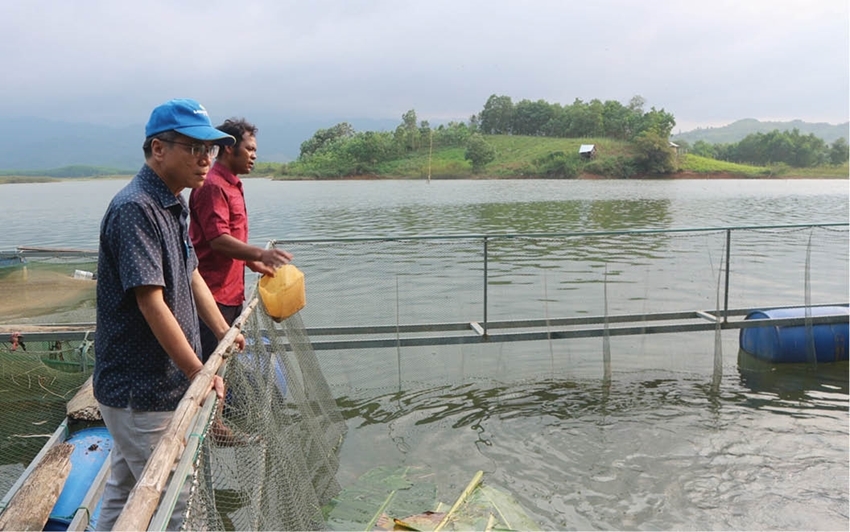 |
| Aquaculture on the reservoir of the A Sap River. Photo: Nguyen Khanh |
Beyond gradually improving his own livelihood, he has also become a “community advocate,” guiding and sharing experience with female members in the group to jointly develop sustainable economic activities, with an average income of around VND53 million per person per year from cage fish and fingerling farming.
As a single mother whose husband passed away in a workplace accident, Ho Thi Thau from KLeng A Bung Hamlet, Quang Nham Commune (now A Luoi 2 Commune), faced immense hardship. Motivated by her three young children, she persevered and became the leader of a 10-member cage fish farming group on the A Sap River. Initially, the group received VND30 million in project support, supplemented by VND10 million in matching funds from members, to invest in cage fish farming in the reservoir, taking turns in management and care. With a scale of about 3,000 to 3,500 commercial fish, after the first harvest, the initial profits were reinvested for subsequent cycles.
Sustainable livelihoods
The project on enhancing women’s capacity in building sustainable livelihood models based on effective water resource management in the upper A Sap River basin was initiated by the Center for Social Research and Development (CSRD) and funded by OXFAM in Vietnam for two years, from 2022 to 2024. The project aims to promote women’s roles in managing and effectively using water resources while ensuring household livelihoods in aquaculture. It also strengthens riverside communities’ participation in water governance and the development of nature-based sustainable livelihood models, with a total budget of more than VND4.1 billion.
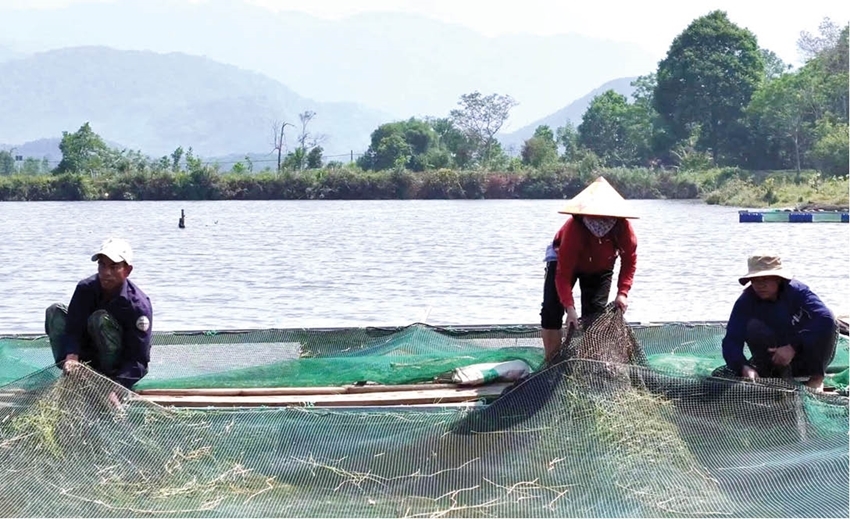 |
| Aquaculture on the reservoir of the A Sap River. Photo: Nguyen Khanh |
Accordingly, the project allocated VND300 million to support 10 sustainable aquaculture livelihood models in five communes: Hong Thuong, Hong Thai, Hong Kim, Son Thuy and Quang Nham in former A Luoi District, with 100 participants (10 households per model), two-thirds of whom are women. In addition to the VND30 million provided to each group, members contributed matching funds to invest in cages, repair and dredge ponds and lakes. After the farming period, both cage fish in the A Sap River and pond fish showed favorable growth, with survival rates ranging from 70 to 95 percent. Average fish weight reached 0.8 to 1.2 kilograms per fish, meeting 100 percent of the initial plan. The success of the model lies in its first harvests generating revenue for reinvestment, creating motivation and confidence among community groups in pursuing sustainable aquaculture livelihoods.
Trinh Thi Dinh, Director of CSRD, assessed that the community-based aquaculture livelihood model was established to promote livelihood development and sustainable poverty reduction among ethnic minority and mountainous communities, especially women. The A Luoi area includes the A Sap hydropower reservoir with over 300 hectares of water surface, of which more than 100 hectares are suitable for aquaculture but remain underutilized. This represents a key strength for project communes to tap into local potential and develop fish cage and raft farming. The model also creates specialty products for tourism, particularly in communes with sightseeing and resort destinations.