



 |
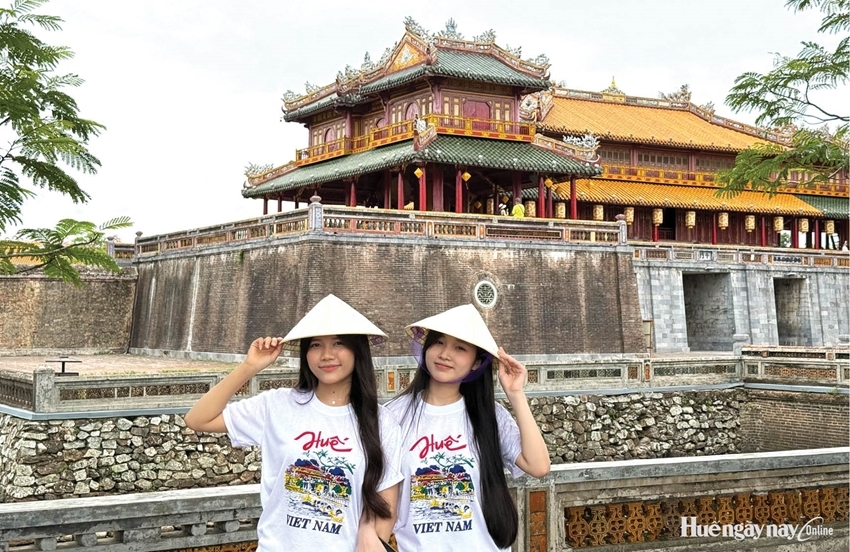
| Visitors from Hanoi posing for commemorative photos in front of the Imperial Citadel. Photo: Minh Anh |
Cultural branding
Recently, the Ministry of Culture, Sports and Tourism began drafting a National Branding Scheme for Vietnam's Cultural Industries.
A highlight of the draft scheme is that it does not view a national brand merely as a title or a communications slogan. Instead, it adopts a rather modern perspective by positioning branding within a broader network that includes intellectual property, digital transformation, innovation, copyright, market development, and international integration.
The draft also candidly acknowledges the current shortcomings of Vietnam's cultural industries: a shortage of brands with broad recognition and influence; fragmented branding efforts; the lack of coordinated support mechanisms; limited capacity in brand management and intellectual property commercialization; and insufficient connections between culture, tourism, technology, and the marketplace.
However, from an implementation perspective, the key challenge in the years ahead may not be how many brands are selected, but rather how to establish mechanisms that allow brands to emerge and develop sustainably.
A cultural brand cannot be created simply through official recognition. It requires time, market acceptance, community engagement, a compelling cultural narrative, and, most importantly, the ability to generate lasting economic value.
Therefore, alongside developing selection criteria, the strategy should devote greater attention to post-recognition support mechanisms, including intellectual property protection, international promotion, digital transformation, derivative product development, business partnerships, market expansion, and workforce training. These are the factors that ultimately determine the long-term vitality of a cultural brand.
Another issue deserving greater attention is the role of local governments.
Reality shows that most successful international cultural brands originate from a particular region, city, or community. Hallyu is closely associated with Seoul; anime with Japan; flamenco with Andalusia; and opera with Italy. Only after establishing strong local identities did these cultural assets come to represent their respective nations.
Vietnam is no exception. A strong national brand cannot be built without equally strong local brands.
It is precisely in this context that heritage cities such as Hue have the potential to make significant contributions.
An opportunity for Hue
Hue is one of the few localities in Vietnam that possesses nearly every advantage needed to develop a cultural industry brand. Its eight UNESCO recognitions, the Complex of Hue Monuments, Nha nhac (Vietnamese court music), traditional festivals, Hue Festival, ao dai, cuisine, traditional crafts, royal performing arts, and the iconic Perfume River - Ngu Binh Mountain landscape together form an exceptionally rich repository of cultural assets.
Yet, despite these strengths, Hue has largely promoted its heritage sites, festivals, and cultural events individually. What may now be needed is the development of a unified brand for Hue as a heritage city.
Such a brand should encompass far more than the Imperial City or the Citadel, and extend beyond Hue Festival or the ao-dai. It should represent a living cultural landscape where heritage continues to inspire creativity, offer meaningful experiences, and generate economic value.
If ‘Vietnam’ represents the national brand, Hue is well positioned to become one of the country's leading cultural city brands.
From this perspective, the scheme could consider introducing mechanisms that encourage the development of heritage city brands, creative city brands, and regional cultural brands, rather than focusing solely on individual products or businesses.
For Hue, this also presents an opportunity to connect sectors that have traditionally developed independently. The ao-dai can evolve beyond a traditional costume into a creative design industry. Hue's cuisine can grow from a tourism product into a nationally recognized culinary brand. Hue Festival can become more than a cultural event by serving as the foundation for a thriving performing arts industry. Traditional craft villages can expand beyond handicraft production into cultural design, heritage-inspired gifts, and e-commerce. It is this integration that creates a genuine branding ecosystem. Moreover, in the digital economy, the greatest value of the cultural industries no longer lies in the number of artifacts preserved or the scale of festivals organized. Rather, it lies in the ability to transform cultural values into intellectual property that can be protected, commercialized, and shared. Cultural icons, design works, artistic creations, performance programs, digital products, and heritage data, if managed effectively, can become powerful drivers of economic development.
For Hue, this represents a particularly important path forward. It is also a way to ensure that heritage remains a living part of contemporary society while creating new jobs, generating income, and expanding development opportunities for local communities.
The ‘National Brand Scheme for Vietnam's Cultural Industries’ is more than just a branding building program. In a broader sense, it offers Vietnam an opportunity to shift from the thought of managing culture to managing cultural value; from utilizing cultural resources to developing cultural assets; and from promoting the country's image to strengthening its national soft power.
If further refined with clearer criteria, stronger support mechanisms, greater decentralization for local authorities, and enhanced recognition of the role of cultural and heritage cities, the scheme will do more than produce a handful of successful brands. It will help cultivate a creative ecosystem rooted in Vietnamese identity.
In that future, each locality will become not only a guardian of heritage but also a creator of new cultural brands. For Hue, this is the path through which centuries of accumulated cultural value can be transformed into a new source of development, contributing meaningfully to the building of Vietnam's national brand through the city's unique identity, cultural depth, and creative vitality of a heritage city.