



 |
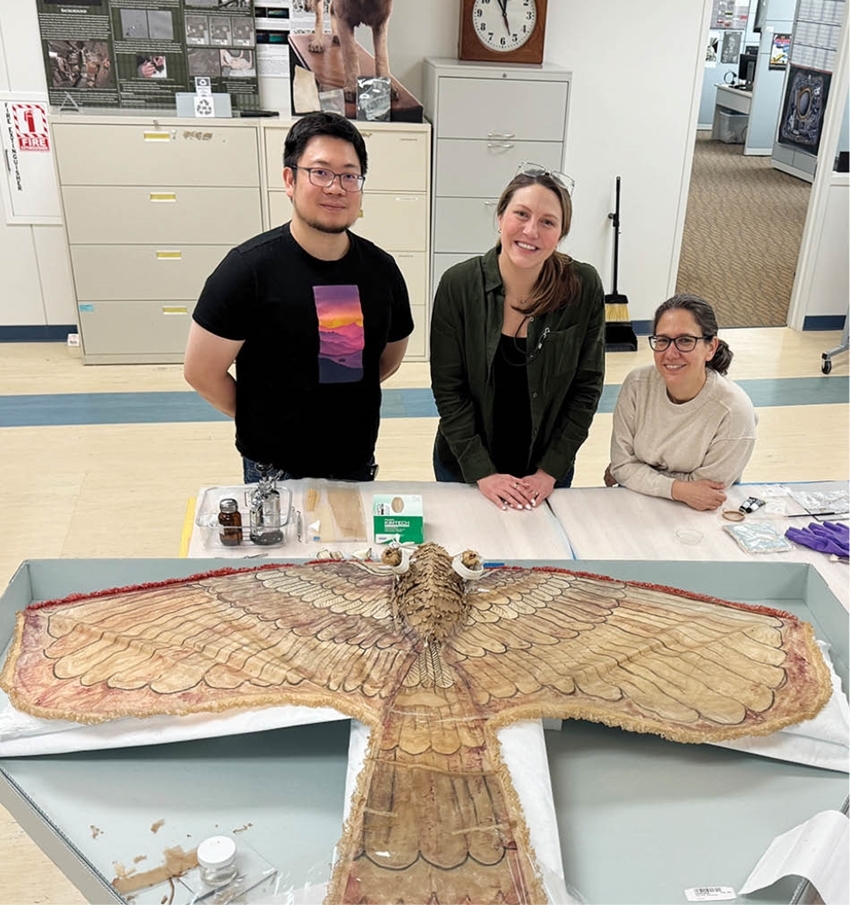
| Expert Vu Do, together with 2 curators and conservators from the Smithsonian National Air and Space Museum by the Hue kite. Photo: Smithsonian National Air and Space Museum |
Resume of a kite
Recently, a seminar held both in person and online connected Vietnam and the United States, bringing together experts and enthusiasts of traditional arts has helped to shed light on the journey of preserving the Hue kite in the land of the stars and stripes. The central figure of that seminar was the restoration expert Vu Do, who is currently pursuing research in the U.S.
According to expert Vu Do, during a visit to the storage room of artifacts at the Smithsonian National Air and Space Museum (U.S.), he happened to discover two artifacts from Vietnam. One of them was the kite originating from Hue.
“I proposed to research and share with everyone the techniques of making kites,” said Vu Do, and he immediately received support. Thus, the project titled “Awakening the Kite: from Smithsonian 2025 back to Hue 1967” was officially born.
To the naked eye, it is clear that the bird-shaped kite was made of bamboo and paper. Over time, because the materials are so fragile, it has been torn in several places, some parts have become crumpled, and the surface is covered in dust. In addition to being stored in a museum-standard container, the kite is also kept inside its original accompanying box. Along with it are archival photos of the officer holding the kite, as well as letters exchanged between the donor and the curator. “This kite was ordered by an officer from an artisan in Hue, then brought to Danang and taken to the U.S. before being transferred to the museum,” recounted Mr. Vu Do.
Rewinding the history, 58 years ago, a U.S. Air Force officer once ‘fell in love’ with the Hue kites and commissioned a kite artisan in Hue to craft a kite; he then brough it back to America following the request of Paul E. Garber, the museum curator at that time. The information provided by Vu Do via a live connection from the United States surprised the guests in Hanoi and Hue. Nearly 6 decades have passed, with many historical ups and downs, and although the kite is no longer intact, it has revealed to us much about a fascinating destiny, the love for traditional art of both its maker and the one who ordered it, as well as the journey of a Vietnamese artifact surviving in American land.
Even more interesting was when Mr. Vu Do discovered the kite maker’s information through a few letters exchanged between the officer and the curator, summed up in just one line: ‘Mr. Doan Van Chuoc, No. 62 Vo-Tanh Street, Phu-Cat Ward, Dong Ba, Hue, Vietnam”.
Through personal connections, he reached out to an artist in Hue for help in searching. Following those brief pieces of information, it was determined that the former Vo Tanh Street is now Nguyen Chi Thanh Street, located in Phu Xuan Ward (Hue City). The house currently located at 76 Nguyen Chi Thanh Street, which was once the living place and is now the communal house of artisan Doan Van Chuoc. Although he was able to meet the grandchildren; since the artisan passed away a long time ago, there remains no documentation.
Together with the support of his colleagues and modern technical tools provided by the museum, Mr. Vu Do started the “journey” of kite restoration. Everything followed a rigorous, scientific process under the supervision of specialists and curators and, above all, on the basis of a proposed plan that included a thorough analysis of the artifact along with clearly defined, approved outcomes.
X-ray the kite
From the photos of the restoration process presented on screen by Mr. Vu Do, the kite looked just like a patient being “X-rayed” by “doctor” Vu Do to examine its structure and degree of damage. Fortunately, the kite’s frame was determined to be intact and still in good condition despite nearly 60 years of existence. In addition, the paper and colors were also analyzed by experts using microscopes.
After many days of “diagnosis,” Vu Do and the experts determined that the kite was made of glassine paper, cotton paper, and nylon threads, with bamboo as the supporting material. The colors were created using cochineal dye, and the adhesive was animal-hide glue.
Although he had experience restoring many artifacts, Vu Do admitted that he was very nervous when facing this kite from Hue. Even the process of taking the kite out of its box required 5 people, and nearly everyone was “holding their breath,” since even the smallest mistake could put the artifact in danger.
Once the kite was taken out and secured, the young Vietnamese expert began to demonstrate his restoration skills. With masterful technique and skillful hands, Vu Do carefully cleaned the surface of the kite. Depending on the area, tears were patched with handmade paper matched to the original color. The entire process was meticulously documented so that future generations could understand the restoration history of the kite, an essential detail for those working in conservation and restoration.
When the tears were patched, the tail straightened, and the kite’s colors were largely restored to their original state, emotions in Vu Do overflowed. “When I turned the kite over, it was truly wonderful, so lovely. I hope that one day soon we can recreate this kite and let it fly again in the sky of its birthplace - the land of Hue,” Vu Do shared.
Vu Do is the first Vietnamese post-graduate student studying under the Fulbright scholarship program in the field of art conservation at SUNY Buffalo State University. He is currently conducting research and studying at the Department of Object Conservation of the U.S. National Gallery of Art in Washington, D.C.