    |
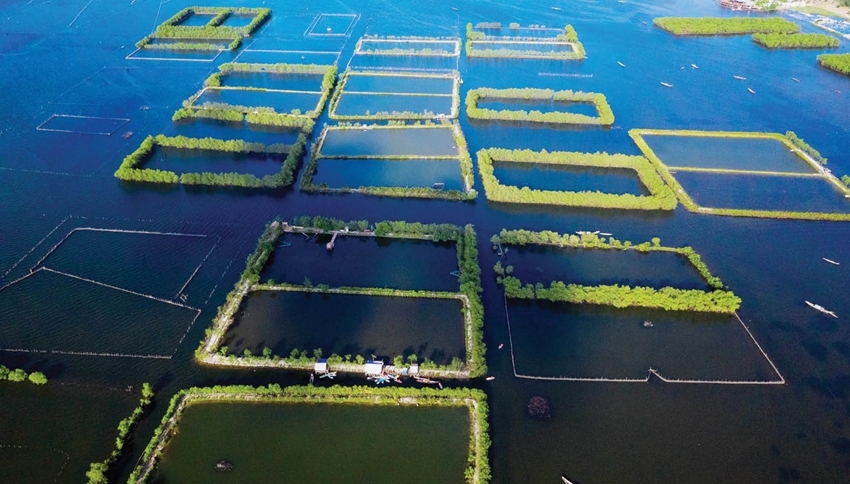 |
| The mangrove forest on Tam Giang lagoon seen from above. Photo: Ngoc Thang |
1. At night on Tam Giang lagoon, the new moon was magical. The water surface sparkled like gold, and the breeze blew through the tops of sour corks and nipa palms. Sitting and drinking tea with the old fisherman of Ha Cong village, Quang Loi commune (Quang Dien), I felt like travelling to the fairyland to Tam Giang.
The old fisherman Ha Cong Phuoc said that his life since childhood was associated with Tam Giang lagoon. He told us: “In the past, there were many shrimps, crabs, and fish in this area; so much so that at that time, when we were casting traps and netting, we often chose the big ones to bring back home, and let the small ones go. Fishing with traps and nets at that time was viable, and earning some million VND a night was normal.”
Remembering the glory days, Mr. Ha Cong Phuoc couldn't help but regret: "But God doesn’t bestow his blessings on one forever. Shrimps, crabs, and fish are gradually depleted because the fishermen raced to make traps, release nets, and catch too much”.
Vice Chairman of Quang Loi Commune People's Committee Phan Dang Bao followed, “In 2016, with the support of international organizations, mangrove planting projects were implemented with various types of sour corks and nipa palms. After 7 years of planting and caring, currently, Quang Loi area has nearly 46ha of mangroves that have been turned into forests along Tam Giang lagoon, including sour corks and nipa palms.
The project also supports people to plant forests at the foot of the dam, aquaculture ponds in 40 lakes. The area of mangroves has been effective in protecting the living environment from the impacts of climate change and bringing rich aquatic resources to the local people.”
2. In the early morning, Van Huu Sang, Director of Tam Giang - Quang Loi Tourist Service Cooperative used a motorboat to take us to visit Ngu My Thanh floating seafood market to watch the sunrise in the mangrove forests. We felt like being immersed in nature, breathing in the fresh air between rows of vibrant cork trees rising above the waves of Tam Giang.
Looking into the distance, Van Huu Sang shared that in March 2020, the Provincial Sub-department of Aquatic Resources Protection coordinated with the district agriculture sector to build the Vung Me Aquatic Resource Protection Zone (Quang Loi commune) with an area of 40ha, with many solutions to retain fish and shrimp resources that are in danger of being exhausted.
Part of the project included planting the mangrove forest, placing tree branches as shelter for aquatic species; along with that, regularly release fish, shrimp, and crab species into the lagoon to regenerate aquatic resources.
“Since Vung Me Aquatic Protection Zone was established, many aquatic species have developed here, contributing to the restoration and protection of biodiversity, helping aquaculture farmers develop towards sustainable ecological farming.
Recently, this lagoon area has been preserved and regenerated, and many kinds of shrimp and fish have been multiplied. The types of shrimps, bong dao, bong mu, day fish ... once almost extinct now appear more and more. Because there are mangrove forests, shrimp appear innumerably. In a particular year, when harvesting shrimp, many fishermen collected tens of millions of VND," Van Huu Sang shared.
Also, thanks to the mangrove forests with typical lagoon ecosystems, right in the lagoon area and the mangrove forest, a “bird forest” is gradually forming. Like the saying "birds perch on fertile lands", an innumerable number of birds and storks come here to live.
Seeing the potential and strengths of mangroves, the local people have turned to community-based tourism. Quang Loi commune has coordinated with tourism units to train people to raise community awareness about tourism activities in order to create jobs and increase incomes for people.
At the same time, they focus on building typical agricultural and aquatic products of the locality to attract tourists. With the unique characteristics of Tam Giang lagoon and mangroves, foreign tourists are very excited when coming here to travel and experience tours under the green mangrove forests.
3. Planting mangroves on Tam Giang lagoon brings dual benefits. The mangrove forests have been proven effective, now people are happy and excited when the mangrove forests become a "shield" before each disaster, storm and flood. Forests become storm shelters, anchorages for boats and fishermen's boats, limit damage during storms, and protect aquaculture ponds. Therefore, people reduce a lot of investment costs in repairing dikes and fish ponds.
Faced with the negative impacts of increasingly unusual natural disasters, causing serious landslides and erosion in localities, threatening people's lives and properties, the restoration and planting of new mangrove forests has been the most effective solution.