This is not merely an ordinary administrative decision; it can be seen as an important milestone in Hue’s approach to heritage development: a shift from an approach focused mainly on conservation and service exploitation toward a model that links conservation with value promotion, the development of cultural industries, the heritage economy, and the creative economy - treating heritage as a resource for sustainable development.
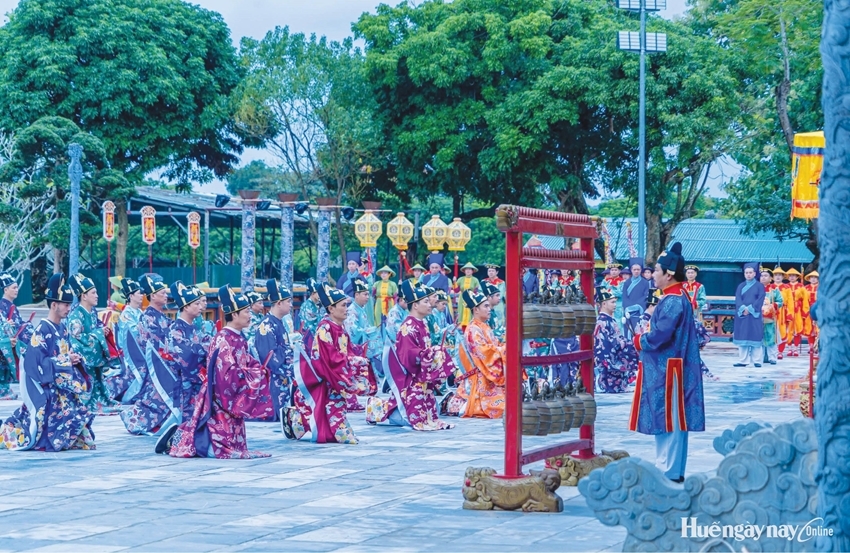 |
| Reenactment of the Nguyen Dynasty’s Lunar New Year Court Ceremony contributes to preserving and promoting the value of the ancient royal cultural heritage. Photo: Bao Minh |
First, the new Project takes a frank look at the reality after more than three years of implementing the Project on ‘Developing Services Based on Promoting the Value of Hue’s Ancient Capital Relics to 2030’, issued under Decision No. 1911/QD-UBND dated August 14, 2023, of the Thua Thien Hue Provincial People’s Committee.
The results achieved are quite clear. Service types have become increasingly diverse. Cultural experience spaces have gradually taken shape. Revenue from service activities in the 2023–2025 period reached over VND 94 billion, creating additional jobs and contributing significantly to the budget. However, the Project itself also frankly points out shortcomings such as products still lacking depth, the absence of a synchronized service ecosystem, few major investors, many legal obstacles, and, in particular, the failure to fully exploit the enormous potential of Hue’s heritage.
This objective assessment is what gives the Project its value this time.
The most important new point is that the Project has changed the way heritage is viewed. Whereas previously, exploiting heritage was mainly understood as developing service activities, the scope has now been expanded to ‘exploitation and value promotion’, meaning every economic activity must contribute to spreading cultural value, educating the community, promoting Hue’s image, and creating additional resources for conservation. This is also the spirit of the 2024 Law on Cultural Heritage and Politburo Resolution No. 80-NQ/TW on developing Vietnamese culture in the new period.
It can be said that this is a shift from the mindset of ‘conservation for preservation’ to ‘conservation for development’.
The Project also showcases a fairly comprehensive vision by placing Hue’s complex of monuments at the center of a heritage economy ecosystem. This includes not only sightseeing but also heritage education, cultural industries, night-time economy, digital transformation, creative experiences, art performances, traditional craft villages, heritage-inspired fashion, souvenir products, virtual reality technology, multilingual audio guides, digital maps, 3D mapping, and holograms. All of these aim to make heritage a livelier and more attractive space for both domestic and international visitors.
In particular, the clear division of functional spaces - ritual/spiritual space, heritage education space, service space, ecological space, and night-time economy space - shows that planning thinking has taken a further step forward, avoiding spontaneous development or rampant commercialization.
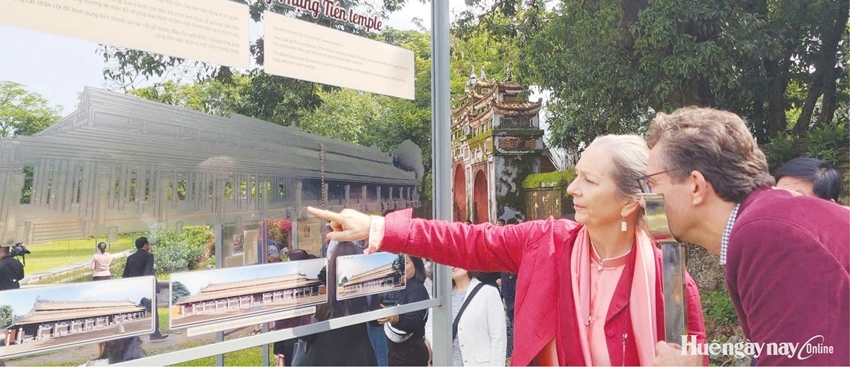 |
| Visitors explore Phung Tien Palace through a virtual restoration system |
However, the more opportunities there are, the more vigilance is needed.
Hue’s heritage differs from many other tourist destinations in that it is a World Cultural Heritage Site with outstanding global value recognized by UNESCO. This means that all exploitation activities must be secondary to conservation requirements.
The Project emphasizes the principle of minimizing the construction of permanent structures within Protection Zone I, prioritizing lightweight infrastructure, controlling capacity, conducting heritage impact assessments before major projects, and avoiding mass commercialization. These principles are entirely correct and must be strictly implemented.
In reality, the boundary between ‘promoting value’ and ‘commercializing heritage’ is sometimes very thin.
Another issue that deserves special attention is the matter of legal frameworks.
The Project points out that regulations on public assets, investment, construction, and cultural heritage are creating many difficulties in attracting businesses and implementing large-scale projects. This is a reality not only for Hue but for many heritage sites around the world.
What needs to be done in the coming period is not to loosen conservation regulations but to build a more transparent governance mechanism, establish clearer procedures, and select investors who truly understand culture. Heritage does not need too many investors, but it needs investors who know how to respect heritage.
Along with that is the issue of human resources.
Exploiting the heritage economy in the new period is no longer simply about selling tickets or organizing services. It requires a workforce with knowledge of conservation, cultural governance, marketing, digital technology, international communications, experience design, and the operation of creative products. Without investing in people, it will be very difficult to create branded products that can compete with the region’s leading heritage cities.
One very encouraging point is that the Project has given appropriate attention to the community.
Heritage cannot belong solely to management agencies. Heritage must create livelihoods for artisans, craft villages, local residents, and creative enterprises. When people benefit from heritage, they will become its most active protectors. This is also the successful experience of many heritage cities around the world.
From that perspective, the target of generating revenue of about VND 1,500–2,000 billion from the exploitation of public assets during 2026–2035, while reaching 40–50% of total ticket revenue by 2035, is an ambitious but entirely meaningful goal if built on a foundation of product quality, modern governance, and sustainable development.
More importantly, the Project has established a sound development philosophy: the economy is not the ultimate goal of heritage; it is merely a means for heritage to be better preserved, to have its stories told more compellingly, and to be passed down intact to future generations.
Hue is standing before a great opportunity, with a new legal framework, the status of a centrally-governed municipality, eight UNESCO titles, and growing global recognition as a distinctive heritage city. If implemented well, the Project ‘Exploiting and Promoting the Value of the Complex of Hue Monuments to 2035’ could not only increase conservation resources but also become a model for Asia in developing a heritage economy on a cultural foundation.