 |
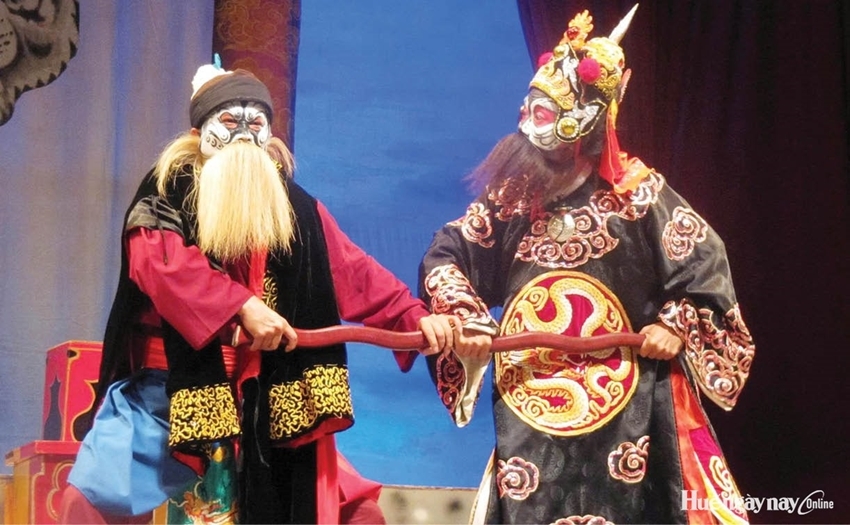
| A performance of Hue-tuong at Duyet Thi Duong Theatre. Photo: Hue Royal Traditional Arts Theatre |
Discovering classical tuong inside the Imperial Citadel
Despite ongoing challenges, Hue Royal Traditional Arts Theatre has continued to stage regular performances of classical tuong. At Duyet Thi Duong Theatre (within the Imperial Citadel), audiences are immersed in a rich artistic setting featuring Hue Royal Court Music (nha nhac), Royal Court Dance and excerpts from classical tuong productions. The repertoire includes some of the genre’s best-known works, such as Tram Huong Cac, Dich Thanh’s Farewell, Ho Nguyet Co Transformed into a Fox, Ky Lan Anh Carrying Her Child, etc. After each performance, visitors can explore an exhibition of more than 250 distinctive tuong masks or pose for photographs in traditional royal costumes.
According to Mr Hoang Trong Cuong, Director of Hue Royal Traditional Arts Theatre, the institution is responsible for preserving and promoting Hue’s royal performing arts, including nha nhac, Royal Court Dance, tuong and Hue-singing (Ca Hue). Among these art forms, tuong has consistently received strong interest from the audience, and it is continuously preserved, produced and regularly performed for both domestic and international visitors by the theatre. Each year, performances attract between 5,000 and 6,000 spectators. Meanwhile, one or two programmes featuring combinations of nha nhac, tuong and Royal Court Dance are staged every day.
Expanding performance spaces
In late 2022, a large-scale public performance entitled ‘Hue Tuong - Echoes of the Past’, within the framework of Hue Festival, offered audiences an innovative way to experience the traditional art form. The programme featured three parts: a tribute ceremony honouring the founders of traditional theatre at Thanh Binh Ancestral Hall, performances of classical tuong excerpts at Nghinh Luong Pavilion, and a colourful public street procession.
For the first time, the city’s streets became a stage for traditional theatre, showcasing the striking beauty of tuong costumes and vividly painted masks. Beyond providing festival-goers with a memorable cultural experience, the event also helped promote Hue’s rich heritage to visitors from across Vietnam and abroad.
Building on the success of ‘Tuong-Hue - Echoes of the Past’, many believe the next step is to diversify performance spaces. Rather than remaining confined to Duyet Thi Duong Theatre, tuong should be brought into open public spaces where it can reach a wider audience. Short street performances and parades could be staged along pedestrian areas such as the Imperial Citadel Night Street and Nguyen Dinh Chieu Walking Street during weekends or the city’s four-season festival programme. Likewise, brief performances could be incorporated into stops along boat tours on Ngu Ha River and Perfume River, linking with the ancient Bao Vinh and Gia Hoi quarters.
In early 2025, Hue Monuments Conservation Centre opened Hue-Tuong Mask Exhibition Space at Duyet Thi Duong Theatre within Hue Imperial Citadel Heritage Site. The venue serves both as a visitor attraction and as a permanent exhibition introducing audiences to the history and artistry of Hue tuong.
Drawing on years of practical experience, Mr Hoang Trong Cuong believes that bringing tuong closer to tourists requires a delicate balance between preserving traditional values and incorporating contemporary elements. This means that productions can thoughtfully integrate more recent historical settings and relatable characters to engage modern audiences. He also stressed the importance of training a new generation of performers to succeed today’s artists and artisans. Young actors must be trained according to the rigorous artistic standards of Hue tuong, preserving its refined classical style and scholarly traditions.
Hue tuong is renowned for its highly stylised movements and expressive choreography. Even without understanding the lyrics, audiences can often identify a character’s personality simply by observing the colours of the masks and the performers’ gestures. If this powerful visual language is fully developed, Hue tuong has every potential to become a distinctive cultural industry product, much like Japanese Kabuki or Chinese Peking Opera.
|
|
| Dating back to 1627, Hue tuong has evolved over four centuries alongside the cultural development of Phu Xuan and flourished during the Nguyen Dynasty. As a comprehensive performing art, it brings together poetry, music, singing, visual arts and dramatic performance. Originating within the Royal Court, Hue tuong gradually spread beyond the palace walls and influenced traditional opera throughout Vietnam. From the reign of Emperor Tu Duc onward, it increasingly became an art form enjoyed by the general public. |