 |
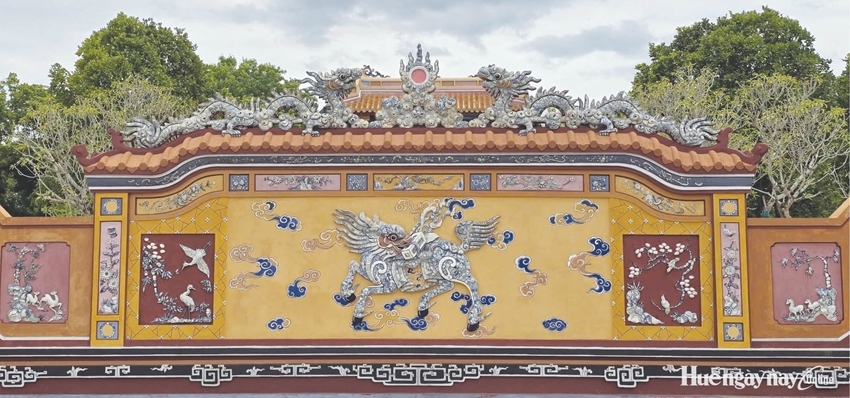
| The guarding screen of Thai Mieu Temple has basically been completed |
From the remaining traces
Thai Mieu Temple sits in the southeast corner inside Hue Imperial Citadel, positioned symmetrically with The Mieu Temple according to the principle of left for junior, right for senior ancestral tablets, and served as a place of worship for the Nguyen lords.
Built in 1804 under Emperor Gia Long, Thai Mieu Temple was once a large architectural complex where important court rituals took place, including ancestor-worship ceremonies and rites associated with royal court music (or Nha nhac).
According to historical records, after 1945, when the Nguyen Dynasty ended, the structures remained largely intact and well maintained. In 1947, war severely damaged Thai Mieu Temple along with many other structures within the Imperial Citadel, reducing it almost to bare ground, leaving only some foundation traces and auxiliary structures.
In 1972, the Nguyen Phuoc Clan Council, headed by Tu Cung - mother of Emperor Bao Dai - built a structure on the old Thai Mieu Temple foundation for worship purposes. This structure was much smaller in scale than the original architecture and used some modern materials.
At present, the Thai Mieu Temple area still has three main structures: Thai To Mieu Temple, Long Duc Palace, and Chieu Kinh Palace. Of these, Thai To Mieu Temple is nearly in ruins. Long Duc Palace has been restored. Chieu Kinh Palace was reconstructed in 2013.
As for Mr. Hoang Viet Trung, Director of Hue Monuments Conservation Center, the overall restoration of Thai Mieu aims to restore the spatial structure and the historical and architectural values of an important area within the Imperial Citadel.
Approved for investment by the Provincial People’s Council (now the City People’s Council) in 2021, the project is divided into two stages, with Stage 1 focused on preserving deteriorating structures and gradually eliminating derelict spaces in the Thai Mieu Temple area.
Begun in October 2024, the Stage 1 project for Conservation, Preservation, Reconstruction, and Overall Embellishment of Thai Mieu Temple has a total investment of 52 billion VND, with an implementation period of 4 years, and is now about 85% complete. According to the Hue Monuments Project Management Board, the work is expected to be completed by the end of December 2026 — about 20 months ahead of schedule.
At the project site, many items were essentially completed, including the Guarding Screen Wall, Hien Thua Gate and Tuc Tuong Gate at 99%, the surrounding walls at 93%, and the foundation of Thai To Mieu Temple at 92%. Preservation work is now entering the finishing stage at the Thai Mieu Gate, Quang Hy Gate and Dien Hy Gate, including vermilion lacquering and traditional-method color application.
The remaining items, including Muc Tu Palace, Tho Cong Shrine, the Left and Right Halls, Tuy Thanh Pavilion, the courtyard and walkways, are being constructed simultaneously and are expected to be completed in Quarter 3, 2026.
The construction process has also uncovered additional architectural traces. Mr. Le Nghi Minh Hieu, the project manager at the Hue Monuments Project Management Board, said that the construction unit discovered ornamental plant beds and some foundations larger than the traces visible on the surface when excavating the foundations.
“Previously, the Thai Mieu Temple area was covered by vegetation, while earlier archaeological work mainly focused on the main structures. When the foundation layers were peeled back, new traces were revealed. Based on this, the unit reviewed and adjusted the dimensions of some details according to what was found on site, but the function of the structures and their basic elements remained unchanged,” said Mr. Hieu.
As for the decorative motifs, patterns, and mythical-creature carvings, reconstruction work is being cross-checked against historical images and documents, the approved dossier, and opinions of experts and specialized agencies.
Some niche details of the foundations were also discovered after removing covering layers from earlier preservations (during the time of Empress Dowager Tu Cung). The remaining traces are being preserved as they are, to serve as a basis for reconstructing similar sections.
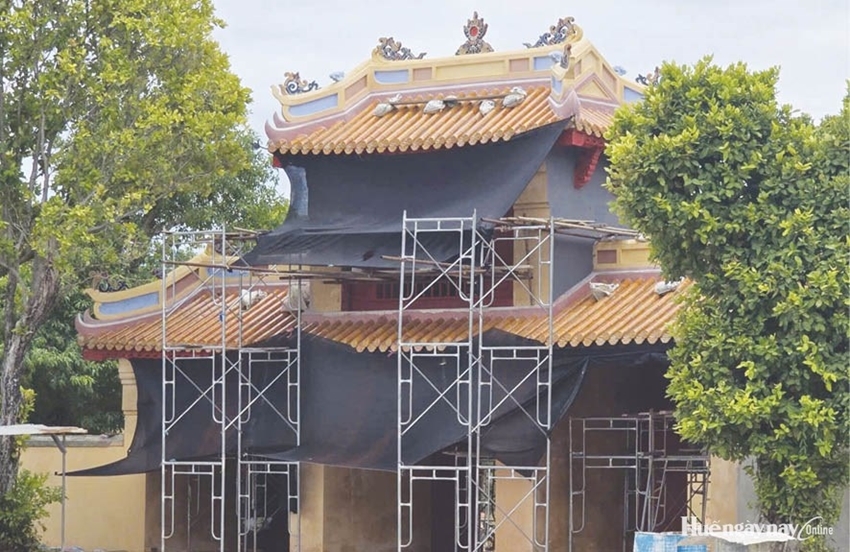 |
| Dien Hy Gate is gradually being completed |
Completing the scientific basis
Alongside the preservation of existing items, the construction unit is accelerating preparations to reconstruct Thai To Mieu Temple.
As for Mr. Phung Van Hoang, Director of Hue Monuments Project Management Board, research and collection of historical documents to support the reconstruction of Thai To Mieu Temple are basically complete. The database and scientific arguments have been built, forming the foundation for the upcoming investment approval process.
The Center will finalize the dossier and carry out appraisal and approval procedures as regulated, aiming to complete the investment approval process in 2026 and begin the reconstruction in Quarter 1, 2027, right after the completion of Phase 1, Stage 1.
The project to reconstruct the main structure of Thai To Mieu Temple has a total investment of 220.7 billion VND and a 4-year implementation period.
The overall Thai Mieu Temple complex comprises 13 items, arranged according to Nguyen Dynasty architectural principles. Among them, Thai To Mieu Temple is the largest wooden structure of all the palaces built under the Nguyen Dynasty, featuring the distinctive double-roofed, joined-house architectural style, notable for its layered roof-beams with hand-shaped carved brackets system.
Although most of the structure was destroyed, the remaining foundation system, together with historical documents, serves as an important basis for reconstructing Thai To Mieu Temple and recreating one of the Nguyen Dynasty’s most important places of worship.
“Once completed, the Thai Mieu Temple area will help recreate a ceremonial space, promote intangible cultural heritage values, and become a highlight for tourism development in the Thai Mieu – Trieu Mieu Temple area and the Imperial City space,” said Mr. Hoang Viet Trung.
In Phase 1, Stage 1, the project prioritizes preserving severely deteriorated structures at risk of collapse, while also eliminating the derelict spaces in this sacred area. Once completed, the project will create an additional landscape and architectural attraction, ahead of the reconstruction of the main Thai To Mieu Temple structure in the next phase.