
Saturday, 28/11/2026 16:48
(GMT+7)
Sculpture camps and the Sculpture gardens of Hue
HNN.VN - To speak of Hue’s sculpture gardens is to recall the international sculpture camps. In the late 1990s, while he was Minister of Culture and Information, the poet Nguyen Khoa Diem saw that Hue’s cultural life needed a fresh, more modern spirit. Instead of proposing closed exhibition halls, he pushed the idea of placing contemporary sculptures from around the world directly on the park lawns along the Perfume River. This set up a unique “heritage dialogue” between the romantic natural landscape and modern sculptural thinking.
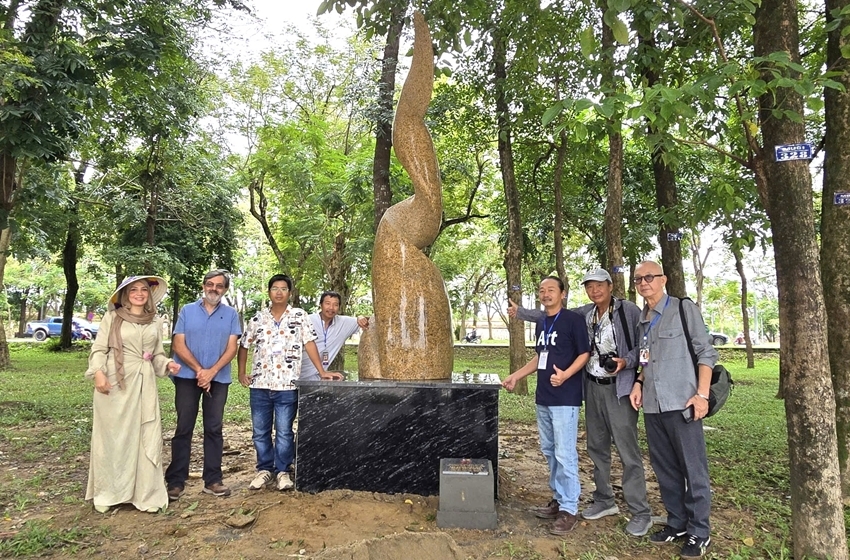 |
| Hue hosts another international sculpture camp at the end of 2026. Photo: LM |
The leaders of Thua Thien Hue Province at the time agreed with the poet’s suggestion. Together with the energy and creativity of the artists, they turned the idea into a 45-day international event in December 1998. About 26 abstract and modern works in granite or metal from the 1998 camp were installed in Ly Tu Trong Park on the south bank of the Perfume River, creating a distinctive sculpture garden there.
The 1998 event started Hue’s tradition of sculpture gardens. Dozens of valuable contemporary works by artists at the 2002 International Sculpture Camp, part of Festival Hue, were then installed in 3 Thang 2 Park (February 3rd Park) on Le Loi Street. The art space later spread to the north bank of the Perfume River, where Phu Xuan Park holds the main body of works from the 2004 International Sculpture Camp. In the quiet, ancient setting across from the Imperial Citadel, the works are spaced further apart, lining the green lawns from the foot of Phu Xuan Bridge to Truong Tien Bridge.
The Dutch sculptor Gerard However once said that Hue’s harsh climate was a fierce challenge for an artist. But that ‘trial by fire’ made him value every grain of stone and every drop of sweat it took to finish his work. Many international artists at the camps were also amazed by Hue’s unusual exhibition space. They called the Perfume River an ideal ‘ambassador gallery’. Instead of being shut away in closed concrete museums, the sculptures stand on the grass under old shade trees. This gives them a livelier ‘second life’, where local people interact with them and touch them every day.
After a long break, Hue is holding another international sculpture camp at the end of 2026 as part of its Four-Season Festival. The camp’s theme is ‘Impressions of Hue, Vietnam – 2026’. It takes place right beside the Perfume River and brings together dozens of Vietnamese and international artists. With the new works from the 2026 camp, Hue will extend its sculpture garden along the riverside parkland from Nghinh Luong Dinh (Nghinh Luong Pavilion) to the foot of Da Vien Bridge. This stretch already has works in natural granite that sit in perfect harmony with the water and the lawns.
What moves people most is how Hue’s sculpture gardens connect with the community. Anyone can touch the stone and feel its coolness and the roughness left by time. This makes art feel as close and welcoming as the people of Hue themselves.
Story: DAN DUY