 |
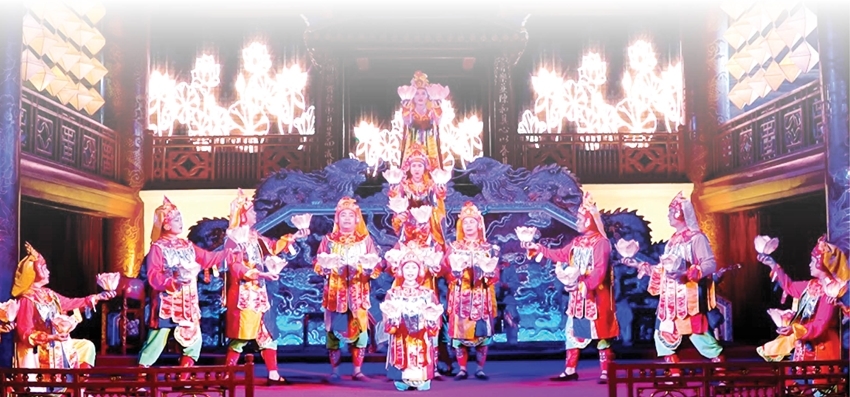
| The Luc Cung Hoa Dang dance (illustrative photo). Photo: Viet Le |
From cultural roots to national mettle
Vietnamese history has been shaped by the will to defend the country and the resilience of its culture. Among the community of 54 ethnic groups, each language, custom, melody, and craft contributes to the nation's shared identity. The ability to preserve its cultural foundations while engaging with and transforming external influences has enabled the nation to overcome challenges and enrich its identity.
The heritage treasure trove is a testament to this creativity. Nationwide, approximately 40,000 sites are included in heritage inventories, more than 3,600 are recognised as national heritage sites, and around 11,000 are classified as provincial-level sites. Each site preserves part of the nation's memory, reflecting how generations have organised their lives, interacted with nature, and nurtured community values.
By 2026, Vietnam had 153 special national heritage sites, 357 artefacts and groups of artefacts recognised as national treasures, nine World Heritage sites, 17 intangible cultural heritage elements, and 11 documentary heritage items inscribed by UNESCO at the global or regional level. The greater these achievements, the heavier the responsibility for preservation.
However, recognition confirms value but does not guarantee vitality. Heritage sites restored but disconnected from communities, honoured crafts without successors, and rare treasures inaccessible to the public all reveal the gap between preservation and promotion. Closing this gap must become a measure of management responsibility, rather than satisfaction with the number of officially recognised heritage records.
Deeper than tangible traces are patriotism, solidarity, a love of learning, tolerance, and self-reliance. These are the resources that have enabled the nation to endure upheavals. In today's development, these resources must be nurtured through a healthy social environment where kindness is protected, talent encouraged, and responsibility upheld.
Eight decades of a guiding ideology
In 1943, when the country had yet to achieve independence, the Party issued the Outline of Vietnamese Culture. The three principles of nationalisation, scientification, and popularisation established the direction for building a new culture and mobilizing intellectuals and artists for the cause of national liberation. Culture was placed among the fundamental issues determining the country's future.
On November 24, 1946, at the First National Cultural Conference, President Ho Chi Minh put forward the idea that ‘Culture lights the way for the nation’. Amid countless challenges facing the young independence, this idea affirmed culture's guiding capacity: helping people recognize the path to follow, the values to preserve, and the responsibilities to shoulder.
The Second National Cultural Conference, held in July 1948 in Dao Gia, Phu Tho, continued to develop this direction. General Secretary Truong Chinh's report titled ‘Marxism and Vietnamese Culture’, together with the principles of turning culture into a force for resistance and resistance into a cultural endeavour, connected cultural activities with the People's strength in fighting and building the nation.
At the National Cultural Conference on November 24, 2021, the call for cultural revitalisation was placed within the aspiration for development after 35 years of Doi Moi. Economic achievements further underscored the need to build a commensurate spiritual foundation and address the imbalance between material growth and the quality of people and the cultural environment.
Throughout these milestones runs a consistent understanding: culture is tied to national independence, people's happiness, and the country's future. Therefore, speaking of culture as a guiding light also means demanding that it be present in policymaking, public-service ethics, development organization, and the distribution of development gains.
A project that generates revenue but harms heritage, a modern city that loses its memory, or a vibrant digital space that tolerates deviant behaviour all raise cultural concerns. The guiding role of culture must become a capacity for making choices, strong enough to adjust immediate interests to protect long-term values.
From strategic importance to the right to participate and benefit
Resolution No. 80-NQ/TW, dated January 7, 2026, of the Politburo identifies culture and people as the foundation, endogenous resources, driving force, pillar, and regulating factor for rapid and sustainable development. This understanding requires cross-sectoral responsibility; the cultural sector alone cannot address problems rooted in all aspects of social life.
Resolution No. 28/2026/QH16, effective July 1, 2026, designates November 24 each year as Vietnamese Culture Day, with employees entitled to a paid day off. Exemptions or reductions in fees for visiting public cultural and sports facilities, as decided by relevant authorities, further expand opportunities for public access.
The requirement to allocate at least 2% of annual state budget expenditure to culture, with gradual increases in line with development needs, provides an important basis for resource allocation. The next challenge is the capacity to absorb and use these resources effectively so that public spending genuinely creates cultural value.
A construction-oriented mindset that neglects programming and the people who operate facilities must be addressed. A library with few readers or a cultural center that is frequently closed demonstrates that investment has not reached its intended destination. Resource allocation must be linked to community needs, service quality, and accountability, while also supporting artisans and creative professionals.
A paid public holiday only becomes meaningful when people have suitable activities in which to participate. Children, older people, people with disabilities, and residents in remote areas must be considered from the design stage. The right to benefit must be reflected in actual accessibility, convenience, and the sense of respect experienced by each individual.
Alongside the right to benefit is the right to create and participate in heritage preservation. When communities have a voice, artisans receive fair benefits, and businesses are encouraged to invest responsibly, culture can generate resources for reinvestment. Uncontrolled commercialization, however, risks depleting the very cultural capital that sustains development.
Bringing heritage into the future
Hue has eight UNESCO-recognized heritage elements across three categories: tangible, intangible, and documentary. From royal architecture and court music to the royal records, woodblocks, and poetry inscribed on royal architecture, the heritage system reflects the culmination of knowledge, art, and the capacity to organize social life. These values need to be further explored, interpreted, and transmitted.
As a centrally governed municipality, Hue faces the challenge of demonstrating that culture can lead an urban development model. This requires integrating preservation into urban planning and treating landscapes and community memory as components of quality of life. Every investment decision must be weighed not only in terms of economic efficiency but also in terms of its capacity to preserve identity.
Hue's cultural industries must also begin from this depth. Products may innovate in form and technology may expand markets, but core values must be rigorously researched. Researchers, artisans, and artists need to be connected with businesses and educational institutions, ensuring that creativity is supported by knowledge, mechanisms to protect rights, and markets, while also contributing back to preservation.
Vietnamese Culture Day can begin with practical initiatives: expanding heritage experiences for students, connecting museums with schools, organizing dialogues with artisans, and bringing arts into residential communities. More importantly, every program should help the public understand a value, develop an interest, and find a reason to return.
Hue should use this occasion to identify gaps in grassroots cultural life and select effective initiatives for sustained implementation. Recognition must be linked to livelihoods and transmission; digitization must open access to knowledge; and tourism development must protect the community's living environment. Heritage vitality depends on these connections.
Eighty years after the idea that ‘Culture lights the way for the nation’, today's responsibility is to ensure that this light is present in every development choice. For Hue, bringing heritage into the future means creating conditions for people to live better alongside their heritage, allowing culture to nurture human dignity and contribute to the strength of the nation.