 |
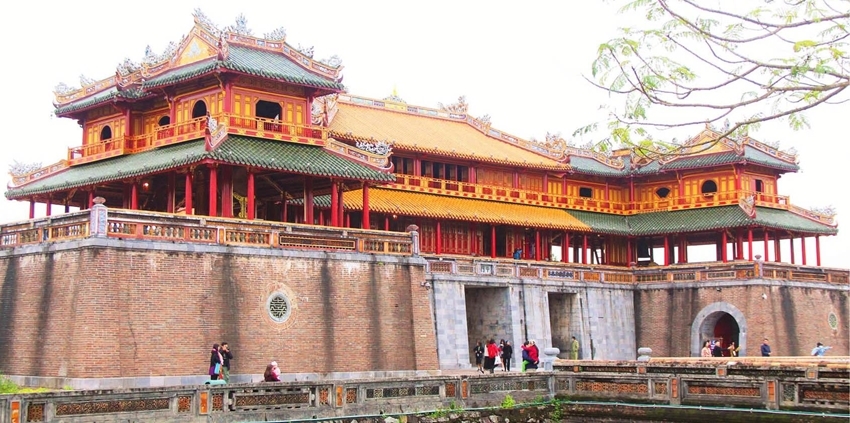
| Ngo Mon - a heritage site of the Nguyen Dynasty and a symbol of Hue culture |
"220 years of Vietnam’s national name - historical milestones (1804 - 2024)" is the theme of the scientific seminar organized by the Provincial Historical Science Association held at the end of April with the participation of numerous scholars and intellectuals.
The name Vietnam persists in the minds of the Vietnamese people
In our country's history, the name Vietnam has appeared for a long time, but it was not yet the official national title. Officially, it was not until the year of Giap Ty, on the 17th of Dinh Suu day (or March 28, 1804), when Emperor Gia Long conducted the Khanh An ceremony at Thai Mieu Temple, inside the Imperial Citadel, and named the country Vietnam. In the edict, the emperor affirmed: "For the emperor to establish a country, he must first attach importance to the national name to express the utmost authority... Reforming the national name to Vietnam to establish a great foundation, lasting through generations. Whatever the country's affairs, whether it concerns the national name or correspondence with foreign countries, Vietnam is used as the country's name, and the old name An Nam is no longer used."
Under the Nguyen Dynasty, the national title Vietnam was maintained for nearly 4 decades through the reigns of two emperors, Gia Long and Minh Mang. By the 19th year of Minh Mang's reign (1838), the emperor changed the national name from Vietnam to Dai Nam. In 1945, the August Revolution succeeded, ending the Nguyen Dynasty. On September 2, 1945, President Ho Chi Minh, in the Declaration of Independence, declared the establishment of the Democratic Republic of Vietnam - now the Socialist Republic of Vietnam.
According to Duong Phuoc Thu, from the time Emperor Gia Long chose the land of Hue to establish the capital, naming the country Vietnam, to when Emperor Minh Mang changed the national title to Dai Nam in 1838, it was a historical moment, marking the achievements for the king to "publicly" declare to the world the powerful position of the nation of Vietnam through the name Dai Nam.
According to Mr. Thu, in reality, the national title Vietnam changed to Dai Nam but could still be referred to as Dai Viet Nam. And since President Ho Chi Minh read the Declaration of Independence, giving birth to the Democratic Republic of Vietnam, now the Socialist Republic of Vietnam, the two sacred words of Viet Nam have echoed across the globe, in international forums, and have been seen as an immortal spiritual symbol.
Symbol of a sovereign nation with a vast unified territory
Dr. Vo Vinh Quang believes that the national title of a country and its people is not only of legal and international significance, it represents the status of the nation, but also an endless source of pride for every citizen of that nation. The name Vietnam, since being chosen as the national title in 1804, despite enduring 220 years with many ups and downs, has not only not disappeared but seems to perpetually exist in every vein, every mind of the Vietnamese people.
Some opinions have argued that the name Vietnam existed before 1804 but it was only an unofficial name in historical records and literature. Dr. Phan Thanh Hai, Director of the Department of Culture and Sports of the province, affirmed that the name Vietnam, born in 1804, was the official national title and has been used in official documents and correspondence. This demonstrates a Vietnam with a clear identity, with a vast and unified territory that had never existed before. This affirms the legal sovereignty over the territory of an independent nation.
To clarify this further, Dr. Nguyen Quang Trung Tien presented many pieces of evidence. The national title Vietnam mentioned in international publications during the reigns of Emperors Gia Long and Minh Mang, although scarce, always highlighted the main content with the recognition of Annam or Vietnam as a unified empire from many territories before, spanning the Indochinese Peninsula and the East Sea, including the Paracel Islands, at that time also including the Spratly Islands located in the territorial waters of Inner Realm (Dang Trong), which were also part of this empire.
According to Mr. Tien, the recognition of the unified territory including the Paracel and Spratly Islands under the "Annam or Vietnam Empire" in international publications during the reigns of Emperors Gia Long and Minh Mang carries profound historical significance: the two words Viet Nam thus became a symbol of a sovereign nation with a vast and unified territory, both on land and at sea, including the Paracel and Spratly Islands.