 |
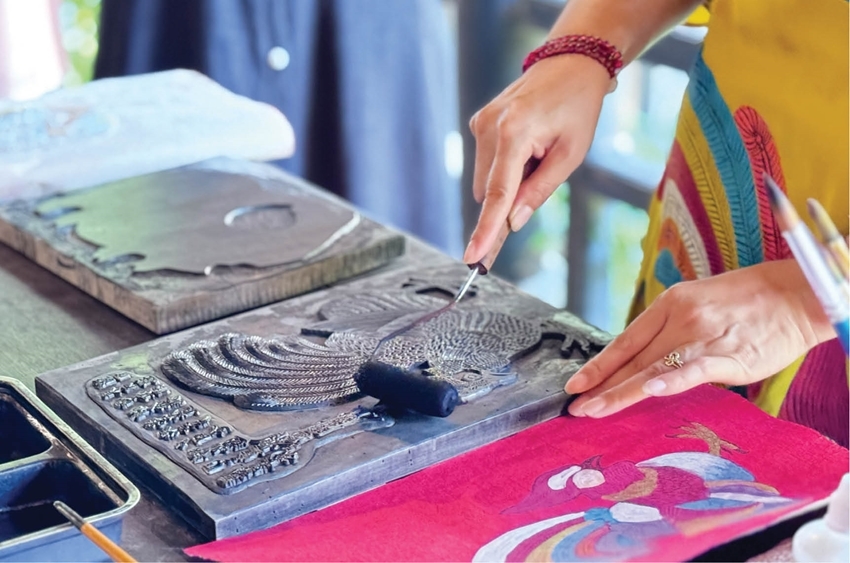
| Woodblocks and the red paper make Kim Hoang folk paintings distinctive |
The journey of re-exploring “red paintings”
Though born and raised in Kim Hoang Village in Hanoi, not until 18 did Nguyen Thi Binh learn about the fact that her native village had once boasted a very special type of folk painting. By then, the craft had gone, and its artisans had all passed. Her initial curiosity soon grew into her concern. She wanted to restore the kind of painting which had made her village famous.
Kim Hoang paintings are also known as ‘red paintings’ because of the red color of the paper. Previously, villagers dyed the Chinese yellow paper red, using their own traditional techniques. Because this type of paper is no longer available, artisans now use alternatives. Kim Hoang paintings are the combination of woodblock printing, hand drawing, and inscribing, giving them a very distinctive look.
To Binh, her greatest challenge is the scarcity of documents about the painting craft. As recorded in remaining documents, most of the woodblocks had been washed away in a devastating flood in the early 19th century. The craft itself was lost. In 2016, the Kim Hoang Folk Painting Project was launched with the aim of researching, restoring, and introducing this traditional art form to the public.
The special event that marked the journey of restoring Kim Hoang paintings was the finding of a Kim Hoang painting woodblock right in a family on her maternal side, which added to the foundation for the restoration.
Since July 2024, Kim Hoang paintings have been brought back to life through a variety of community-based activities and hands-on workshops with the support and participation of local elders. In addition to restoring traditional designs, Binh has spent many years researching and creating new designs. Her series of zodiac animal paintings is well received by the public. Those paintings are made in the contemporary style while retaining the spirit, shape, and techniques that characterize the traditional painting.
“I’ve always been cherishing cultural values of the country and want to preserve and promote them. Creativity is necessary, but we must always respect the characteristics of the traditional painting so that viewers can still feel the national spirit in every painting,” said Binh.
The meeting of folk paintings in Hue
Nguyen Thi Binh decided to choose Hue as a stopover on her journey of promoting Kim Hoang folk paintings because this cultural city is home to Sinh Village paintings, one of the four representative folk painting traditions still preserved in Vietnam. While Kim Hoang paintings disappeared for decades before being revived, Sinh Village paintings have been well preserved and passed down from generation to generation. Although each craft has its own journey, they both contain stories about how to preserve the heritage and how to bring folk arts to the public.
Ngu Ha Garden became the gathering place for people who love traditional Vietnamese art with exhibitions and hands-on workshops. Artisans, painters, lecturers, students, and visitors sat by ancient woodblocks, listening to the story of the over-300-year-old folk painting, experiencing printing and coloring on the distinctive red paper.
According to Ky Huu Phuoc, an artisan about Sinh Village paintings, there remain only 4 major folk painting traditions in Vietnam: Dong Ho, Hang Trong, Kim Hoang, and Sinh Village. Though each possesses its own artistic style, they all reflect the cultural and spiritual life of the Vietnamese people across generations.
The presence of Kim Hoang paintings in Hue, the place where people are very well aware of heritage conservation, opens up a perspective on reviving traditional cultural values. More than just an exhibition or a hands-on activity, the event created an opportunity for artisans, artists, art students, and culture enthusiasts to discuss traditional techniques, materials, restoration methods, and ways of bringing folk paintings closer to the community.
In addition to restoring paintings themselves, Nguyen Thi Binh has also tried to integrate Kim Hoang designs onto everyday products such as bags, notebooks, souvenirs, etc. However, her greatest aspiration is to restore original pigments. As of now, the paper is dyed, using her new method. Because natural pigments are no longer able to produce visual effects as desired, she has to rely on artificial paint.
“We are still studying ancient paintings, espeheritagecially the original materials and colors. Our biggest desire is to be able to recreate the true spirit of Kim Hoang paintings using materials which are as close as possible to traditional ones,” said Binh.
With the finding of ancient woodblocks, new designs, and the enthusiastic response of the public, including young people, Kim Hoang folk paintings have opportunities to be continued and flourish. The journey of restoring this kind of folk painting is very promising.