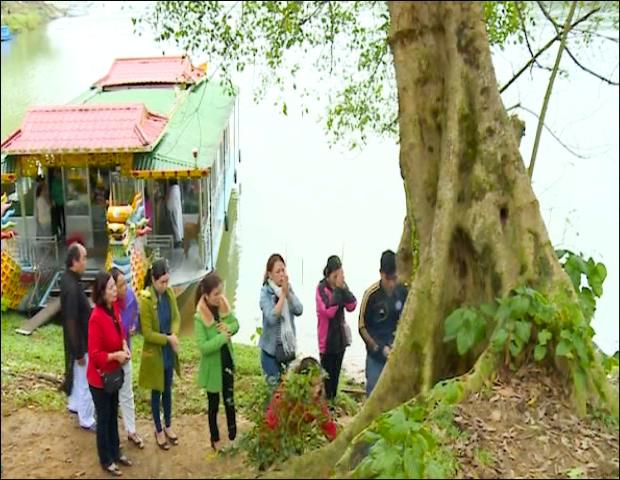
The pool where Hue agarwood businessmen organize their offering ceremony
The offering ceremony by the pool
On lunar December 16th every year, on the Perfume river, to the right of Hue Nam temple (Hai Cat village, Huong Tho commune, Huong Tra district), near the ancient fig tree, there gather agarwood businessmen in Hue. They come for the offering ceremony to express their gratitude towards the ancestors for giving them a prosperous year with agarwood business. Exactly one month later, they return here to ask for permission to “open” the forest, or more precisely they pray for a smooth year of agarwood business. Mr. Le Van Trai, the chairman of Hue agarwood association said: “As a convention, people related to agarwood business gather here for the offering ceremony. I have no idea when it first started as those joining this association before me don’t know about the origin of the ceremony either.”
No one of the agarwood association knows the reason why the offering ceremony takes place by the pool to the right of Hue Nam temple. Most of culture researchers have agreed that the offering of Hue agarwood association placed to the right of Hue Nam temple, the worship place of Thien Y A Na signifies the commemoration of the Mother of the land - who has given them such a precious thing.
Legend has it that agarwood is the embodiment of the Mother of the land - Poh Nagar of the Cham and also called Thien Y A Na by Vietnamese – considered as the spiritual symbol of the Mother. The connection between the most spiritual thing and a kind of fragrant wood is perfectly beautiful. Researcher Nguyen Phuoc Bao Dan (Sub-Institute of culture and arts studies of Vietnam in Hue) stated: “Shrines and temples worshipping Mother Thien Y A Na in Central Vietnam basically have the root of agarwood as it is the embodiment of the Holy Mother. Since then, agarwood becomes the symbol of a folk belief.”
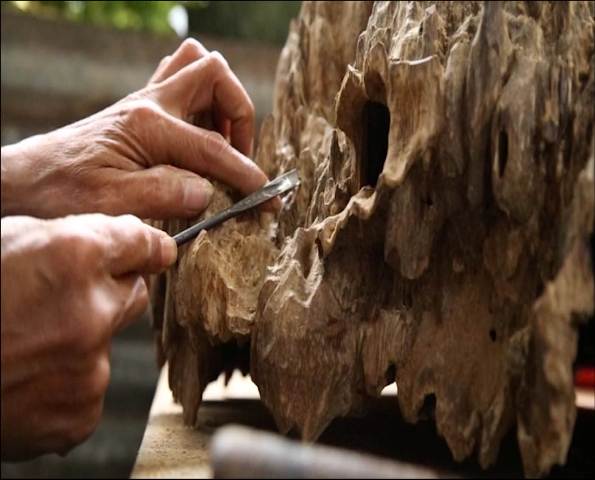
Stripping agarwood
In fact, there are plenty of agarwood roots worshipped in Hue Nam temple. Carved and worshipped agarwood objects were also seen in some temples worshipping the Holy Mother Thien Y A Na.The medium Le Van C who is in charge of the ceremonies in Hue Nam temple said: “Documents on the Mother Thien Y mentions the incarnation of the Mother into the agarwood root, so worshipping the root means worshipping the Mother…”
Agarwood business
When I visited a famous agarwood shop in Lich Doi Street, Hue City, the hospitable owner offered some wine taken from a jar of a light yellow wine soaked with agarwood. He said, “It’s special,” I didn’t know how special it was, but I could smell the agarwood fragrance coming from the throat to the nose.
For more than 40 years doing agarwood business, he sees himself lucky as agarwood brings him many things. The most valuable thing is the absolute respect that he, his wife and children hold for the spiritual value. That is the reason why he has still kept the agarwood figures he carved at the beginning of his business.
There is a variety of agarwood businesses in Hue such as agarwood traders, agarwood incense producers, carvers, etc…But agarwood traders can be considered closest to agarwood business as they have experienced different types of jobs. Some of them hunted agarwood in the wild forest and then become traders. Some inherit the profession from their ancestors.
At the present, due to ruthless exploitations, the amount of natural agarwood has dropped significantly, so businesses of artificial agarwood have developed in many villages such as Bang Lang village (Thuy Bang commune, Huong Thuy town) and Thanh Phuoc village (Huong Phong commune, Huong Tra town). Agarwood businesses from Hue has recently spread out to countries in Southeast Asia.
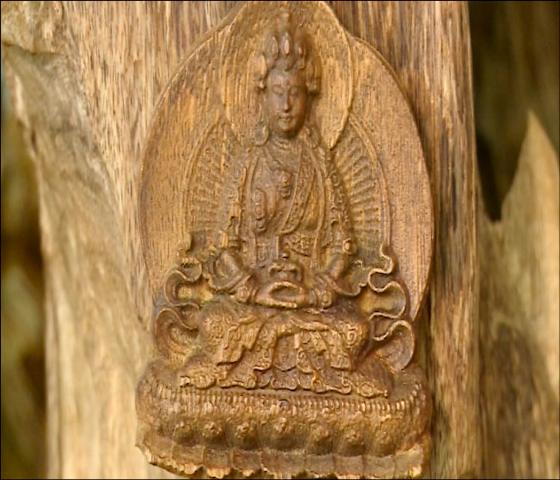
Buddha statue carved from agarwood
Phan Huu Thuong, Head of Thanh Phuoc village said: “Men are in charge of sawing, whittling, and women are responsible for stripping, sorting and making incense. Grinding, delivering and drying agarwood are mostly men’s jobs.”
There is a Vietnamese saying: “Southern agarwood, Northern cinnamon”. It means that in this S-shaped country, agarwood and cinnamon are two specialties of the wild forest, and agarwood is native to the South. Hai Van Pass divides two different regions of agarwood and kynam. The most valuable agarwood is in Hue and the most precious kynam in Khanh Hoa. By long time experience, agarwood businessmen in Hue and Central Vietnam confirm the value of agarwood depending on its location. The farther agarwood is located away Hue, the less valuable it becomes.
The value of Hue agarwood has been recognized for long as stated in Japanese ancient documentation a thousand years ago. Documents of the Arab also mentioned this. Thus, Hue or specifically the North of Hai Van Pass is the capital of agarwood business where agarwood has developed and become a cultural value.
By Dinh Dinh