 |
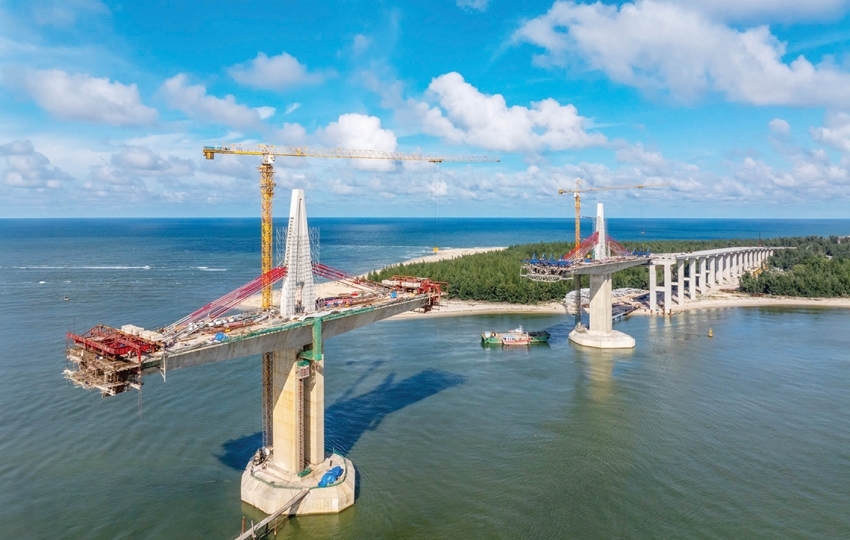
| The bridge crossing Thuan An sea gate is ahead of schedule. Photo: Minh Thu |
The master urban planning for Hue until 2045, with a vision to 2065, was approved by the Government in January 2024. It identifies Thua Thien Hue (now Hue City) as the growth pole of the central coastal region in terms of marine economy, tourism economy, industrial development, and national seaport operations. Investment in inter-regional transportation infrastructure is seen as a strategic solution to drive socioeconomic development.
The Project on Coastal Road and Thuan An Sea Gate-Crossing Bridge (Phase 1) is managed by the City Traffic Construction Investment Project Management Board. The project, with a total investment of 2,400 billion VND, began construction in March 2022 and is scheduled for completion in three years. The joint contractors Tan Nam, Dat Phuong, and 479 Hoa Binh are responsible for construction. It begins at the intersection of National Highway 49B - Tam Giang Bridge and ends at the intersection of National Highways 49A and 49B.
Sharing the pride of "conquering" historical sea-crossing projects, Mr. Ngo Van Truong, a representative of Tan Nam Construction Joint Stock Company, said that the bridge over the Thuan An sea gate is a large-scale project. The company is responsible for a construction package valued at over 1,100 billion VND, including components starting from the approach road at the (former) Hai Duong area.
Despite challenges posed by the coastal construction environment and adverse weather conditions, the contractor has adopted efficient construction methods to ensure progress and quality. The Thuan An sea gate-crossing bridge has reached approximately 80% of its construction value and is expected to be finalized by March 2025.
At various seminars, the economic experts recommended the province to attract major investors. To this end, the transportation infrastructure must be gradually improved. As a result, the local authorities and agencies have been striving to implement major transportation projects to enhance inter-regional connectivity. A typical example is the transportation system in Phu Vang District - a coastal plain and lagoon area with beautiful beaches and landscapes that attract tourists.
In the areas between the sea and the Tam Giang – Cau Hai Lagoon, the step-by-step transformation of the region is evident, with large-scale tourism service investment projects registered and under development. The visit to the International Golf Course Project in Vinh Xuân Commune and the Hotel and Tourism Project in Vinh Thanh, both invested in and finalized by BRG Group for operation, highlights how Hue’s investment attraction policies have significantly impacted the coastal and lagoon communes.
In early 2024, the People's Committee of Thua Thien Hue (now Hue City) approved the investment in the Tam Giang Lagoon Bridge Project, connecting Phu Da Town to Vinh Xuân Commune (Phu Van District). The project has a total investment of over 1,000 billion VND, funded by the state budget.
Expressing his joy over the upcoming bridge, Mr. Nguyen Van Trung, a resident of Phu Da town, shared that for a long time, the coastal and lagoon areas were known only for their white sands and challenging ferry crossings. Hearing about the bridge project and large-scale tourism projects being initiated has excited locals. Roads and bridges will open up many opportunities for the lagoon region's development and job opportunities for locals, reducing the need to migrate for work.
According to the Department of Transport, the bridge over the Tam Giang Lagoon, connecting Phu Da Town to Vinh Xuân Commune, will span 1.4km and is expected to be finalized by 2028. It will shorten the distance between coastal communes and the Phu Da District center and Hue City. This will be the sixth bridge over the Tam Giang – Cau Hai Lagoon, serving as a catalyst for investment, socioeconomic development, and meeting community needs. In the future, at least three more bridges over the Tam Giang Lagoon will be built to support socioeconomic development.
To "prosper from the sea," Hue is focusing on building infrastructure, attracting investment, finalizing planning, and implementing solutions for marine economic development. In the long run, a completed coastal road system will connect with bridges over the Tam Giang – Cau Hai Lagoon, facilitating transportation, attracting investment, and promoting trade for locals.
Recently, Hue has endeavored to mobilize public investment funding from the central and local budgets and from ministries and sectors to invest in key infrastructure development projects. These include the extended To Huu Street to Phu Bai Airport, Nguyen Hoang Street and bridge over the Hương River, the coastal road and Thuan An sea gate bridge, and phase 2 of the Chan May Port breakwater. Simultaneously, Hue has accelerated public investment disbursement, ensuring that 100% of the planned capital is disbursed.
With the advantage of over 128 km coastline and the largest Tam Giang – Cau Hai Lagoon system in Southeast Asia, covering about 22,000 hectares, the process of building and planning centrally-governed Hue City is identified as“urban cluster, polycentric” model, extending toward the sea.
Based on this, in the short run, Hue City plans to develop the Tam Giang – Cau Hai Lagoon area into a national and international ecotourism region. This region will serve as a key driver for the development of a marine economy cluster in Central Coastal Vietnam, in tandem with establishing the Hue – Da Nang area as a national marine economic hub. Priority will be given to attracting projects, investing in infrastructure finalization, and ensuring convenient transportation connectivity, especially along the coastal road system, to promote tourism and services.