



 |
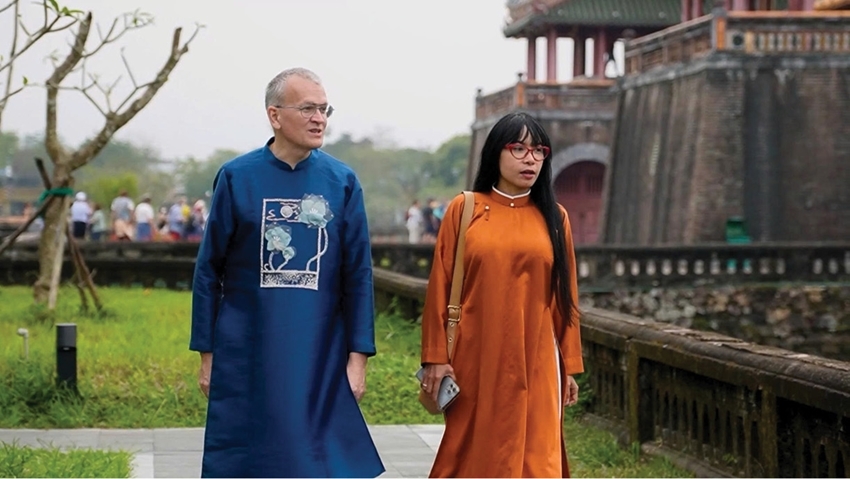
| Mr. Anthony Garrison visits a Hue heritage site |
Ms. Kato Yasuko, a Japanese woman, fell in love with ao-dai the very first time she tried it on. With a bachelor’s degree in Social Sciences and Humanities, she hoped to meet new people and explore new places after retirement. Her passion for cultural exchange eventually led her to join the Japan Foundation in Vietnam. She is now working as a Japanese teacher in several schools in Hue.
For her, the most touching moment was putting on an ao-dai and slowly strolling amid the historic surroundings of Hue Imperial Citadel, capturing memorable moments along the way.
“I truly love ao-dai. Wearing it allows me to appreciate its dignified yet graceful beauty and gain a deeper understanding of how much Vietnamese people cherish their traditional attire. In Hue, ao-dai is part of the school uniform for students. Seeing them wear it inspired me to put one on myself, so I could experience a sense of belonging and feel more connected to the local community,” Ms. Kato Yasuko shared enthusiastically.
Meanwhile, Mr. Anthony Garrison, a Canadian aviation expert, also shares a special fondness for ao-dai. Having travelled to 82 countries over 30 years, he is now working as a pilot in Hanoi and has lived in Hue for two years. Since his first visit to Hue in 2016, he has maintained a special love for the city.
With a keen interest in exploring different cultures and histories, he has researched and tried on traditional costumes in many countries. For him, wearing ao-dai and leisurely strolling with friends while contemplating Hue from the Upper Citadel on the golden, sunlit afternoons was an unforgettable experience.
“I am drawn to ao-dai for its classical charm, its elegance, and rich cultural significance. It is a great honor for me to wear it here in Hue. Whenever I wander around the Imperial Citadel and see people dress in this traditional attire, I deeply appreciate the way Vietnamese people preserve the nation’s cultural heritage,” Anthony shared.
For Venue Flores Moraga, a young girl from the Philippines, her visit to Hue marked the first time she had the opportunity to wear ao-dai. As a young Filipina expat in Hue, she feels lucky to have the opportunity to explore Hue’s rich cultural and historical heritage through ao-dai.
She is fascinated by the royal costumes of the Nguyen Dynasty displayed at Hue Museum of Royal Antiquities. At the same time, she enjoys seeing ao-dai woven in everyday life, from the streets around Truong Tien Bridge to local schools. Despite her busy teaching schedule, Venus is eager to explore the distinctive designs of old-style ao-dai and mix-and-match accessories. Through this interest, she is finding her own way to connect with one of Hue’s long-established cultural traditions.
Venus shared: “Experiencing different cultures broadens my mind and allows me to embrace new values. I have a special love for the traditional ao-dai because it reflects Vietnam’s cultural identity and is closely connected with many important moments in the country’s history. As a Filipino, wearing ao-dai is a way of showing my appreciation and respect for the beauty of Vietnamese culture.”
What makes ao-dai special to international visitors is not just its beauty as a traditional attire, but also the cultural experience it offers when they wear it in Hue. From the Imperial Citadel and the Upper Citadel Surface to the streets along the Huong River, ao-dai can be seen against the backdrop of both heritage sites and everyday life, allowing wearers to gain a clearer feeling for the rhythm, character, and culture of the former imperial capital.
By trying on Vietnamese traditional costumes, visitors not only can “take home” memorable experiences but also have the chance to discover Vietnamese culture through the most familiar things.
Through the experiences of international visitors, ao-dai goes beyond a traditional attire; it serves as a gateway to discovering Hue’s rich culture and heritage. Their personal feelings and love for ao-dai have contributed to bringing the images of Hue and local people closer to friends around the world.