



 |
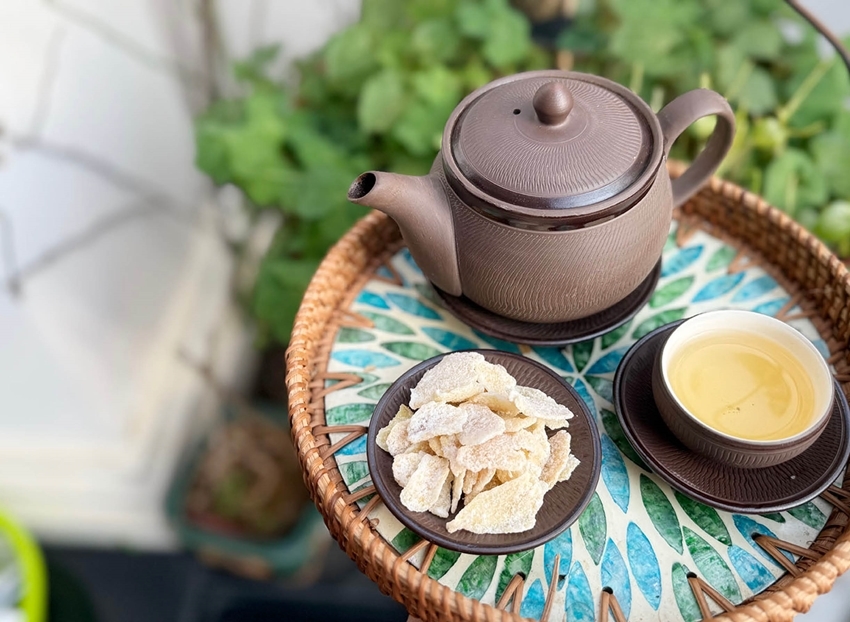
| Savoring candied ginger with a cup of hot tea is a simple pleasure. Photo: Minh Anh |
Hue-style banh tet is not elaborate in appearance, but it demands care and precision at every step. Many families usually make about 10 to 15 rolls of banh tet for the new year’s days. Fragrant new sticky rice, buttery mung beans, and pork belly are tightly wrapped in fresh green banana leaves or dong leaves. Some families make the traditional savory banh tet; others add banh tet gac (colored red with gac fruit) or sweet banana banh tet. Whatever the type, the rolls are wrapped firmly and tied neatly with string. For many households, making banh tet is a family affair: adults soak the rice and prepare the filling, while children help clean the leaves and tie the strings. The night of wrapping the cakes is when stories of the old year are recalled and plans for the new year are discussed.
“My family wraps at least a dozen banh tet every year. If we do not, it feels like Tet is missing. All year long we look forward to Tet, when the whole family can gather together. Wrapping the cakes while chatting and laughing creates such a joyful, lively Tet atmosphere,” shared Mrs. Nguyen Thi Hoa, a resident of Kim Long Ward. For her, banh tet is first and foremost an offering to ancestors during Tet, a way of preserving family traditions and reminding children and grandchildren that Tet begins with togetherness. Only after that comes the matter of filling the stomach after days of spring outings and New Year visits.
If banh tet signals that Tet is approaching, then dua mon (mixed pickled vegetables) and candied ginger are the dishes that keep Tet around the longest. A colorful jar of pickled vegetables, with the red of carrots, the white of daikon radish, and the yellow of papaya, soaked in a well-balanced sweet fish sauce that is neither too sweet nor too salty, becomes an indispensable side dish. It helps balance the richness of banh tet and fatty pork.
Hue candied fruits are the same. Not flashy in color, Hue candied fruits emphasize flavor. Candied ginger is spicy and warming, perfect for the chilly, rainy weather at the end of the year. People in Hue slowly enjoy the candied fruits with a cup of hot tea, letting early-year conversations stretch on in warmth and comfort.
“When guests visit during Tet, people in Hue do not need lavish spreads or elaborate displays of dishes. Just a plate of candied ginger and a pot of hot tea placed in the middle of the table are enough for everyone to sit together and chat for hours,” Mrs. Hoa said with a smile.
Mr. Tran Minh, a visitor from afar, said: “With just a plate of candied ginger and a pot of hot tea, you can already feel the warmth of Tet in Hue. Slowly savoring the gently spicy pieces, listening to the year-end drizzle outside the window, I feel the peaceful and intimate atmosphere of the ancient capital. Those simple moments make me realize that Tet is not just a holiday, but a feeling of togetherness and love.”
Mrs. Bui Thi Huong, a resident of Phong Thai Ward, shared: “Every time we wrap cakes, pickle vegetables, or make candied fruits, generations in the family gather together, telling old stories and laughing happily. Those flavors stay with anyone who lives far from home, making Tet in Hue feel close no matter where they are.”
Tet in Hue is not bustling like big cities, nor is it showy with colors. Tet arrives gently and unhurriedly, weaving its way into every kitchen and every family meal. Just seeing neatly placed rolls of banh tet on the table, a jar of mixed pickled vegetables in the corner of the kitchen, or a plate of candied ginger is enough for people in Hue to know: Tet is just around the corner.