



 |
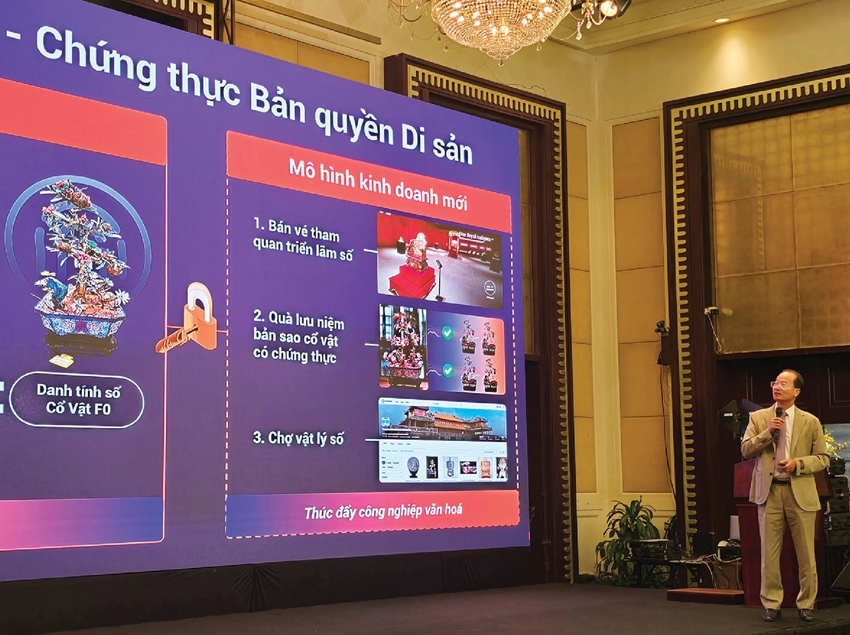
| Director of Hue Monuments of Conservation Center Hoang Viet Trung sharing about data exploitation at the launching ceremony of the Global Data Expert Network |
“Data as blood”
In the storage system of Hue Monuments Conservation Center, each set of drawings and each image has been meticulously digitized. Over 40 heritage sites, over 11,000 artifacts/antiques, 1.3 million m² of water surfaces and greenery, along with thousands of scientific data, images, and project records, all are gradually being consolidated into the Hue heritage database system.
“In the past, stored data was quite scattered. Each staff member kept a little on their own computer, and when someone retired or transferred, many data were also lost. There were restoration projects without the original drawings, forcing us to look for them everywhere. That’s why we always tell each other, ‘Data is blood, losing data is losing heritage’,” shared Mr. Hoang Viet Trung, Director of Hue Monuments Conservation Center.
From that concern, the Center has developed the Digital Transformation Project for the 2022-2025 period, approved by the Provincial People’s Committee (now the City People’s Committee) under Decision 1310/QĐ-UBND, with the goal of digitizing all heritage data, aiming toward the development of a digital cultural economy and smart tourism.
To date, the Center has established a data management system encompassing tangible and intangible heritage, greenery and landscapes, artifacts and antiques, royal court music, restoration projects, scientific research records… All of these are connected, stored, and regularly updated, making heritage management and utilization more convenient, accurate, and transparent.
Notably, over 1,000 antiques have been digitized, among which the first 100 were digitally identified and entered into the national database, an important step in transforming heritage value into digital assets, serving the cultural industry and creative tourism services.
A vivid example is Ho Quyen site (Tiger Arena), the only elephant-tiger arena in Asia. This place is tucked away in a residential area and is little known. Now, the Center is planning to apply immersive technology and virtual reality to recreate the historic battles, allowing visitors to both admire the heritage space and ‘experience history firsthand’. “This is exactly how we turn heritage into a development resource”, said Mr. Trung.
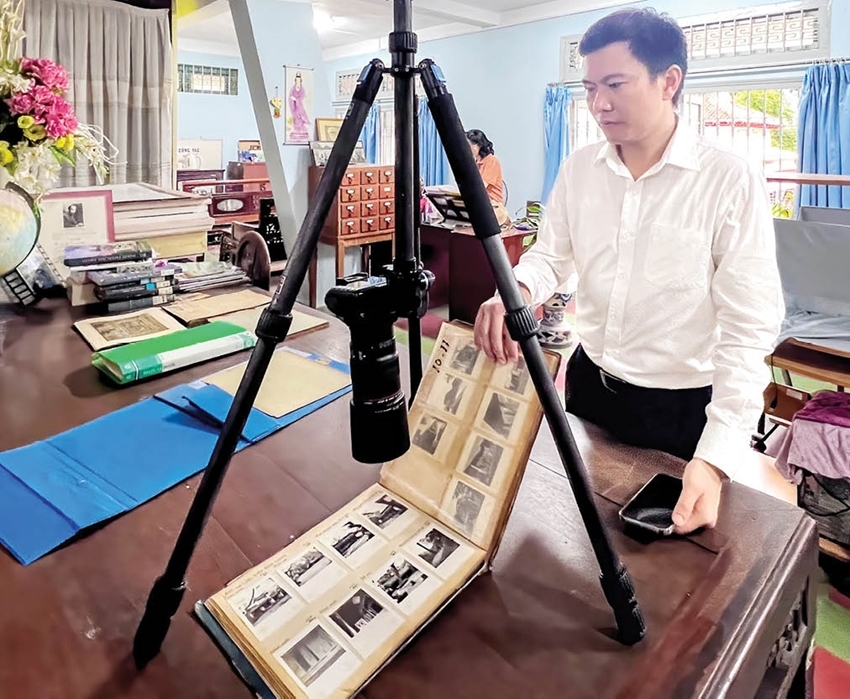 |
| Collecting and taking data photos of the Nguyen Dynasty relics at the History Museum of Ho Chi Minh City. Photo: TTDT |
The journey of collecting data for heritage
The story of restoring Kien Trung Palace is a vivid testament to the value of data. When the restoration started, photographic records were missing, and some images were too blurry to discern details. “We had to go to France, visiting nearly ten archives, the École française d’Extrême-Orient, and museums, to find each photo, each page of documents,” recounted Director Hoang Viet Trung.
“There were places where we spent hours flipping through old albums without finding anything. Fortunately, we discovered a precious album belonging to the Governor-General of Indochina, which contained a few photos of Kien Trung Palace’s interior and exterior. At that moment, we were incredibly happy. Just a few photos, but they were an entire “lifeline” to revive the palace,” Mr. Trung said emotionally.
Those photos were digitized, analyzed, enhanced, and restored on a 3D data platform. Along with many other materials, Kien Trung Palace has been restored almost to its original form, demonstrating the power of data in heritage preservation.
In 2024, Hue Monuments of Conservation Center sent staff to the Ho Chi Minh City Museum of History and the National Archives Center II to search, collect, and digitalize data related to the Nguyen Dynasty. Mr. Vo Quang Huy, Deputy Chief of the Center’s Office, stated: “At these two institutions, we collected and digitized thousands of archival photos and dozens of ancient drawings, including many valuable images of Thoai Thanh Mausoleum, architectural plans of Thai Hoa Palace, as well as several mausoleums and Hue Nam Temple. Notably, we also found images of Thai Mieu gate and records of Cuu Tu Dai, the data of great value for the upcoming restoration of historical sites”…
To date, for each project, the Center has preserved everything, from original drawings and paper plans to digitized versions, creating a detailed archive system comprising thousands of pages. This is a valuable data resource that supports restoration, repair, or research in the future whenever needed.
“We consider data to be our most valuable resource, not just for preservation, but also for utilization to create new value. Data allows heritage to live in the digital space, connecting the past with the present,” emphasized Mr. Trung.
Currently, the Center has signed cooperation agreements with numerous domestic and international organizations to expand the collection and sharing of data. Following the launch of the Global Data Expert Network in Hue, the Center aims to integrate heritage data into the national data ecosystem, making Hue’s heritage a part of the knowledge-based economy.
“We must regard building a database as a matter of survival. All the knowledge of the nation and of humanity needs to be preserved and utilized. When data is interconnected, heritage will no longer remain only in museums or archives, it will live in everyday life, in the economy, and in the consciousness of the people”.
From these initial steps in Hue, it is clear that the digital transformation of heritage is not merely about preservation; it opens the way for cultural - economic development to go hand in hand. As Mr. Trung affirms: “Preserving data is preserving the lifeblood of heritage. And when the flow of data continues, heritage will live on forever”.