



 |
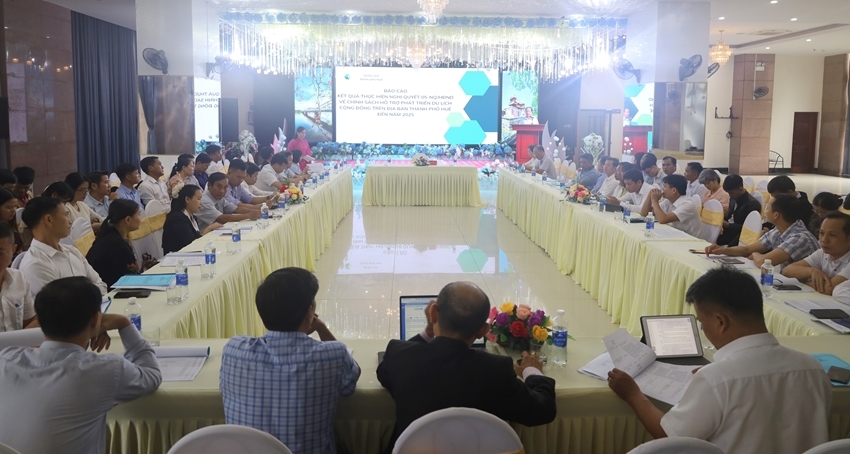
| The conference had the participation of representatives from departments, agencies, and 40 communes and wards across Hue City |
Resolution 05/2019/NQ-HDND, issued in 2019, provided an important legal framework for developing community-based tourism in Hue City. After nearly five years of implementation (2020 - 2025), the policy has contributed to the formation of an extensive CBT network, spreading cultural and ecological values, improving local livelihoods, and reinforcing the brand “Hue - a destination of heritage, culture, ecology, and community”.
According to representatives of the Department of Tourism, notable results include support for 30 CBT sites with more than 65 new homestays, 12 renovated homestays, 44 directional signs, 24 signature tourism products, 34 professional training courses, and 8 craft training classes. These have together formed a distinctive network of CBT destinations throughout Hue City.
Resolution 05/2019/NQ-HDND has brought about significant changes in community awareness and action; it has unlocked local tourism potential, promoted rural economic restructuring, preserved cultural heritage, and increased local incomes. The total number of CBT visitors from 2020–2025 is estimated to exceed 2.8 million annually. Tourism infrastructure has been improved, with many roads connecting CBT sites upgraded. Hue’s CBT brand has taken shape, highlighted by signature products such as Hue pomelo, non la, Thanh Tien paper flowers, A Luoi tourism, Thanh Toan tiled-roof bridge countryside market, and Phuoc Tich ancient village.
The conference also proposed continuing and adopting a new Resolution for the 2026 - 2030 period, with higher levels of support and an estimated total budget of 194 billion VND (including 162 billion VND for development investment and 32 billion VND for operational funding). The plan prioritizes investment in 20 - 30 key CBT destinations, aiming for CBT visitors to account for 30% of the city’s total tourists by 2030. In addition, the proposal calls for policies supporting environmental protection, marketing and promotion, and digital transformation in CBT. It also stresses the need to enhance social participation and inter-sectoral coordination to ensure the policy’s long-term effectiveness and sustainability.