



 |
|
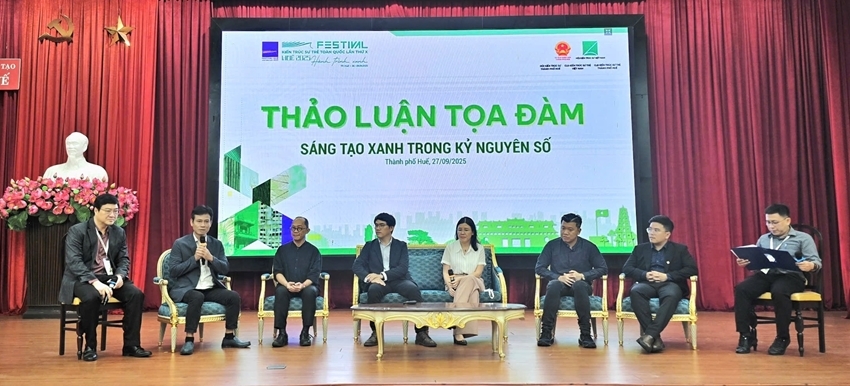
The presentations at the seminar revolving around solutions for digital urban planning, low-carbon cities, green architecture, and AI application in design |
Speaking at the seminar, Nguyen Thu Phong, architect, Vice President of Vietnam Association of Architects emphasized: “The seminar offers multidimensional perspectives on digital transformation in architecture and urban development, suggesting solutions for energy and eco-friendly materials, while also encouraging creative ideas and fostering collaboration among young architects toward the goal of building green, smart, and sustainable cities”.
In the framework of the seminar, several typical presentations were delivered, in which, Dr. Dang Minh Nam (Hue Institute for Development Studies) introduced the digital city model, applying ArcGIS Urban and Digital Twin technology to visualize planning, integrate cross-sectoral data, enhance transparence, and promote community participation. Dr. Le Dam Ngoc Tu, architect. (Central University of Civil Engineering) discussed the orientation for low-carbon urban development in the South-Central Coast region built on 4 pillars, including sustainable spatial planning, green transportation, energy-efficient construction, and circular economy.
From another perspective, Dam Huynh Quoc Vu, architect, (KIENTRUC O) called for “Letting nature shape architecture”, placing emotions and harmony with the natural environment above rigid standards. Nguyen Xuan Man, M.Sc., architect. (XM Architect) introduced a green modular housing model in the digital & AI era, featuring flexible assembly solutions using local and recycled materials, adaptable to various contexts, from dense urban areas to mountainous regions or flood-prone areas.
The seminar also sparked many creative ideas and opened up collaboration opportunities for young architects across the country. Participants affirmed that the event had become an open academic forum, encouraging innovative ideas and fostering strong connections between young architects, experts, and local community.