 |
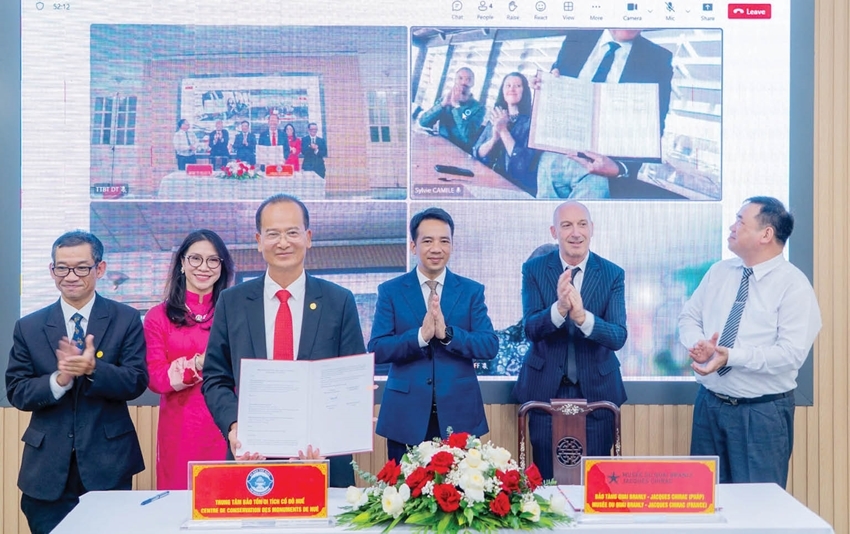
| An online signing ceremony for the cooperation agreement between Hue Monuments Conservation Center and Quai Branly - Jacques Chirac Museum (France) |
Archives beyond the borders
In heritage conservation work, the answer does not always lie in artifacts that still exist before our eyes. Sometimes, an old photograph, an architectural drawing, or an archival record halfway around the world from Hue becomes the key to questions researchers have sought to answer for years.
Mr. Hoang Viet Trung, Director of Hue Monuments Conservation Center, said the biggest gap in current conservation efforts is the lack of visual documentation of structures that have been lost or badly damaged.
“Some research questions have gone unanswered for years, but finding just the right photograph can open up an entirely new approach,” said Mr. Trung.
According to Mr. Trung, many archival materials related to the Nguyen Dynasty are currently preserved in France or in private collections abroad… Accessing, locating, and bringing these sources back to support conservation work is a long journey full of difficulties.
Two years ago, the Center sent staff to archival institutions in France to search for such materials. Among millions of archived documents, identifying which images, or drawings, or records related to Hue was like searching for missing pieces of a puzzle.
“Often we do not even know whether what we are looking for exists or not. Some trips lasted for days without the results we had hoped for. Still, this is the work that has to be done if we want to restore and preserve heritage in a scientific way,” shared Mr. Trung.
One of the most notable outcomes of this international archival cooperation is the scientific and cultural cooperation agreement recently signed between the Hue Monuments Conservation Center and France’s Quai Branly - Jacques Chirac Museum in late April.
Reaching this agreement took more than two years of discussion and negotiation between the two sides.
‘Quai Branly - Jacques Chirac’ Museum currently houses around 10,000 archival materials and artifacts related to Vietnam. However, accessing these materials is far from simple, given France’s strict regulations governing the archiving and ownership of materials.
The first result of the partnership is a digital collection of 101 photographs and 38 graphic works depicting Hue Imperial City transferred to Hue.
Among them are numerous images of Can Chanh Palace - the most important structure in the Nguyen Dynasty’s Imperial Citadel, which is currently being reconstructed.
These photographs, drawings, and records, which document the architecture, spatial layout, and court rituals in detail, are considered valuable references that will help researchers and scientists compare, verify, and improve the accuracy of restoration work.
Mr. Emmanuel Kasarhérou, President of the Quai Branly - Jacques Chirac Museum, expressed hope that the cooperation would open up opportunities to share the museum’s collections, contributing to heritage conservation in Hue.
According to Vice Chairman of Hue City People’s Committee Tran Huu Thuy Giang, the newly accessed materials will help the city gain deeper access to data related to Can Chanh Palace as well as the Nguyen Dynasty’s court costumes, laying the foundation for research and restoration projects in the future.
Beyond sharing archival materials, the two sides are also looking to cooperate on data digitization, research, exhibitions, and the application of technology in heritage conservation.
Building a ‘data mine’
Alongside the search for materials, Hue is also building a network of collectors, organizations, and individuals at home and abroad to help bring Nguyen Dynasty artifacts back to their homeland.
Mr. Hoang Viet Trung said that in recent years, a growing number of individuals overseas have proactively reached out to donate artifacts to Hue.
Some antiques, if they appeared on the international market, would have to be bought back at enormous cost. Yet through cooperative relationships, exhibitions, research, and heritage communication efforts, many collectors have chosen to donate the artifacts rather than put them up for auction.
“What started as hesitation has gradually turned into trust that these artifacts will be preserved and their value will be promoted in accordance with their historical significance,” noted Mr. Trung.
In France, the descendants of Emperor Ham Nghi are also continuing to coordinate the return of artifacts connected to the Emperor to Vietnam, following earlier donations of valuable artifacts to Hue.
Mr. Ngo Van Minh, Director of Hue Museum of Royal Antiquities, remarked that each returned artifact not only enriches the collections of Hue and of the museum but also helps reconnect historical narratives that have long been separated by time and distance.
Alongside the search for materials abroad, Hue is also focusing on building a large-scale digital database for its entire heritage complex. Tens of thousands of artifacts are digitized. Thousands of restoration records, drawings, and archival documents are being standardized to support long-term research.
The archival resources received from France alone include thousands of images from France’s National Overseas Archives (ANOM), and the French School of the Far East (EFEO), along with several other archival repositories.
According to Mr. Hoang Viet Trung, data is becoming an especially critical resource for conservation work. “Data is the new resource. Effective conservation begins with comprehensive, accurate, and standardized data,” he said.
With this data in hand, Hue’s heritage can not only serve the research and restoration but also enable the development of digital cultural products, online exhibitions, virtual reality applications, and creative cultural industries.
More than 30 years after the Complex of Hue Monuments was recognized by UNESCO as a World Cultural Heritage Site, Hue’s approach to conservation has changed considerably. Today, the restoration, conservation, and reconstruction of heritage structures are carried out on a scientific basis, supported by technological applications, and aimed at harnessing the value of heritage for sustainable development.